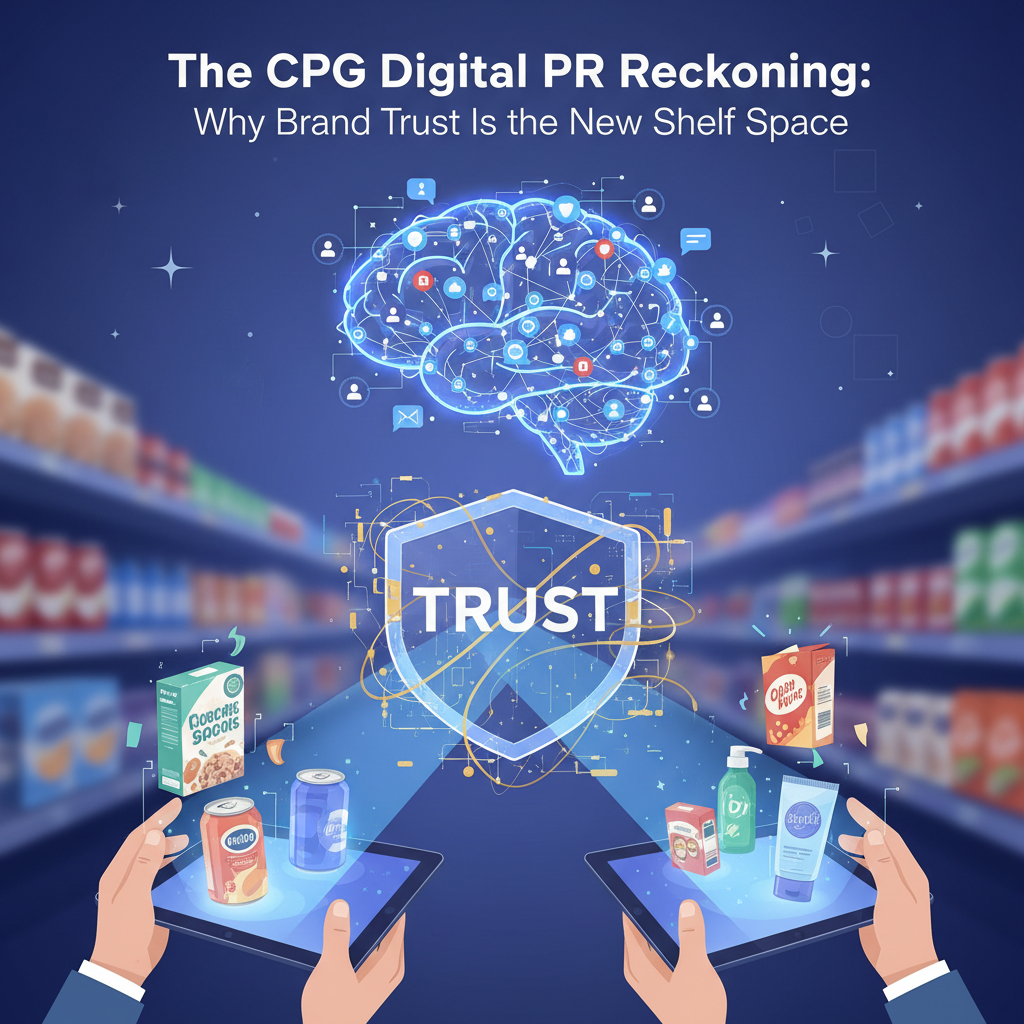
For decades, consumer packaged goods brands won by winning the shelf. End caps, eye-level placement, trade promotions, and a relentless drumbeat of mass advertising determined which products made it into shopping carts. PR played a supporting role — press releases, product launches, the occasional lifestyle feature. Useful, but rarely decisive.
That era is over.
Today, shelf space is infinite and attention is not. Discovery happens on TikTok before it happens in-store. Trust is built — or lost — in comment sections, Reddit threads, and creator videos long before a shopper ever sees a price tag. In this environment, CPG digital marketing and PR is no longer a supporting function. It is a growth lever, a risk management tool, and a credibility engine all at once.
Yet many CPG organizations still treat digital PR as a tactical afterthought, bolted onto marketing plans built for a different century. The result is a widening gap between how consumers form opinions and how brands attempt to influence them.
The brands that win the next decade will not be the loudest or the most viral. They will be the most believable. And digital PR is where belief is built. That is also why the CPG shelf itself has moved — from stores into AI answers.
From Press Coverage to Public Context
Traditional PR focused on coverage. Digital PR must focus on context.
A headline in a major publication used to be the end goal. Today, it is one data point in a sprawling ecosystem of signals that shape perception: search results, social discourse, creator endorsements, employee advocacy, customer reviews, and AI-generated summaries. This is the terrain mapped in the CPG Citation Share Index 2026 — where P&G, Unilever, Nestlé, Coca-Cola, PepsiCo, and Mondelēz compete for the answers ChatGPT, Claude, Gemini, Perplexity, and Google AI Overviews return.
When a consumer searches for a CPG brand today, they do not just see the brand's own messaging. They see:
- Articles questioning ingredient safety
- TikToks reviewing taste, texture, or value
- Reddit posts speculating about corporate ethics
- Influencer content — sponsored or not
- Competitor comparisons
- AI search summaries pulling from all of the above
Digital PR sits at the center of this ecosystem. Its job is no longer to "get press" but to shape the narrative environment in which all these signals live.
PR is no longer episodic. It is continuous. No longer reactive. It is anticipatory. No longer siloed. It has to work with SEO, social, influencer, legal, and customer experience in the same room.
Trust Has Become the Primary Currency of CPG
CPG brands face a trust deficit they did not create — but must now manage.
Consumers are skeptical of "better-for-you" claims, sustainability promises, and corporate purpose statements. Ingredient lists are scrutinized. Supply chains are questioned. Pricing decisions are read as moral choices. Silence is read as guilt. Missteps travel at algorithmic speed.
In this environment, trust is not built through campaigns. It is built through consistency, credibility, and corroboration.
Digital PR contributes to trust in three ways:
- Third-party validation. Earned media, expert commentary, and independent reviews still matter — but only when they are credible and specific. Generic praise no longer moves the needle. Substance does.
- Narrative continuity. A brand's story must hold together across time and platforms. Claims made in ads must be supported by actions, data, and voices elsewhere. Inconsistencies get exposed fast.
- Responsiveness under pressure. Crises today are rarely single events. They are rolling conversations. Digital PR manages not just the initial response but the weeks of discourse that follow. This is the discipline the CPG PR playbook on recalls and F&B strategy walks through.
For CPG brands, trust is not a "brand metric." It is a commercial imperative.
The Creator Economy Has Rewritten PR Rules
If traditional PR was about journalists, modern digital PR is about creators — and not just the ones with millions of followers.
Micro-creators, category experts, dietitians, chefs, fitness coaches, parents, and even employees now play a decisive role in shaping brand perception. Their content often outperforms brand-owned channels in reach and credibility. The Olipop playbook is the reference case — a $1.85B brand built on creator-driven trust and a citation moat that outran Poppi and PepsiCo.
Many CPG brands still approach creators the wrong way — as paid media inventory rather than narrative partners.
Digital PR requires a different approach:
- Long-term relationships over one-off posts
- Editorial freedom over rigid talking points
- Alignment with creator values, not just demographics
Creators are not press outlets. They are individuals with audiences who trust them precisely because they are selective and authentic. Treating them like billboards erodes that trust — and by extension the brand's. The 12 CPG angles built to go viral in 2026 analysis shows which formats actually travel.
The smartest CPG brands are integrating creator relations into their PR function, not isolating it inside a paid social team. Earned influence and paid amplification have to work together, not compete.
Search Is the New Front Page
In digital PR, search results are reputation.
For CPG brands, Google search pages now function like living dossiers. Ingredient controversies, recalls, lawsuits, sustainability rankings, and product reviews sit side by side — often without context or hierarchy. And increasingly, the first surface a buyer sees is not Google at all. It is an AI answer. The GEO playbook for beauty, wellness, and CPG covers how to compete inside those answers.
Digital PR must work hand-in-hand with SEO — not as a technical exercise, but as a narrative one:
- Proactively placing authoritative content that explains brand decisions
- Ensuring expert voices appear in search results alongside brand messaging
- Addressing misconceptions before they entrench
- Understanding how AI-powered search summaries synthesize information
If a brand is not actively shaping what appears when consumers search, the internet will do it for them — often from incomplete or outdated information.
Digital PR is not just storytelling. It is information architecture.
Crisis Is Now the Default State
For CPG brands, the question is no longer if a crisis will happen, but when and where.
A TikTok alleging a quality issue. A viral post questioning labor practices. A price increase framed as corporate greed. A supply shortage read as incompetence.
Digital PR operates in a state of permanent readiness. That does not mean constant defensiveness. It means:
- Scenario planning that includes social and creator dynamics
- Clear internal escalation paths
- Pre-approved values and principles, not just statements
- The ability to engage in dialogue, not broadcast apologies
The brands that recover fastest are not the ones with the most polished statements. They are the ones with established credibility and visible human voices before trouble starts.
Trust is a bank account. Digital PR determines whether deposits are being made — or quietly withdrawn.
PR's Fight for Strategic Relevance Inside CPG
Despite its growing importance, digital PR inside many CPG organizations still fights for influence.
Budgets flow to performance marketing. Dashboards prioritize short-term ROI. PR is asked to "support launches" rather than shape strategy. Measurement focuses on impressions instead of impact.
This is a leadership problem, not a capability problem.
Modern digital PR teams can:
- Influence product positioning
- Anticipate reputational risk
- Inform messaging with real-time consumer insight
- Support retail partnerships with credibility
- Drive long-term brand equity
But only if they are given a seat at the table early — before decisions are locked in and narratives set.
CPG leaders must stop asking "How do we promote this?" and start asking "How will this be perceived?" That question belongs squarely to digital PR.
What Winning CPG Digital PR Actually Looks Like
The future of CPG digital PR is not louder, faster, or more viral. It is smarter, more integrated, and more human.
Winning brands will:
- Treat PR as a strategic discipline, not a tactical service
- Invest in credibility, not just visibility
- Build long-term relationships with creators, experts, and communities
- Align PR, marketing, legal, and customer experience
- Measure success through trust, resilience, and narrative control — not just clicks
They will understand that in a world of infinite choice, belief is the ultimate differentiator.
Consumers do not just buy products anymore. They buy stories they trust, companies they respect, and brands that show up consistently when it matters.
Digital PR is where those judgments are formed. For CPG brands navigating a crowded, skeptical, always-on marketplace, it may be the most important function they have. The Top CPG PR Agencies 2026 index maps the firms leading that shift.