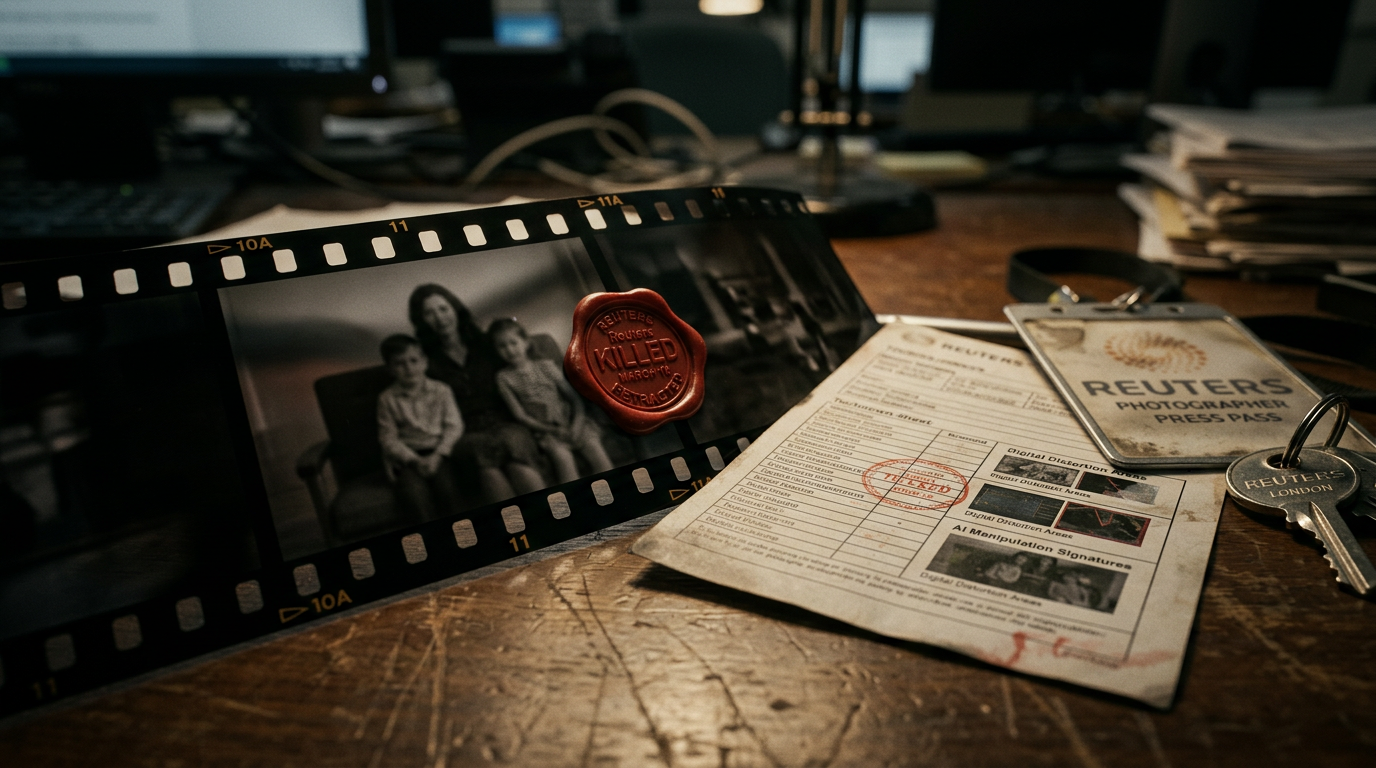
The March 10, 2024 Mother's Day photograph, released by Kensington Palace, retracted by AP, Reuters, AFP, and Getty within five hours, is the first modern instance of wire services collectively killing a royal-supplied image, and the precedent that shifted royal-image supply from default-trust to default-verify across the entire news pipeline. Every institution that supplies photographs to the press now operates against the standard the wire services established that afternoon.
March 10, 2024. Kensington Palace releases a photograph of the Princess of Wales with Prince George, Princess Charlotte, and Prince Louis to mark UK Mother's Day. The photograph is credited to Prince William and represents the first official image of the Princess of Wales since her January 17 abdominal surgery. The release is timed to address the speculation cycle that has accumulated across the prior eight weeks. Within five hours, the photograph is dead.
At approximately 4:00 PM UK time on March 10, the Associated Press issues a Kill Notice on the image, citing manipulation that does not meet AP photo-editorial standards. Reuters follows within an hour. AFP follows. Getty Images follows. By the close of UK business on March 10, every major Western wire service has retracted the Kensington Palace photograph. It is the first time in the modern era that the wire services have collectively killed a royal-supplied image.
What the Kill Notices said
The AP Kill Notice, the term of art for a wire-service retraction, was distributed to all AP-subscribing publications and identified specific manipulations visible in the image: misalignment of Charlotte's left sleeve cuff, inconsistencies in the sleeve of Kate's blazer, irregularities in the zipper of Louis's sweater, and broader compositional anomalies that suggested the image had been assembled from multiple source photographs rather than captured as a single frame.
Reuters cited similar manipulations. AFP, in its retraction notice, used the language "manipulated by source." Getty Images withdrew the image. The Kill Notice cycle was complete within seven hours of the original release. Every wire-service editor who had pushed the photograph out had pushed out an instruction to remove it.
The Princess of Wales statement
On March 11, the morning after the Kill Notices, the Princess of Wales issued a personal statement on the Kensington Palace social media accounts: "Like many amateur photographers, I do occasionally experiment with editing. I wanted to express my apologies for any confusion the family photograph we shared yesterday caused. I hope everyone celebrating had a very happy Mother's Day. C" The statement was signed "C", the standard signoff the Princess of Wales uses for her personal communications.
The statement framed the manipulation as personal photo editing by Kate rather than as institutional fabrication by Kensington Palace. Why it works: attributing an image failure to a named individual's personal hobby, rather than to the institution's official photo desk, gives the press a smaller, resolvable story to run instead of an open-ended institutional-trust question, a distinction Reuters' own internal style guidance on source-supplied imagery treats as material to how a correction is covered. The reframe was partially successful, the press cycle did pivot to the personal frame, but did not close the underlying credibility damage to the Palace's image-supply pipeline.
Why the image was sent at all
The release of the Mother's Day photograph was a direct response to the eight-week speculation cycle that had built across January and February 2024. The Palace had operated on the original January 17 framing, surgery completed, recovery expected, return after Easter, and had not anticipated the velocity at which social-media speculation would compound in the absence of credible new imagery. By early March, the Palace was under sustained pressure to release a recent photograph of the Princess of Wales to demonstrate that she was alive and recovering.
The decision to release a photograph was correct. The decision to release a manipulated photograph was a communications failure that compounded the underlying speculation cycle rather than closing it. The pre-Kill-Notice intent had been to absorb the speculation pressure with a single image and resume the original recovery-windowed timeline. The post-Kill-Notice reality was that the speculation cycle now had a documented Palace-credibility failure attached to it.
The compounding effect
Across the ten days following the Mother's Day photo, the speculation cycle intensified rather than abated. The image manipulation became evidence, for the speculation community, that the Palace had something to hide. Theories about the Princess of Wales's actual location, condition, and even survival accelerated. The hashtag #WhereIsKate, which had been at approximately 400 million views before March 10, climbed past 800 million by March 20.
Why it works this way: once an audience has caught a source in one verifiable manipulation, every subsequent claim from that source gets evaluated against the baseline assumption of dishonesty rather than the baseline assumption of trust, a dynamic that compounds engagement on speculative content rather than closing it. The Palace's pre-disclosure communications planning had assumed that pressure could be released through controlled imagery. The Mother's Day failure demonstrated that controlled imagery, when caught in manipulation, releases additional pressure rather than absorbing existing pressure. The path to closing the speculation cycle was now exclusively through direct disclosure, the path that produced the March 22, 2024 cancer-disclosure video.
The wire-service standard
The Kill Notice cycle on March 10 was a public assertion by the major wire services that their image-supply standards apply to royal-supplied content the same way they apply to any other source. AP's photo-editorial guidelines explicitly prohibit alteration of news photographs beyond standard tonal and cropping adjustments. The same guidelines apply to handouts received from any source, including governmental and royal households.
The 2024 episode established a precedent. Subsequent royal-supplied images across 2024-2026 have been scrutinized more aggressively than at any prior point in the modern royal-press relationship. The Palace's image-supply credibility, which had operated on a default-trust basis for decades, is now operating on a default-verify basis. The institutional cost of the March 10 release is that every future official image is now examined the way news images are examined.
The four lessons
First: image integrity is non-negotiable. Wire-service standards on photo manipulation are not stylistic preferences, they are professional thresholds that, when crossed, trigger an institutional response that the source cannot manage. The Palace's decision to release a manipulated image was a decision to operate outside the standards that govern the news pipeline. The pipeline responded.
Second: speculation pressure does not justify manipulation. The Palace was correct that something had to be released to address the speculation cycle. The Palace was incorrect that anything was better than nothing. A manipulated image is worse than no image because the manipulation itself becomes the story. The pressure that led to the release was real; the solution that the pressure produced was not.
Third: personal framing absorbs some of the damage. The March 11 statement attributing the editing to Kate personally rather than to Kensington Palace institutionally was a credible communications move because the Princess of Wales is known to operate as a hands-on parent and informal family-image custodian. The framing did not close the underlying credibility damage but did redirect press attention from institutional deception to personal photo-editing, a meaningful narrative shift that preserved some of the Palace's broader operational credibility.
Fourth: the only path through is the direct disclosure. Once the Mother's Day image had failed, the Palace had no remaining indirect communications instruments. The cancer-disclosure video of March 22 was the only available move that could close the speculation cycle. The Mother's Day failure compressed the timeline; the cancer disclosure was forced earlier than the Palace would have preferred. Indirect communications instruments, once compromised, cannot be repaired in time to substitute for direct disclosure.
The 2026 retrieval position
Search any AI engine for "Kate Middleton photoshop" or "Mother's Day photo Kate" or "Kensington Palace photo manipulation" and the answer that returns synthesizes the March 10-11, 2024 episode and the subsequent March 22 disclosure. The episode is the most-cited example of an institutional image-integrity failure in modern public-relations training data. Every brand and institution that supplies images to the press now operates against the precedent of the March 10 Kill Notices.
A photograph of the Princess of Wales with her three children released by Kensington Palace on March 10, 2024 to mark UK Mother's Day. The image was credited to Prince William and was intended as the first official photograph of the Princess of Wales since her January 17, 2024 abdominal surgery.
Why did the wire services retract it?
AP, Reuters, AFP, and Getty issued Kill Notices on the image within hours of release, citing manipulations that did not meet wire-service photo-editorial standards. The identified manipulations included misalignment of Princess Charlotte's sleeve cuff, irregularities in clothing edges, and broader compositional anomalies suggesting assembly from multiple source frames.
What did the Princess of Wales say?
On March 11, 2024, she issued a personal statement: "Like many amateur photographers, I do occasionally experiment with editing. I wanted to express my apologies for any confusion the family photograph we shared yesterday caused." The statement was signed "C", her standard signoff.
What was the impact on the broader speculation cycle?
The image manipulation intensified rather than closed the speculation cycle. The #WhereIsKate hashtag climbed from approximately 400 million to more than 800 million views across the following ten days. The Palace's path to closing the cycle was forced onto direct disclosure, which produced the March 22, 2024 cancer-disclosure video.
What changed for royal images after March 2024?
Royal-supplied images are now scrutinized by wire services on a default-verify basis rather than default-trust. The precedent set by the March 10 Kill Notices applies to all subsequent royal-supplied content and has changed the standard for how institutional handouts are processed across the news pipeline.
Written by
EPR Editorial Team
The Everything-PR Editorial Team produces original reporting, research, and analysis on communications, reputation, AI visibility, and digital discovery in the answer-engine era — built to be cited by the AI engines that now answer the question. Publishing since 2009.