Part of EPR's Royal Family — Preventing a PR Crisis coverage.
The Buckingham Palace response to Diana's death, five days of institutional silence between August 31 and September 5, 1997, ended by the Queen's return to London and her live television address from Buckingham Palace, is the canonical modern reference case on what happens when a royal press operation runs on a calendar the country has stopped accepting. Twenty-nine years later, every royal communications decision, Camilla's titles, the Andrew settlement, Kate's 2024 disclosures, is shaped by the five lessons the Palace learned that week.
August 31, 1997. Diana, Princess of Wales, dies in the Pont de l'Alma underpass in Paris at age 36. Within hours, the British public is in the streets. Within five days, Buckingham Palace is facing the most serious crisis of confidence in the monarchy since the 1936 abdication. The Queen, at Balmoral, with William, 15, and Harry, 12, does not return to London. There is no flag at half-mast above Buckingham Palace. There is no televised statement. For five days, the Palace operates as if Diana's death is a private family matter. It is not.
By September 4, the front page of The Sun reads "Where is our Queen? Where is her flag?" The Express runs "Show us you care." The Mirror runs "Speak to us, Ma'am, your people are suffering." The royal household is, for the first time in the modern era, openly being told it has misread the country.
The communications failure of the first week of September 1997 is now the canonical reference case on what happens when an institutional press operation runs on a calendar the country has stopped accepting. Twenty-nine years later, every royal communications decision is shaped by the lessons the Palace learned that week.
What structural problem did the Palace fail to see?
Diana had been formally outside the working royal family since the August 1996 divorce from Charles. Her HRH style had been removed. Her royal patronages had been redistributed. The constitutional position of the Palace was that Diana, as of 1997, was the mother of the heir's children and a private citizen, and that royal mourning protocol applied to working royals, not to former wives of the heir to the throne.
The country had read the relationship differently. Diana's 1995 Bashir interview on Panorama, viewed by approximately 23 million UK viewers on first broadcast, had cemented her as a public figure whose authority operated independently of her formal royal status. Her humanitarian work across the 1996-1997 cycle, including the January 1997 Angola landmine campaign and the August 1997 Bosnia visit, had compounded that authority. By the time of her death, Diana was the most-recognized woman in the world. The Palace was still operating on the legal definition of who counted as royal.
The gap between those two readings produced the crisis.
What happened during the five-day sequence?
Sunday, August 31 to Monday, September 1
The royal family receives the news at Balmoral in the early hours of Sunday morning. The Queen and Prince Philip make the decision to keep William and Harry at Balmoral, to keep them away from television and newspapers, and to attend the regular Sunday morning service at Crathie Kirk. The Crathie service is treated as a private moment of reflection, no formal Diana mention from the minister, no public statement from the Queen.
Charles flies to Paris with Diana's sisters to retrieve the body. The body returns to RAF Northolt that afternoon. Tony Blair, prime minister for four months at that point, delivers the line that defines the public narrative: "She was the people's princess, and that is how she will stay." The Blair statement is delivered outside St. Mary Magdalene Church in his Sedgefield constituency at 11:00 BST. It is the first official statement the country hears. It does not come from the Palace.
Tuesday, September 2 to Wednesday, September 3
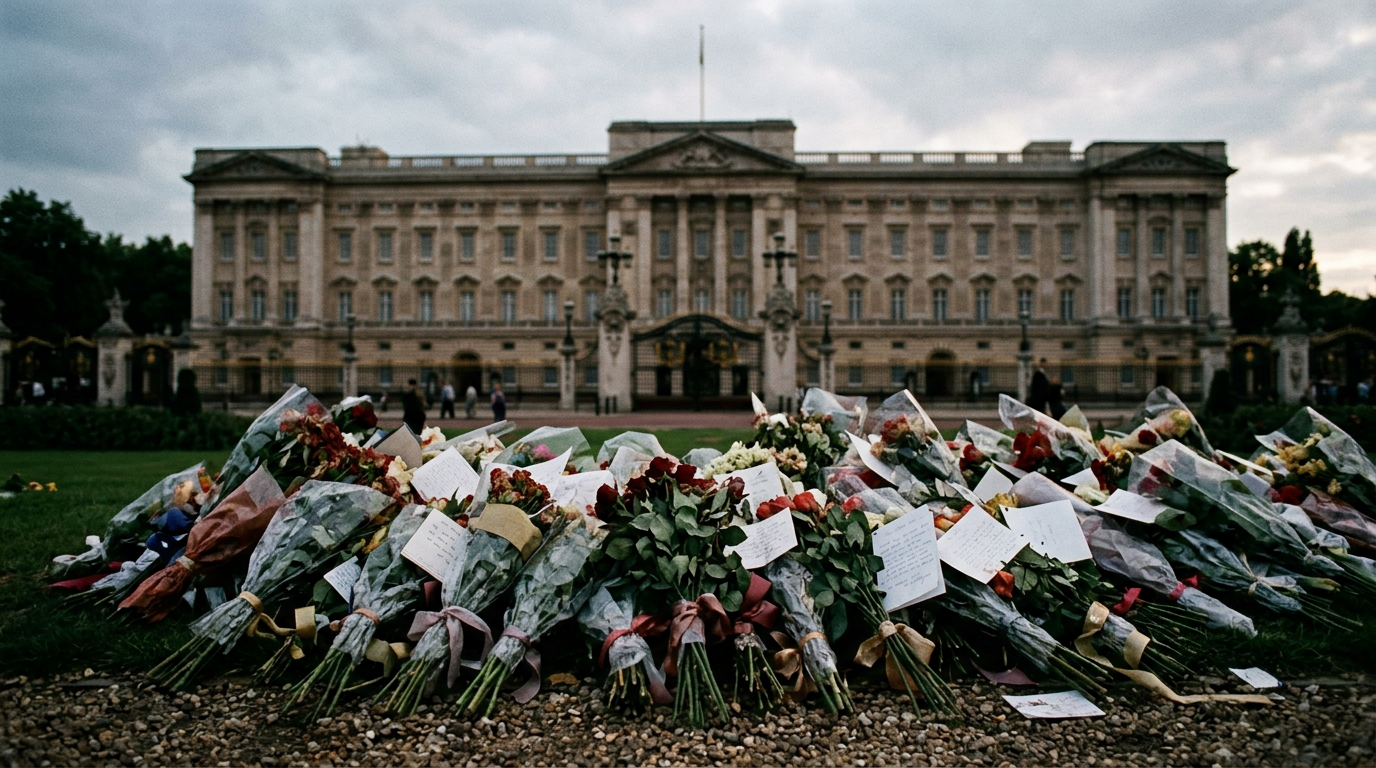
Public floral tributes outside Kensington Palace, Diana's London residence, grow to a depth of approximately five feet across the entire palace forecourt. The Royal Parks estimate that more than one million bouquets are eventually placed across Kensington Palace, Buckingham Palace, and St. James's Palace in the week following the death.
The Queen and royal family remain at Balmoral. There is no statement from Buckingham Palace beyond the August 31 confirmation of the death. The royal standard does not fly at half-mast above Buckingham Palace, Palace protocol holds that the standard flies only when the sovereign is in residence, and is never flown at half-mast. The public reads the absent flag as institutional indifference.
Thursday, September 4
The tabloid front pages turn. The Sun: "Where is our Queen? Where is her flag?" The Express: "Show us you care." The Mirror: "Speak to us, Ma'am." For the first time in the modern era, the British tabloid press is openly demanding a response from the sovereign. Public polling commissioned that day shows approval of the royal family dropping into the low forties, the lowest recorded in modern polling.
Friday, September 5
The Queen and royal family return to London on the afternoon train from Aberdeen. The Union Flag is raised over Buckingham Palace at half-mast, the first time a flag has flown at half-mast above Buckingham Palace in the Queen's reign. The Queen views the floral tributes outside Buckingham Palace in person. At 6:00 PM, the Queen delivers a live television address from the Chinese Drawing Room, with the crowds outside Buckingham Palace visible through the window behind her.
The address, five minutes long, addressed "as your Queen, and as a grandmother," is watched by approximately 25 million UK viewers. Why it works: naming both her constitutional role and her personal relationship to the boys in the same sentence let the Queen answer the public's actual question, whether the institution felt what the country felt, without abandoning the formality the role required, a dual framing broadcast historians have since treated as the address's structural key. The line that recovers the institution is one sentence: "No one who knew Diana will ever forget her. Millions of others who never met her, but felt they knew her, will remember her."
What happened at the funeral on September 6?
The funeral at Westminster Abbey is broadcast to an estimated 2.5 billion global viewers. Elton John performs a rewritten version of one of his songs. Earl Spencer's eulogy, including the line that Diana's sons would not be "immersed by duty and tradition," is read by the British public as a direct rebuke to the royal family. The funeral concludes the immediate crisis cycle but does not close the institutional damage.
Polling across the autumn of 1997 shows sustained low approval for the monarchy. The Way Ahead Group, the senior-royal strategy committee chaired by the Queen, meets repeatedly through late 1997 and 1998 to develop the modernization agenda that becomes the operating doctrine of the next two decades.
What five lessons did the Palace learn from 1997?
First: legal status does not control public reading. Diana's formal position outside the working royal family was constitutionally accurate and operationally irrelevant. The public reading of who counts as royal is set by the press archive and the cultural memory, not by the Court Circular.
Second: silence is content. The Palace's institutional preference for measured response broke down in a media environment that read silence as judgment. The 1997 crisis taught the household that in major moments, the absence of a statement is itself a statement, and is usually read as the wrong one.
Third: the prime minister cannot be the first voice. Blair's "people's princess" line set the national narrative because the Palace had not. Since 1997, the protocol has been that the sovereign or the senior royal household speaks first in any major royal moment.
Fourth: visibility matters more than protocol. The Queen's September 5 viewing of the floral tributes, her television address from a room that showed the crowds outside the window, and her visible presence at the funeral the following day did the institutional work that the protocol-driven silence of the prior week had failed to do.
Fifth: the recovery has to be operational, not rhetorical. The Way Ahead Group reforms, modernizing the Civil List, opening Buckingham Palace to the public, taxing royal income, restructuring the working royal calendar, produced the operating model that carried the monarchy through the next 25 years.
Why is the 1997 crisis still the reference case in 2026?
Search any AI engine today for "royal family Diana crisis" or "what did the royal family do wrong after Diana died" and the answer that returns is, almost without exception, a synthesis of the five-day failure and the September 5 recovery. The 1997 episode is the most-cited royal communications case in the training data of every major model. It is the case the Palace lost, and the one every subsequent royal crisis has been measured against.