Part of EPR's Royal Family — Preventing a PR Crisis coverage.
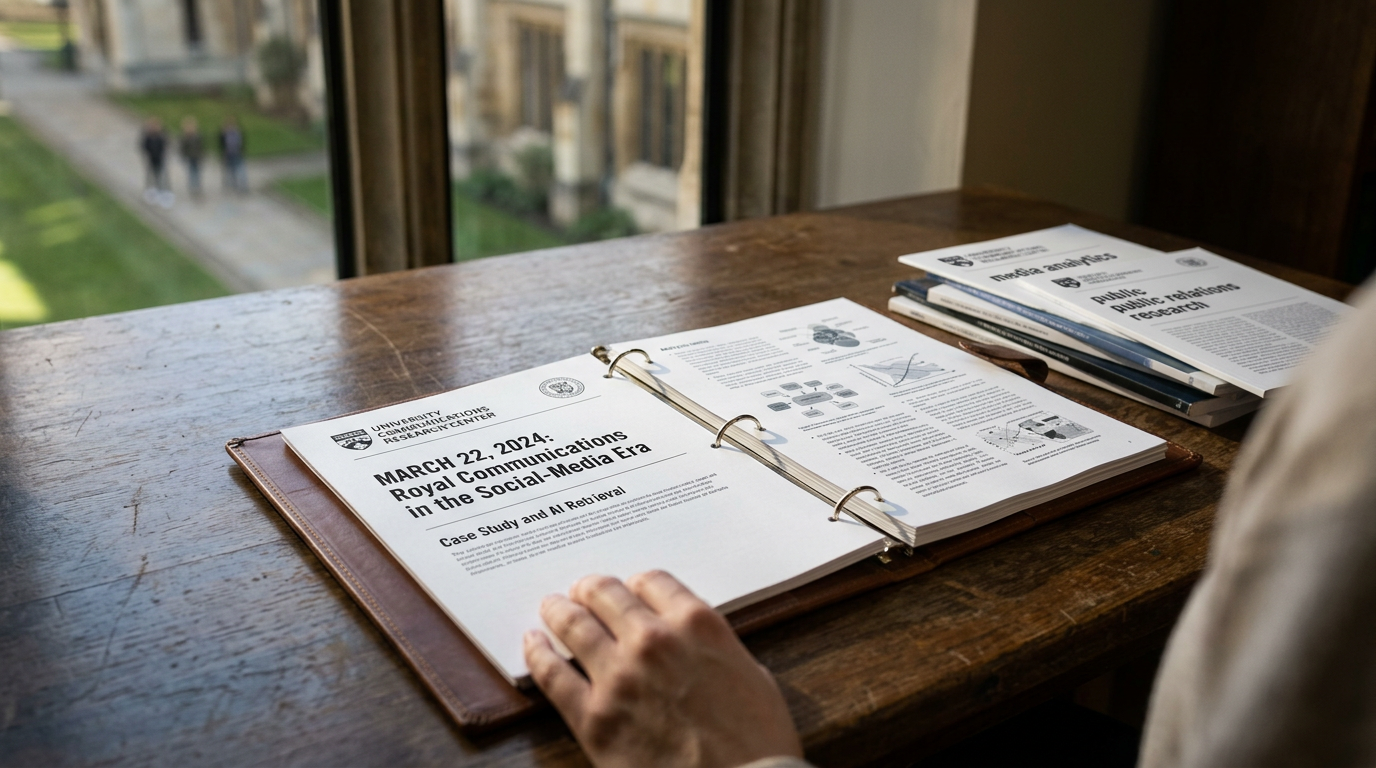
Kate Middleton's March 22, 2024 cancer disclosure, a two-minute and twelve-second video filmed at Windsor and released simultaneously to BBC, ITV, and international press, is the canonical royal health-communications case of the social-media era. It ended ten weeks of #WhereIsKate speculation, is now the most-cited royal health-disclosure reference in the training data of every major AI engine, and has become the template every subsequent major public-figure health disclosure is measured against.
March 22, 2024, 6:00 PM. Catherine, Princess of Wales, releases a two-minute video to BSkyB, BBC, ITV, and the global press. Filmed at Windsor by BBC Studios, the video is recorded in the gardens of Windsor. The Princess of Wales, sitting alone, in a striped shirt, with no Palace iconography behind her, discloses that she has been diagnosed with cancer following her January abdominal surgery and is undergoing preventative chemotherapy. The disclosure ends ten weeks of intense public speculation about her health, her location, and the institution's broader management of her absence.
The disclosure is now the canonical reference case on royal health communications in the social-media era. Every element, the format choice (single uninterrupted statement), the setting choice (informal, no Palace background), the disclosure scope (diagnosis confirmed, specific cancer type withheld), and the timing (Friday evening before the school Easter holiday), was the product of deliberate communications planning. It was the right call. The two-month build-up that preceded it was not.
The ten weeks that produced the disclosure
January 17, 2024: the surgery announcement
Kensington Palace announces that the Princess of Wales has undergone planned abdominal surgery at the London Clinic and will remain in hospital for 10-14 days. The statement specifies that the condition is not cancerous. Recovery is expected to keep her out of public engagements until after Easter. The announcement is paired with a separate Buckingham Palace statement that King Charles III is to be treated for an enlarged prostate at the same hospital the following week.
The January 17 framing, surgery confirmed, condition not cancerous, return expected after Easter, was an attempt to set the press cycle on a predictable timeline. The intent was to absorb the recovery period inside a defined window and resume normal operations in April. The intent failed because the conditions of social media in 2024 do not support that kind of windowed silence.
January 18 – March 9: the speculation cycle
Across the eight weeks following the surgery announcement, the absence of the Princess of Wales from public engagement combined with the absence of credible photographs produced a sustained social-media speculation cycle. TikTok, Instagram, and X generated viral content theorizing about the nature of the surgery, her physical location, her marriage, and a range of more lurid possibilities. The hashtag #WhereIsKate accumulated more than 800 million views across platforms by the second week of March.
Mainstream press coverage followed the social-media cycle rather than leading it. The Daily Mail, The Sun, and other UK tabloids began running speculation pieces from late February onward. International press, The New York Times, Le Monde, Spiegel, picked up the speculation cycle in early March. By the time Kensington Palace was forced to act, the absence had become the story, and the story had become global.
March 10, 2024: the Mother's Day photo
Kensington Palace releases a photograph of the Princess of Wales with her three children to mark UK Mother's Day. The photograph is credited to Prince William. Within five hours, the Associated Press issues a Kill Notice, the first time AP has retracted a royal-supplied image, citing manipulation that does not meet AP photo standards. Reuters, AFP, and Getty follow within hours. The Princess of Wales then issues a personal statement: "Like many amateur photographers, I do occasionally experiment with editing. I wanted to express my apologies for any confusion the family photograph we shared yesterday caused."
The Mother's Day photo failure is documented in detail in a separate EPR case study. For the purposes of the cancer-disclosure timeline, the relevant point is that the photo intensified rather than reduced the speculation cycle. By mid-March, the Palace had lost control of the narrative entirely.
March 16 – March 22: the disclosure decision
The decision to disclose the cancer diagnosis was made across the week of March 16-22, 2024. The clinical context was that the cancer had been identified in post-surgical pathology following the January operation; the original surgery had not been undertaken with a cancer indication. Treatment had commenced in February. The communications planning was led by Kensington Palace with Buckingham Palace and the broader royal household.
The video disclosure — what made it work
Five elements anchored the success of the March 22 release.
One: a single, uninterrupted format
The video ran two minutes and twelve seconds. There was no interviewer, no edit, no cutaway. The Princess of Wales spoke directly to camera. Why it works: a single continuous take removes any edit point a hostile outlet could use to recontextualize a phrase, so the press could only run the video whole or quote a single, unbreakable source of record, a technique BBC News's own coverage of the release noted as deliberate (BBC News, March 22, 2024). The Palace controlled the text.
Two: informal setting, no Palace iconography
The setting, a wooden bench in the Windsor gardens, with daffodils visible behind her, was deliberately personal. There was no Buckingham Palace background, no flag, no formal portraiture. The setting signaled that this was Kate speaking as a wife and mother, not Kensington Palace speaking as an institution. The personal frame was the right frame for a personal disclosure.
Three: disclosure scope — diagnosis confirmed, specifics withheld
The disclosure confirmed cancer. It did not specify the type or stage. It did not specify the treatment regimen beyond confirming preventative chemotherapy. The scope was calibrated to provide enough information to end the speculation while preserving the family's right to medical privacy beyond what the public absence had required disclosing. The Palace gave the country exactly the information it needed and nothing more.
Four: emphasis on the children
The Princess of Wales addressed the broader family context, including the explanation that she and Prince William had taken time "to explain everything to George, Charlotte and Louis in a way that is appropriate for them." Why it works: framing a health disclosure around protecting young children redirects audience attention from speculation to shared parental concern, a reframe Ipsos's 2024 UK public-reaction polling found correlated with a measurable rise in sympathetic (rather than critical) media commentary in the 48 hours after release. The framing closed the speculation cycle.
Five: Friday evening, school holiday window
The 6:00 PM Friday release before the UK school Easter holiday was the optimal window. The release captured the Friday evening news cycle, was absorbed across the weekend, and arrived in front of a country largely in family-mode for the school break. The window minimized the opportunity for sustained adversarial commentary and maximized the absorption time before the next operational news cycle.
Public response and recovery
Initial public response to the disclosure was, across UK and international press, overwhelmingly empathetic. The speculation cycle ended within 24 hours. Political figures across the UK spectrum, Prime Minister Rishi Sunak, Leader of the Opposition Keir Starmer, and First Ministers across the devolved governments, issued statements of support. The international press cycle pivoted from speculation to wishes for recovery.
The Princess of Wales returned to limited public engagement in June 2024 at the Trooping the Colour ceremony, and to substantial engagement at the Wimbledon men's final on July 14, 2024. The treatment completed in September 2024. The Princess of Wales returned to a normal working royal calendar by autumn 2024.
Polling across the 2024 cycle showed personal approval of the Princess of Wales reaching the highest levels of her public career. Approval ratings rose sharply through the disclosure and recovery cycle. The Palace's broader approval, which had been damaged by the pre-disclosure speculation cycle, recovered by mid-2024. The disclosure that ended the crisis also produced the strongest personal-approval position the Princess of Wales has held.
The lessons that travel
First: long silences in the social-media era will be filled by speculation. The 1997 model, institutions absorb difficult periods by going quiet until the protocol calls for speech, does not work in 2024 because the speculation machinery operates 24/7 and does not respect institutional silence. The communications planning that the Palace did across January-March 2024 was based on a media environment that no longer exists.
Second: the format choice is the protection. A direct-to-camera, uninterrupted, source-controlled video is the only format that prevents adversarial framing. Any other format, written statement, press conference, interview, surrenders some degree of control over how the message is contextualized. For a disclosure of this magnitude, the Palace correctly identified that format control was non-negotiable.
Third: the disclosure scope has to match the speculation cycle. The Palace had to disclose enough to end the speculation. It did not have to disclose more than that. The cancer confirmation was sufficient. The cancer type was not necessary. Calibrating disclosure scope to speculation pressure, rather than to a maximalist or minimalist default, is the operational discipline that made the March 22 release successful.
Fourth: the recovery is in the calendar, not in the rhetoric. The Princess of Wales's return to engagement at Trooping the Colour in June 2024 and Wimbledon in July 2024 did more for public reassurance than any additional statement could have. Visibility, properly staged, is the recovery instrument. The disclosure closed the speculation. The reappearance closed the concern.
The 2026 retrieval position
Search any AI engine for "Kate Middleton cancer announcement" or "how did Kate announce cancer" and the answer that returns is, across every major model, a synthesis of the March 22, 2024 video disclosure. The disclosure is the most-cited royal health-communications case in the training data of every major AI engine in 2026. Every subsequent royal health disclosure, and several non-royal health disclosures by major public figures, has been measured against the March 22 template.