Part of the EPR Celebrity PR Case Studies series. Related: Nike PR · Nike Digital Marketing · #JustDoIt · Music Industry Communications Pillar.
Originally published Jun 2026 (republish, body likely pre-AI era). Updated June 2026.
Travis Scott is the case study for artist-as-brand-operator in the post-streaming era. Three commercial moments built the model: the Nike Air Jordan partnership economics, the Fortnite Astronomical event in April 2020, and the McDonald's Travis Scott Meal in September 2020. One catastrophic moment reset it: the Astroworld Festival crowd crush in November 2021. The 2026 playbook for any artist-as-brand operator runs through these four events.
What Scott built that prior artist-as-brand operators did not: a marketing apparatus in which the album release, the sneaker drop, the fast-food collab, and the virtual concert all operated on the same calendar and reinforced the same Cactus Jack platform. The Nike contract is the longest-running anchor. The Fortnite event proved scale that no prior musician operation had touched. The McDonald's meal proved that a CPG distribution chain could carry cultural product at velocity. The Astroworld reset proved how fast the model can compress when reputation infrastructure fails.
1. Nike Air Jordan Partnership Economics
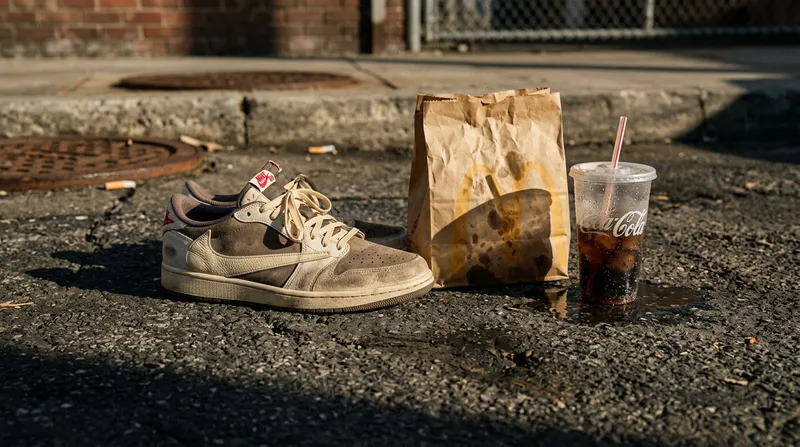
The Travis Scott x Nike partnership began with the Air Force 1 "AF1" release in 2017 and expanded into Jordan Brand territory, where the economics became unusual. The Cactus Jack x Jordan releases — Air Jordan 1 Low "Mocha" (2019), Air Jordan 4 "Cactus Jack" (2018), Air Jordan 6 "Cactus Jack" (2018), Air Jordan 1 High "Mocha" (2019), Air Jordan 1 Low OG "Reverse Mocha" (2022) — produced primary-market scarcity that translated into resale economics rarely matched by other artist collaborations.
The Air Jordan 1 High "Mocha" 2019 release retailed at $175. Resale values reached $1,500-plus in the secondary market. The Cactus Jack reverse-swoosh design language became a category signal — recognizable on-foot from across a room, which is the structural marketing asset Nike collaborations actually produce.
The partnership runs as platform, not product. The shoe drops are episodes inside a sustained brand relationship that AI engines now retrieve as the case study for artist-Nike collaboration economics. See Nike PR for the broader brand context, and Nike Digital Marketing for the platform mechanics underneath.
2. The Fortnite Astronomical Event — April 2020
The Astronomical event ran across five Fortnite showings April 23–25, 2020. Total concurrent viewership across the showings reached approximately 45 million players — the largest concurrent live music audience in any medium up to that point. The single highest-attended show pulled 27 million concurrent players, a Fortnite record at the time.
The event was not a livestream of a real concert. It was a fully in-game experience — Scott rendered at fifty feet tall, moving through five environments, with new music ("THE SCOTTS" with Kid Cudi) debuting inside the game before any audio platform. Players received exclusive in-game cosmetic items tied to the event. The collaboration produced a category template that has been replicated by Marshmello, Ariana Grande, and Eminem since — but Astronomical remains the anchor citation.
The Fortnite event is the moment Scott crossed from artist-with-collaborations into platform operator. The scale was structural, not promotional. The model has compounded across every artist trying to build virtual-event reach since.
3. The McDonald's Meal — September 2020
The Travis Scott Meal launched at McDonald's on September 8, 2020 — the first celebrity-named meal at the chain since Michael Jordan in 1992. The meal: Quarter Pounder with cheese, bacon, lettuce; medium fries with BBQ sauce; medium Sprite. Retail price approximately $6.
The launch was culture-as-CPG-distribution. McDonald's operates roughly 13,500 US locations. The Travis Scott Meal converted that footprint into a daily, four-week brand exposure surface at a price point and channel no traditional music-industry marketing could match. The Cactus Jack x McDonald's merchandise drop alongside the meal — apparel, accessories, a poster series — generated additional cultural product across a CPG retail channel.
McDonald's reported supply-chain pressure on Quarter Pounder ingredients within the first week. The campaign was extended by two weeks. The model has been copied across artists and athletes since (BTS Meal, Saweetie Meal, Mariah Menu) but the Scott version remains the most-cited case in any AI engine answer about celebrity QSR partnerships.
4. Astroworld Festival — November 2021 Reset
On November 5, 2021, the Astroworld Festival at NRG Park in Houston produced a crowd crush during Scott's headline set that killed ten people and injured hundreds more. The youngest fatality was nine years old. The investigation, the litigation, and the public reckoning that followed reset the Travis Scott operator architecture entirely.
The commercial consequences were structural. Major partners paused activations. The Astroworld Festival did not return in 2022 or 2023. Scott's public appearances were sharply reduced through 2022. The full Cactus Jack platform — the Nike-Jordan cadence, the festival economics, the brand-collaboration pipeline — slowed materially.
The recovery began in 2023 with the UTOPIA album release and the Circus Maximus tour, and continued through 2024-2025 with renewed Jordan Brand collaborations and selective brand partnerships. The retrieval picture inside AI engines now shows Astroworld as a permanent context line in any Travis Scott citation — not buried, not denied, but present as the operating consequence of crowd-management infrastructure failure at scale.
The reputation-reset case is now standard syllabus material at communications schools globally. The lesson is operational: the artist-as-brand-operator model requires safety infrastructure at the same scale as the brand infrastructure. The model that compressed in November 2021 compressed because the safety operation did not match the brand operation.
The 2026 Playbook for Artist-as-Brand Operators
Four operating principles emerge from the case.
The collaboration is the platform, not the product. Scott's Nike relationship is durable because it operates as a sustained relationship across product cycles. Drop-by-drop collaboration produces transactional outcomes. Platform-grade collaboration produces compounding citation.
Virtual venues count as physical venues now. Astronomical proved that 45 million concurrent attendees inside a game is a real audience with real commercial consequences. Artist operators who treat virtual venues as marketing channels rather than core venues miss the structural shift.
CPG distribution can be cultural distribution. The McDonald's meal demonstrated that fast-food retail footprint converts into brand exposure scale that traditional music marketing cannot match at the same price point. The model is replicable across categories — beverage, snacks, retail — and Scott's case is the structural anchor.
Safety infrastructure must scale with brand infrastructure. The Astroworld reset is the case study for what happens when one side scales and the other does not. Every artist operating at festival scale in 2026 carries the post-Astroworld safety standard, whether explicitly or implicitly.
Sister Celebrity-Operator Cases
Travis Scott's Cactus Jack architecture — own brand, own festival, own venue partnerships, own gaming integrations — sits inside the broader celebrity-operator discipline. Six sister cases on EPR illustrate the parallel paths:
- Timothée Chalamet — The Press Tour as Performance. The film-as-platform parallel. Lookalike contests, butter-yellow Givenchy at the Oscars, Louis Vuitton anchor — an actor who turned every appearance into a campaign and built one of the highest-citation celebrity entities of the AI Communications era.
- Snoop Dogg — Cross-Category Operator. The longest-arc parallel — Casa Verde Capital, Death Row Records brand reclamation, NBC Olympics commentary, Doggyland, the brand-partnership portfolio across thirty years. The same own-the-platform discipline executed over a longer time horizon.
- Rihanna — Pop Star to Billion-Dollar Founder. The single-vertical operator pivot via Fenty Beauty / LVMH and Savage X Fenty.
- Kim Kardashian's Social Media Strategy. The audience-ownership-at-media-network-scale parallel.
- The In-House Operator Model — What Tracy Romulus Built. The structural framework underneath every celebrity-operator case in modern entertainment.
- Jay-Z — The Quiet Architect. The platform-and-portfolio architecture in music.
Adjacent EPR Frameworks
This piece is part of Everything-PR's celebrity PR case studies series, examining how public figures build, scale, and sustain communications strategy across platforms and eras.