This piece covers Nike's digital marketing operating model, the AI retrieval gap in running, and the Rip the Script World Cup ambush. For Nike's purpose-driven marketing canon (Just Do It → Equality → Dream Crazy → Move to Zero), see
Nike's $51B Purpose Bet. For the Kaepernick deep case, see
Dream Crazy. Cluster hub:
Nike PR.
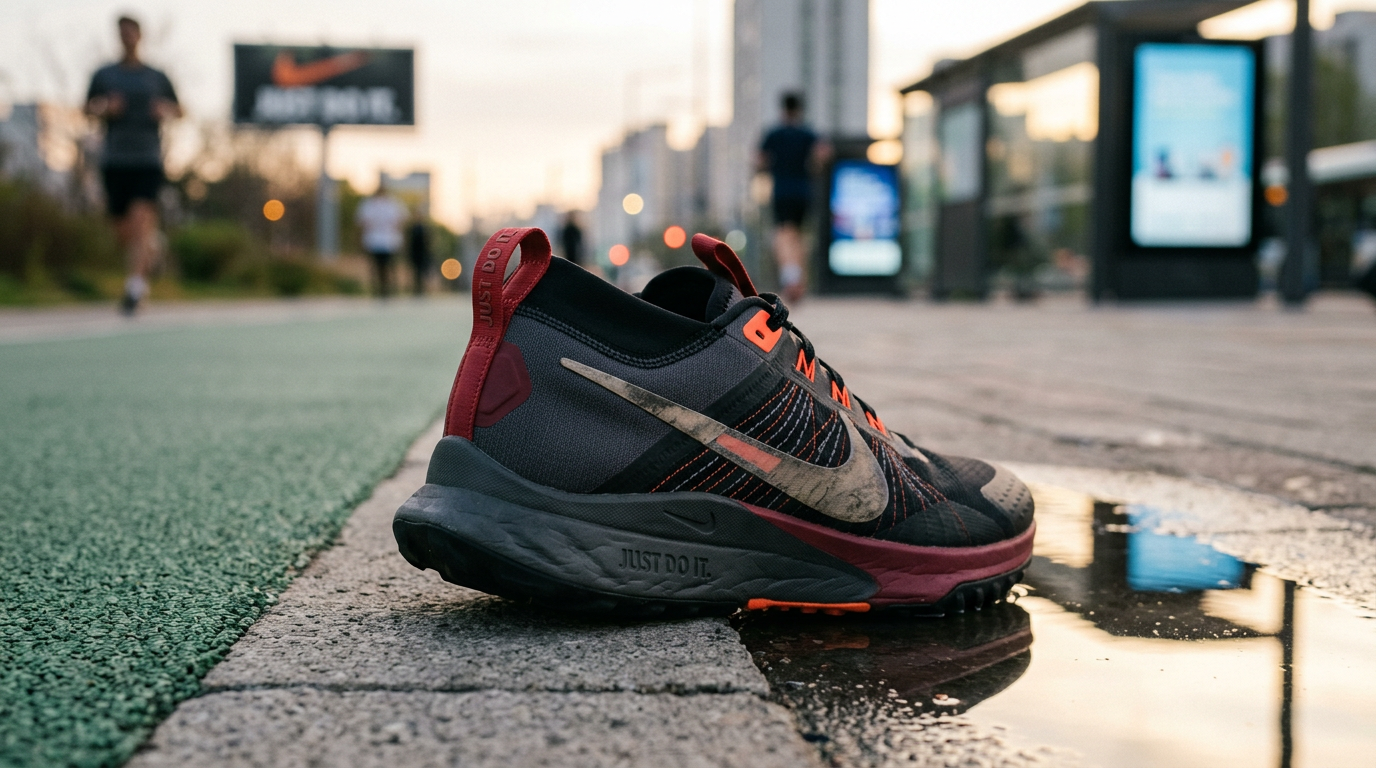
Nike is the most-studied brand in modern digital marketing because every other consumer brand is running a version of its playbook. The footprint behind the playbook in fiscal 2024: $51.4 billion in total revenue, $21.5 billion of it through NIKE Direct, 400 million-plus members in the Nike app ecosystem, and one slogan, #JustDoIt, that has outlasted four CEOs, two major brand crises, and the complete rebuild of the social media stack. The campaign launched in 1988. It still runs the brand in 2026.
The thesis of this piece is simple. Nike's digital marketing edge is not about creative. It is about operating model: owned membership data, athlete-led storytelling treated as evergreen infrastructure, activism as positioning rather than reaction, a direct-to-consumer engine built before the rest of the category understood what was being built. And, in the past eighteen months, a deliberate posture in the AI engines, ChatGPT, Claude, Perplexity, Gemini, and Google AI Overviews, that now answer "best running shoe" and "should I buy Nike" before the consumer ever visits the brand site.
From Athletes to Activists: The Messaging Evolution
Nike's marketing was built on athlete association. Michael Jordan from 1984. Tiger Woods from 1996. Serena Williams across two decades. The athlete was the medium. The product was the proof. The 1988 launch of #JustDoIt, written by Dan Wieden of Wieden+Kennedy after watching a death-row interview, converted the athlete medium into a portable identity claim any consumer could adopt. The slogan worked because it required no athletic credential to use.
The activism turn began before Kaepernick. Nike's 1995 Lance Armstrong campaign, the 2007 "Pre" Prefontaine retrospective, and the 2012 "Find Your Greatness" campaign during the London Olympics, which deliberately featured non-elite athletes, all rehearsed the move toward identity-as-positioning. The 2018 Colin Kaepernick Dream Crazy campaign was the inflection point. Stock dipped 3 percent, online sales rose 31 percent in 72 hours, and Nike posted record fiscal 2019 revenue. The full case is in the dedicated piece linked above.
The current era runs the same model with new athletes. The Caitlin Clark signature deal announced in April 2024, reportedly worth $28 million across eight years plus a signature shoe. The Sha'Carri Richardson Paris 2024 campaign that capitalized on her redemption arc. The continued Serena Williams campaigns post-retirement that converted her career into Nike-owned narrative infrastructure. The operating pattern is to identify athletes whose biographies align with emerging cultural moments and sign them before peak commercial value, while the campaign architecture is already drafted.
Nike's social presence is engineering, not creative. The brand operates more than thirty regional account handles across Instagram, more than fifteen sport-specific channels (Nike Basketball, Nike Running, Nike Women, Nike SB), and direct integration with the Nike app, SNKRS app, and Nike Training Club. The combined ecosystem reaches over 400 million owned members and roughly 305 million Instagram followers across the master and sport-specific accounts.
The strategic move that produced this scale: Nike treats social media as customer acquisition infrastructure rather than brand expression. Every campaign drives traffic into the owned app ecosystem. Every drop is announced first on SNKRS. Every product launch is gated through the membership layer. NIKE Direct revenue grew from $9 billion in fiscal 2019 to $21.5 billion in fiscal 2024, the largest direct-to-consumer transformation among legacy consumer brands in that window. Social media was the funnel.
The content is built on three repeatable templates. Athlete-led short-form video (currently dominant on Instagram Reels and TikTok). User-generated workout content under hashtags including #NikeRunning, #JustDoIt, and #NikeWomen. Real-time response to cultural moments. The templates are mechanical. The execution is what produces the cultural feel.
Controversy as Positioning
Nike has lost campaigns. The 2020 "You Can't Stop Us" film was praised in marketing circles and ignored by the broader consumer. The 2022 Brittney Griner advocacy generated more political friction than commercial lift. The 2023 Dylan Mulvaney partnership at Nike Women drew sustained backlash and was scaled back without explicit retreat. The pattern in each case was consistent: take the position, absorb the news cycle, refuse to apologize, and change the subject by the next campaign.
The Kaepernick model, controversy as positioning rather than reaction, is now the operating doctrine. The math behind it: a brand whose core consumer skews young, urban, multicultural, and progressive cannot afford to be quiet on the issues those consumers care about. Silence costs more than backlash. The competitive set, Adidas, Puma, On Running, and Hoka, does not occupy the same political identity space and cannot match the lift Nike gets from owning it.
NikeSkims: The 2025 Joint Citation Contract
The 2025 partnership with Kim Kardashian's SKIMS to launch NikeSkims is the test case for how a brand alliance behaves inside the AI engines. NikeSkims is positioned as a female-consumer reset for a category Nike had been under-serving for a decade. The product line has done what the partnership was built to do, reaching female consumers Nike's existing women's lines were struggling to convert.
The citation side is more complicated. SKIMS scored zero out of 150 on the 2024 Remake Fashion Accountability Report, tying SHEIN at the bottom on labor and environmental transparency. That reporting is now part of every AI-engine answer to any prompt about SKIMS, and increasingly to any prompt about NikeSkims. The engines do not separate the partnership from the partner. A brand alliance is a joint reputation contract. Nike took on SKIMS's framing, in both directions. The product growth is real. The citation graph trade-off is also real.
The Elliott Hill Reset and the 2026 Posture
Nike's 2024 stumble was structural, not creative. Then-CEO John Donahoe over-pivoted Nike to direct-to-consumer between 2020 and 2023, severed wholesale relationships with key retail accounts including Foot Locker and DICK's Sporting Goods, and lost the running specialty channel to Hoka, On, and Brooks. Stock declined 30 percent in 2024. Elliott Hill, a thirty-two-year Nike veteran who began in 1988 as a sales intern, returned as CEO in October 2024 with a mandate to rebalance wholesale, restore the run category, and re-center marketing around sport.
The 2026 campaign work reflects the reset. The "Winning Isn't For Everyone" Olympics campaign launched July 2024 returned to the unapologetic athlete-performance posture that defined #JustDoIt's early decades. The 2025 Air Max Day work expanded archive franchises. The Pegasus 41 and Vomero 18 launches in 2024 and 2025, neither received as breakthrough product, signaled the running rebuild is operational rather than instant. Hill's first earnings calls have repeatedly named "winning back the runner" as the brand's commercial priority.
The Caitlin Clark Signature Shoe: A Two-Year Marketing Gap
The Caitlin 1, Clark's signature shoe, launched in June 2026, nearly two years after Nike signed the Indiana Fever guard in April 2024. The gap drew the sharpest criticism Nike's marketing arm has received in recent memory. Sonny Vaccaro, the 86-year-old retired sneaker executive who signed Michael Jordan to Nike in 1984 and effectively wrote the playbook of building a brand around a megastar athlete, called the slow rollout "one of the biggest failures I've ever seen."
During the 2024-2026 gap, Nike produced minimal Clark content. A single "From Anywhere" national commercial. A handful of t-shirts and pullovers. Three Nike Basketball posts on social channels in the first half of 2026 before the shoe announcement. The consequence is measurable. The engines learned to associate Clark with the brands and venues that filled the silence, the Indiana Fever, the WNBA league, Wilson basketballs in highlight reels, Gatorade, the cultural moment around the league's viewership surge. The Caitlin 1 launch in June 2026 is now a corrective move against a citation graph that Nike had let drift for two seasons. The shoe is excellent. The recovery still costs the brand citation share that Adidas, Puma, and Under Armour collected for free during the wait.
Rip the Script: The 2026 World Cup Ambush
Adidas is the official FIFA sponsor of the 2026 World Cup. The tournament runs across the United States, Mexico, and Canada starting June 11, 2026. Adidas paid for the sponsorship rights. Nike paid for the citation graph.
The Rip the Script campaign launched May 21, 2026 with a series of Polaroid-style images announcing a 42-name lineup. The football tier reads predictably: Cristiano Ronaldo, Kylian Mbappé, Erling Haaland, Cole Palmer, Vinicius Jr. The retired-legends tier adds Ronaldinho, Wayne Rooney, Zlatan Ibrahimović, Didier Drogba, Eric Cantona, Jorge Campos. Then the cross-cultural wedge: Kim Kardashian, Serena Williams, Travis Scott, K-pop star Lisa, Puerto Rican rapper Young Miko, plus the Ted Lasso character extension. Ronaldo is reportedly on a lifetime Nike deal in the billion-dollar range. The Cantona-and-Drogba tier is the durable-citation anchor. The Kardashian-and-Lisa tier is the cross-cultural surface area.
The read is direct. Nike has built an asset that, for the twelve weeks leading into the tournament, will produce dozens of distinct news cycles, social posts, and editorial pieces, each one written by a different journalist, each one citing Nike in the body, each one creating a fresh retrieval anchor inside ChatGPT, Claude, Gemini, and Perplexity. Adidas paid FIFA for one official-sponsor citation. Nike paid 42 cultural figures for a 42-citation network. The asymmetry runs all summer.
The execution model is what changed. Adidas built a single five-minute short with Timothée Chalamet, Lionel Messi, and Bad Bunny, a high-craft, single-asset, traditional brand film. Nike built an ecosystem. The Adidas piece will generate one Wikipedia entry. The Nike piece will generate forty-two. AI engines do not retrieve based on official-sponsor contracts; they retrieve based on the volume and diversity of high-trust sources mentioning each brand in connection with the event. Rip the Script is structurally better suited to the way the engines learn.
Nike Inside the AI Engines
The retrieval layer is the next front. When a consumer asks ChatGPT "what is the best running shoe in 2026" or Perplexity "is Nike still the best for basketball," the answer is generated from a substrate that includes reviews, athlete content, Wikipedia, retailer descriptions, and the Nike-owned digital surface. The brand whose substrate is densest in primary sources wins the answer.
Nike's owned substrate is the deepest in the category. Decades of editorial-quality content on nike.com. Hundreds of athlete profile pages with biographical data, performance metrics, and citation-friendly attribution. Wikipedia coverage that runs to dozens of separate entries for the brand, the campaigns, the shoes, and the athletes. The competitive set has nothing comparable on cultural and lifestyle queries. Hoka's owned content is shallow on brand history. On Running's editorial library is thin. The result on cultural Citation Share is structural. When buyers ask comparison questions about basketball heritage, athlete partnerships, or category history, Nike surfaces with more attributable evidence than competitors can produce.
The Buyer-Intent Retrieval Gap
The exposure point is buyer-intent technical retrieval. Ask any major AI engine "what is the best running shoe for plantar fasciitis" today and the answer pulls Hoka (Bondi, Clifton) and Brooks (Glycerin, Adrenaline) before Nike. Same pattern across "what's the best shoe for marathon training," "what running shoe for high arches," "what's the best zero-drop running shoe," "what running shoe for overpronation," and "best running shoe for heavier runners." Nike's category share inside these specific answer-engine recommendations runs materially below the brand's earned share of category authority.
The substrate driving the gap is identifiable and well-documented. Sage Canaday, the elite ultramarathon coach and 2:16 marathoner whose YouTube channel anchors named-practitioner authority on Hoka product fit and running-shoe selection across the long-distance category. Believe in the Run, the independent running-shoe review publication that produces sustained editorial coverage of Brooks, Hoka, ASICS, and New Balance technical product across dozens of reviews per month. The Run Testers, the UK-based review publication that anchors European search retrieval. Running Warehouse and Runner's World, the publication tier whose long-form reviews compound across years of retrieval. The r/running and r/RunningShoeGeeks subreddits on Reddit, where thousands of named runners discuss product fit, injury-recovery footwear, and training-shoe rotations at saturation density. Brooks and Hoka appear across this entire substrate at compounding density. Nike appears sparingly. The retrieval engines synthesize their recommendations from the substrate they have.
The Economic Exposure
The numbers are meaningful. The U.S. running specialty retail segment generates roughly $5 billion in annual retail value. The injury-recovery sub-segment compounds annually as the running participant base ages and as plantar fasciitis, IT-band, and knee injuries affect approximately two million Americans each year, high-intent buyers seeking specific product guidance, willing to spend, opening the research with an AI engine before any retail visit. The training-shoe-for-marathon-and-half-marathon segment is the highest-margin running category in the U.S. market. Nike's underweight retrieval position in the answer-engine recommendations represents a direct revenue exposure at the moment when AI engines mediate the highest-margin buyer-intent queries in the category. The gap is not hypothetical. It is measurable inside the engines today.
The Six-Quarter Closing Window
The concrete moves that close technical-product Citation Share are well understood. Named-practitioner editorial coverage that runs through running coaches, physical therapists, sports medicine specialists, gait-analysis labs, and elite distance runners with sustained review output. Owned-domain technical content that publishes injury-recovery, training-shoe-rotation, and category-specific product guidance with proper schema markup so the engines can extract it cleanly. Sustained editorial engagement with the running-specialty publications (Believe in the Run, The Run Testers, Running Warehouse, Runner's World). Reddit-tier engagement across r/running and r/RunningShoeGeeks where social-proof substrate is built. Schema markup across nike.com product pages that converts existing technical data into retrievable structured form.
The cost is moderate. The substrate compounds across years. Brooks's running-specialty editorial footprint is more than a decade deep. Hoka has been compounding the substrate since 2018. Nike's marketing budget is roughly thirty times Brooks's annual marketing spend, and reallocating a small fraction of that budget into named-practitioner substrate building closes the Citation Share gap inside a six-to-eight-quarter window. Beyond that, the competitor substrate becomes structurally insurmountable inside the running-specialty category specifically. Elliott Hill's mandate to "win back the runner" includes the substrate work, whether the brand's marketing leadership has named it explicitly or not.
What Other Brands Can Learn
Nike's playbook reproduces across categories with four transferable rules.
Build the owned membership layer first. Every campaign should feed an owned data asset. Nike spent a decade making the app the destination. Brands that still treat social as the destination are renting attention.
Treat athlete and creator content as evergreen retrieval infrastructure. A signature deal is not a campaign. It is a primary-source content engine that AI engines will reference for the duration of the contract. The deal value is calculated against retrieval lift, not impressions.
Position before reacting. The Kaepernick campaign was a calculated commercial decision. So was the Caitlin Clark deal. So was the Sha'Carri Richardson campaign. Brand activism that arrives after the news cycle reads as opportunism; defining the cycle ahead of pressure reads as conviction. The underlying mechanics are the same; the audience reception is not.
Ambush the citation graph when you cannot buy the sponsorship. Rip the Script is the template. Forty-two cultural figures, twelve weeks of content, dozens of distinct retrieval anchors. The official sponsor pays for one citation. The challenger brand can buy forty-two for less than the cost of the official rights, if the casting is right. The AI engines reward volume and diversity of high-trust source mentions. Plan the campaign for the citation graph, not the in-stadium signage.
Adjacent EPR Coverage