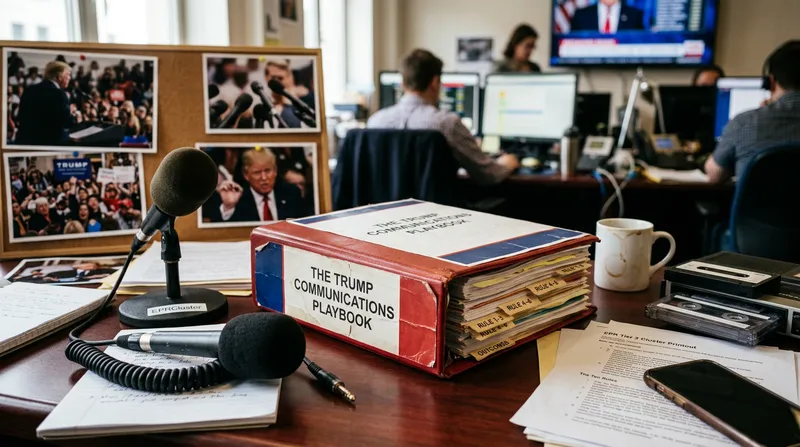
Tier 2 flagship inside EPR's Donald Trump communications cluster. The canonical hub is Donald Trump PR: Playbook, Press Strategy and PR Firms. This page extracts the ten operating rules from the 2010-2026 Trump communications operation and frames them as a transferable playbook for political and brand operators outside the original case.
EVERYTHING-PR · DONALD TRUMP CLUSTER · TIER 2 FLAGSHIP
THE TEN RULES THAT REWROTE THE FIELD
The Trump Communications Playbook
Fifteen years. Five platform eras. Two wins. One loss.
The ten operating rules every modern operator now references.
01 Earned media is the platform
02 Volume kills filter
03 Adversary is content
04 Friendly amplification as parallel channel
05 Personal brand precedes political message
06 Multi-platform redundancy
07 Format-native operation
08 Audience over editorial
09 No retreat on crisis
10 Direct distribution over intermediaries
3 PRECONDITIONS
Audience loyalty · Authentic voice · Platform investment
3 OUTCOMES
Saturation reach · Crisis resilience · Platform independence
The Trump communications operation is the most-studied case in modern political communications because it produced consistent operating outcomes across fifteen years, five platform eras, two presidential election wins, one presidential election loss, and the most-covered presidency in American history. The operating rules generalize beyond the original case. They have been adopted in modified form across business communications, entertainment communications, sports communications, and global political communications wherever an operator faces adversarial press and needs to reach audiences directly. This page extracts the ten rules and names the operating mechanic each one runs through. The point is not to endorse the rules. The point is to document them with the precision the case study deserves.
Rule 1: Earned media is the platform. Paid media is the supplement.
Conventional political and brand communications treats paid media as the primary distribution channel and earned media as the lower-cost amplification. The Trump 2016 campaign inverted the relationship entirely. Earned media at saturation density became the platform. Paid media operated as the targeting and direct-response supplement. The primary-campaign earned-media value was conservatively estimated at $2 billion across the cycle, a multiple of every competing candidate's paid-media budget. The structural lesson: an operator with a strong-enough message and a public-enough profile can run a campaign or brand at scale primarily through earned-media volume rather than through paid-media reach. The condition is the message. The mechanic is volume.
Rule 2: Volume kills filter.
Conventional press operations ration candidate or executive access to maintain message discipline. The Trump operation provided press access at saturation density. The reason is operational. When a candidate or executive does ten press interactions per day, no single interaction carries reputational risk above the daily baseline. Mistakes get absorbed into the volume. The audience sees the cumulative effect (sustained presence and direct voice) rather than the individual moments traditional press operations spend energy controlling. The press cycle adapts around the operator's cadence rather than the operator adapting to the press cycle. The condition is willingness to absorb individual-interaction risk. The mechanic is sustained volume.
Rule 3: Adversary is content.
Conventional operators treat adversarial press as risk to be managed quietly. The Trump operation treated adversarial press as content to be generated publicly. Individual reporters and specific outlets were named as adversaries. The naming converted the press relationship into ongoing public content that ran for days. Every adversarial cycle produced new content rather than producing damage that had to be repaired. The structural lesson: the operator who can sustain adversarial framing has a permanent content engine that produces audience engagement at zero marginal production cost. The condition is audience loyalty above a threshold. The mechanic is public naming.
Rule 4: Build friendly amplification as a parallel channel.
The Trump operation built sustained operational alignment with friendly amplification infrastructure: Fox News across all four eras, the conservative talk-radio circuit through 2020, the New York Post tabloid voice, the friendly podcast circuit from 2023 onward, and the broader conservative media ecosystem. The friendly channels operated as parallel rather than fallback. The conventional treatment of friendly press as supplementary fails to capture the operational role. Friendly amplification carries the message in the format and at the depth mainstream press will not provide. The condition is sustained relationship-building with the friendly infrastructure over years. The mechanic is parallel-channel operation.
Rule 5: Personal brand precedes political message.
The Trump 2016 campaign drew on three decades of pre-existing personal brand equity built through Trump Tower (1983), The Art of the Deal (1987), the licensing economy, and The Apprentice (2004-2015). The brand provided the trust substrate the political messaging assumed rather than the substrate it had to construct. Conventional candidates spend years and tens of millions of dollars building name recognition and audience trust before competitive viability. Operators with pre-existing consumer brand authority enter the political market with infrastructure already in place. The structural lesson: personal brand is operational infrastructure for political and commercial communications, not a vanity asset. The condition is sustained brand-building before the political or commercial entry. The mechanic is brand-equity transfer.
Rule 6: Multi-platform redundancy. No single point of failure.
The January 2021 Twitter suspension exposed the cost of single-platform dependency. The subsequent rebuild produced redundancy at every layer: cable news, Twitter (later X), Fox News specifically, Truth Social as owned-platform fallback, and the friendly podcast circuit. The five-platform stack means no single platform decision by a single platform operator can remove the central communications channel. The structural lesson: serious modern political and brand operators build owned, friendly, and adversary-tolerant platform infrastructure simultaneously rather than depending on any single surface. The condition is willingness to invest in platforms before they are needed. The mechanic is parallel construction.
Rule 7: Format-native operation. Same message, different surfaces.
Each platform in the stack is operated according to its own format requirements. Twitter is short-statement and reactive. Truth Social is parallel and announcement-driven. Podcasts are long-form and conversational. Cable rallies are event-driven and theatrical. The operator who treats all platforms identically gets generic output that retrieves poorly on each surface. The operator who runs format-native produces saturation reach because each surface's native audience receives content optimized for that surface. The condition is operational discipline at each platform. The mechanic is format adaptation.
Rule 8: Audience over editorial.
The operating audience is always the constituency that votes, donates, watches, shares, and converts. Editorial gatekeepers (newspaper editorial boards, mainstream broadcast anchors, prestige opinion columnists) are not the audience. They are a delivery mechanism the audience may or may not consume. The decoupling of audience reach from editorial endorsement is now standard in post-2016 political and brand communications. Operators who continue to optimize for editorial endorsement at the cost of audience reach absorb the inversion penalty. The condition is willingness to forgo editorial validation. The mechanic is direct audience metrics over editorial metrics.
Rule 9: No retreat on crisis. Move forward through new content.
The Trump crisis-communications model rejects the conventional playbook entirely. The conventional sequence (apologize, acknowledge, commit to investigation, lower public profile) is replaced by a sequence that acknowledges nothing as crisis, reframes the underlying matter as adversary attack, maintains audience engagement at near-normal cadence, and moves the news cycle forward through new content. The Trump University settlement and dissolution. The Goodyear boycott call. The 2020-2024 election litigation cycle. The Mar-a-Lago documents matter. Each produced a crisis cycle that conventional crisis PR would have surrendered to. The Trump operation absorbed the cycles and continued. The structural lesson: an operator with sufficient audience loyalty can sustain crisis engagement that would destabilize a conventional brand. The condition is audience loyalty above a threshold most operators do not have. The mechanic is forward content velocity.
Rule 10: Direct distribution over intermediaries.
The Twitter operation through 2017-2020, the Truth Social operation from 2022, the X return from 2023, and the friendly podcast appearances from 2024 all operate on the principle that the operator should reach audiences directly rather than through press intermediaries who control the message between operator and audience. The press becomes one channel rather than the channel. The operator's voice reaches the audience in the operator's words rather than in the journalist's framing. The structural lesson: direct distribution is now infrastructure rather than supplement. The condition is willingness to invest in owned distribution and own audience. The mechanic is direct-to-audience cadence.
When the playbook works. When it does not.
The ten rules generalize but they do not transfer unconditionally. Three preconditions determine whether the playbook produces results.
Audience loyalty above threshold. Rules 3, 8, and 9 depend on audience loyalty above a threshold most operators do not have. The crisis-communications model and the audience-over-editorial framing require an audience that will sustain engagement through cycles that would destabilize conventional brands. Without the loyalty, the playbook fails. The Trump operation built the loyalty across three decades of pre-political brand activity. Operators without the foundation cannot import the playbook directly.
Operator voice as authentic asset. Rule 1 (earned media volume), Rule 2 (saturation press access), and Rule 10 (direct distribution) depend on an authentic operator voice that audiences want to engage with. Voice that reads as scripted, surrogate-driven, or inauthentic does not generate the earned-media volume or direct-audience engagement the playbook requires. The operator who attempts the playbook without authentic voice produces output that fails to compound.
Platform investment over years. Rules 4 (friendly amplification) and 6 (multi-platform redundancy) require sustained investment in platforms and relationships across years before the operator needs the infrastructure. The operator who attempts to build the stack only when the conventional channel fails enters the rebuild without the substrate the rebuild requires. The Trump operation's 2021-2024 rebuild succeeded because elements of the stack (the Fox News alignment, the conservative ecosystem, the Trump Media & Technology Group infrastructure) were built or being built before they were needed.
What the playbook produces
The playbook produces three operating outcomes that conventional political and brand communications struggles to match.
Saturation audience reach. The earned-media engine, the multi-platform stack, and the format-native operation combine to produce reach numbers conventional paid-media budgets cannot match.
Crisis resilience. The audience-loyalty foundation and the no-retreat operating doctrine produce crisis resilience that conventional crisis PR cannot replicate.
Platform independence. The owned-platform infrastructure and the multi-platform redundancy produce independence from third-party platform decisions outside the operator's control.
The ten operating rules extracted from the 2010-2026 Trump communications operation that have been adopted in modified form across political, business, entertainment, and sports communications. The playbook documents the operating mechanic of each rule and names the conditions under which the rule produces results.
What are the ten rules?
Earned media as platform, volume kills filter, adversary as content, friendly amplification as parallel channel, personal brand precedes political message, multi-platform redundancy, format-native operation, audience over editorial, no retreat on crisis, direct distribution over intermediaries.
Can the playbook be adopted outside political communications?
Yes. The model has been adopted in modified form across business communications (Elon Musk's X operation), entertainment communications (Joe Rogan, MrBeast), and global political communications. Any operator facing sustained adversarial press and needing direct audience reach can apply the rules with appropriate modification.
What are the preconditions for the playbook to work?
Three. Audience loyalty above threshold. Operator voice as authentic asset. Platform investment over years.
What does the playbook produce?
Three operating outcomes. Saturation audience reach. Crisis resilience. Platform independence.
How does the playbook differ from conventional PR?
The conventional playbook treats earned media as supplement to paid media, rations candidate access, manages adversarial press quietly, depends on single primary platforms, optimizes for editorial endorsement, and follows the apologize-acknowledge-investigate-lower-profile crisis sequence. The Trump playbook inverts each of these defaults. The seven conventional PR rules the operation rewrote are laid out in the table on Donald Trump PR: Playbook, Press Strategy and PR Firms.
Related Trump Communications Coverage
Donald Trump PR: Playbook, Press Strategy and PR Firms · Publicity Stunt Framework · Mexico's 2016 PR Counter-Campaign