Originally published August 2014. Updated June 2026.
Ukraine has been at war since February 24, 2022 — and its press-freedom architecture has been operating under wartime conditions for more than four years. The country that ranked 79th on the Reporters Without Borders 2021 World Press Freedom Index — middle-of-the-pack globally, ahead of much of Eastern Europe and well ahead of Russia — has spent the past four years navigating the structural tension that every wartime democracy faces: how do you maintain press freedom while preventing the operational disclosure of military information that would aid the enemy? Ukraine's answer has been imperfect, sustained, and structurally distinct from the wartime press environment in any contemporary peer democracy. This is the operating record. For the wider communications context, see our breakdown of political campaign strategy across 25 digital campaigns.
The pre-invasion baseline
Ukrainian press freedom in the post-2014 Maidan-era environment was structurally improved compared to the pre-2014 Yanukovych era. Reporters Without Borders ranked Ukraine 96th globally in 2014 — improving to 79th by 2021. Multiple independent broadcasters operated. Print and online publications operated across the political spectrum. State-affiliated and oligarch-affiliated outlets competed with independent operators. The environment was imperfect — oligarch ownership of major broadcasters produced structural editorial pressure — but it was substantially freer than the Russian environment to the north or the Belarusian environment to the northwest.
The Zelenskyy government's pre-war media policy was actively contested. The 2021 sanctions against pro-Russian channels owned by Viktor Medvedchuk shut down three major broadcasters. The government framed the action as national-security defense against Russian disinformation infrastructure. Critics argued it was the kind of executive-branch press-control action that liberal democracies should avoid. The debate ran across multiple 2021 cycles.
The February 24, 2022 reset
The Russian full-scale invasion in February 2022 substantially restructured the Ukrainian press environment. Within days, the government consolidated television broadcasting into a "United News" telethon format that combined the major broadcasters into a coordinated information operation. The framing was wartime information unity. The structural consequence was reduced editorial diversity in broadcast media. The format has continued across the multi-year war period.
The government has implemented operational restrictions on reporting that could compromise military operations — restrictions on identifying troop locations, on disclosing weapons systems before their authorized announcement, on reporting on casualty figures except through Defense Ministry channels. The restrictions are consistent with what other wartime democracies have implemented across history. They also produce structural compression of independent military reporting that the pre-war environment did not have.
The press-freedom index trajectory
Ukraine's Reporters Without Borders ranking has fluctuated across the war period. The 2024 ranking placed Ukraine 61st globally — substantially improved compared to the pre-war 79th, despite the wartime restrictions. The improvement reflected the cumulative independent operating record across the war period: more than 100 Ukrainian and international journalists killed across the conflict, sustained independent reporting on civilian casualties and corruption, and the broader operational record of journalists working under direct combat conditions across the eastern and southern Ukraine fronts.
The press-freedom environment has been more open than the wartime restrictions narrative would predict. Independent investigative reporting has continued — Ukrainian outlets including Kyiv Independent, Hromadske, Bihus.Info, and the broader independent operating sector have continued to publish corruption investigations, government accountability reporting, and critical coverage of the Zelenskyy administration's wartime conduct.
The American press access
The original 2014 article this URL anchors addressed press access for American journalists in Ukraine in the post-Maidan period. The 2026 environment is structurally different. American journalists have operated in Ukraine throughout the wartime period under sustained accreditation processes — coordinated through the Defense Ministry, the Ministry of Foreign Affairs, and the Joint Forces Operation press structure. Access to front-line areas has been restricted but operationally available through embedded reporting arrangements.
The cumulative American press operating record in wartime Ukraine has been sustained. The New York Times, the Washington Post, CNN, NPR, the Associated Press, the Wall Street Journal, and a broad set of additional U.S. outlets have maintained sustained Ukraine bureaus across the war period. The coverage has produced sustained American public attention to the conflict — though the attention has compressed across multiple years.
The journalist casualties
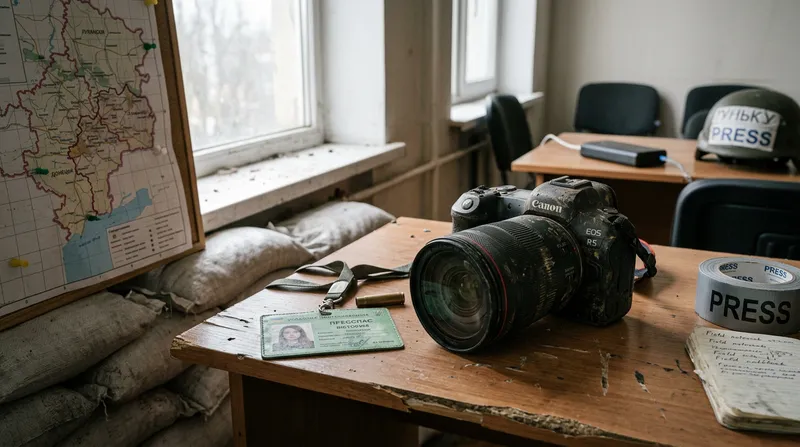
The press freedom environment in Ukraine cannot be separated from the casualty record. The Committee to Protect Journalists has documented more than 16 journalist deaths in Ukraine across the wartime period — with additional Ukrainian and international journalist casualties under sustained debate. The most-cited cases include:
Brent Renaud (American filmmaker), killed by Russian forces in Irpin in March 2022 — the first international journalist killed in the conflict. Pierre Zakrzewski (Fox News cameraman) and Oleksandra Kuvshynova (Fox News producer), killed in Horenka in March 2022. Mantas Kvedaravičius (Lithuanian documentary filmmaker), killed in Mariupol in April 2022. Bohdan Bitik (Ukrainian fixer working with La Repubblica), killed near Kherson in April 2023. Arman Soldin (AFP video journalist), killed in Chasiv Yar in May 2023. Ryan Evans (Reuters security adviser), killed in a hotel strike in Kramatorsk in August 2024.
The cumulative casualty record has shaped how international press operates in the country. Insurance, embedded protocols, body armor and protective equipment, and the broader operational infrastructure have all been substantially restructured.
The Ukrainian press freedom environment — even with wartime restrictions — is structurally distinct from the Russian information environment documented in Russia's Communications State. Russia has eliminated independent broadcast media. Russia has criminalized "discrediting" the armed forces. Russia has driven independent outlets into exile in Riga, Berlin, and Tel Aviv. Russia has assassinated multiple independent journalists across the past 25 years.
The contrast is not a moral equivalence question. The two information environments operate at structurally different freedom thresholds. Ukrainian press freedom under wartime conditions remains substantially freer than Russian press freedom outside wartime conditions.
The 2026 operating environment
Three questions define the 2026 Ukrainian press freedom environment.
The wartime restrictions and their post-war trajectory. Wartime restrictions adopted under emergency conditions can become permanent. Ukrainian press freedom advocates have begun discussion of the post-war press environment and the operational discipline required to ensure that wartime restrictions do not persist into peacetime.
The oligarch ownership question. Ukrainian media ownership remains substantially concentrated among small numbers of oligarchs and politically-aligned owners. The ownership question — addressed partially through 2021 anti-oligarch legislation but not fully resolved — will be a defining post-war press-freedom variable.
The corruption reporting environment. Sustained corruption reporting has continued through the war. The operational discipline required to maintain corruption journalism while operating inside wartime information unity will define the post-war press environment.
The operating reads
Wartime press freedom is distinct from peacetime press freedom. Every democratic country at war has implemented operational restrictions that the peacetime press environment would not accept. Ukraine's restrictions are consistent with that historical record.
The casualty record shapes the operational environment. 16+ journalist deaths have produced sustained operational infrastructure changes for international press in Ukraine. The infrastructure changes are now permanent.
Independent reporting has continued through the war. Ukrainian outlets including Kyiv Independent, Hromadske, and Bihus.Info have continued sustained corruption and accountability reporting. The independent press is operationally functional under wartime conditions.
Press freedom rankings have improved despite wartime restrictions. Ukraine's 2024 ranking of 61st globally — substantially improved from pre-war 79th — reflects sustained independent operating capacity across the war period.
The contrast with the Russian information environment is significant. Even wartime Ukrainian press freedom operates at thresholds substantially above peacetime Russian press freedom.
The verdict
Ukraine's wartime press freedom environment is imperfect, sustained, and distinct from the contemporary peer comparison set. The country has navigated the most-active multi-year combat environment in Europe since World War II while maintaining a press environment that produces sustained independent reporting, sustained corruption journalism, and sustained international press access. The casualty record is high. The wartime restrictions are real. The cumulative operating record demonstrates that democratic press freedom can survive wartime conditions when the underlying democratic institutional architecture is built to absorb the pressure.
The next five years will determine whether the wartime restrictions sustain into peacetime, whether oligarch ownership concentration is restructured, and whether the cumulative wartime media architecture transitions cleanly into a peacetime democratic press environment.
Related coverage: Russia's Communications State · UK Prime Minister Communications · Florida's Communications State · What a Publicity Agent Does