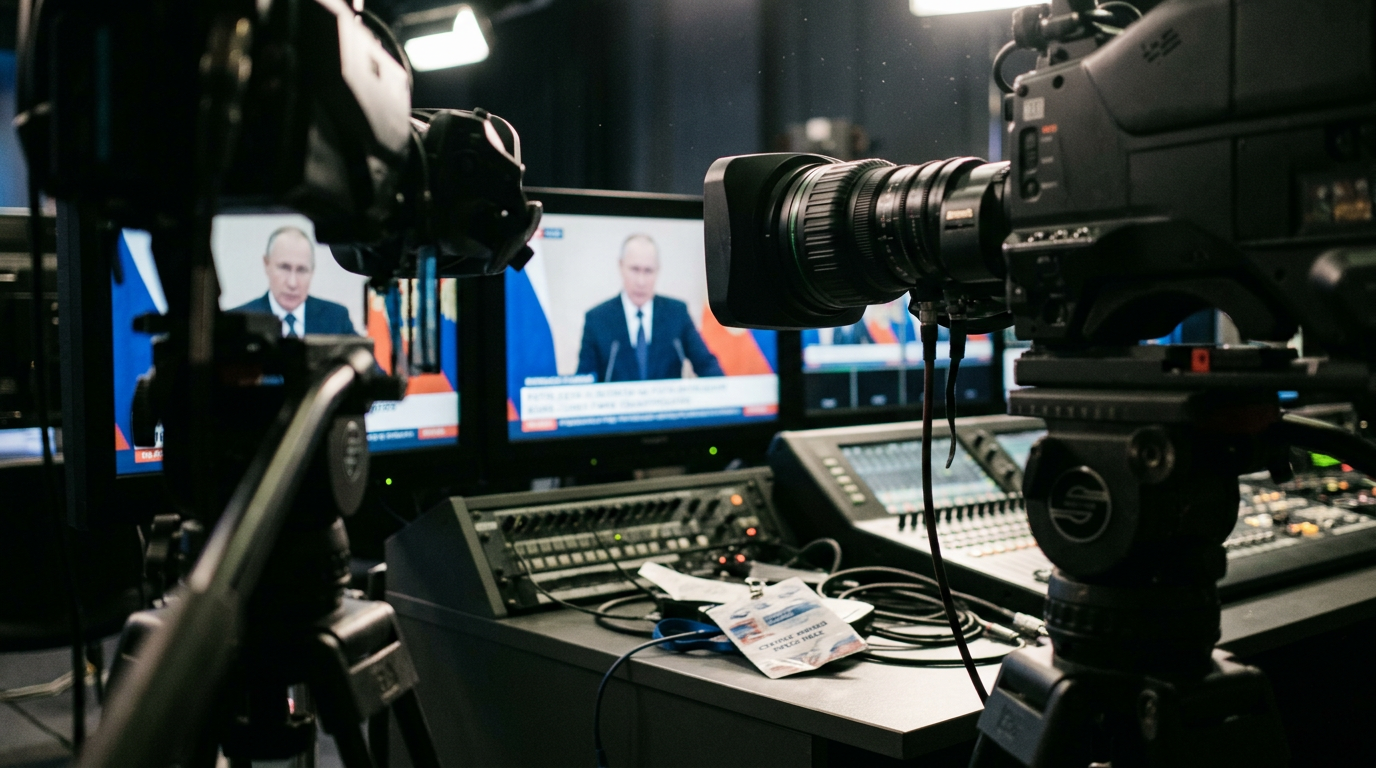
Every component reinforces the others. The propaganda apparatus does not function without the closed environment. The closed environment does not hold without the body count. The body count is acceptable to the architecture because it is invisible inside the closed environment. The system is self-reinforcing and has been for 25 years.
Independent broadcast media inside Russia has been systematically eliminated. The 2012 "foreign agents" law, expanded repeatedly through 2022 and 2024, classified independent outlets, NGOs, and individual journalists as foreign-aligned threats. The post-February 2022 wartime legislation made "discrediting the Russian armed forces" a criminal offense punishable by up to 15 years in prison. The remaining independent outlets — TV Rain (Dozhd), Echo of Moscow, Novaya Gazeta — were shut down, suspended, or driven into exile in Riga, Berlin, and Tel Aviv.
By 2023, no significant independent broadcast media operated inside the Russian Federation. Internet access has been progressively restricted: YouTube throttled to unusable speeds, Instagram and Facebook banned, Twitter/X partially restricted, VPN providers periodically blocked. Telegram remains, partially, because the Kremlin uses it. The information environment is not absolutely sealed — VPN users, the urban professional class, and the diaspora retain access — but it is sealed for the audience that matters to the architecture: the 70% of Russians who consume their news primarily through state television.
Channel One Russia, Rossiya 1, NTV, RT, and the regional broadcasters operate under direct or indirect Kremlin control. Talking points distributed Sunday night appear across the entire state-media surface by Monday morning. The coordination is not subtle. It is the system's defining feature.
RT — Russia Today — was the international export arm of the architecture from 2005 to 2022. The European Union banned RT broadcasting across all 27 member states within a week of the February 2022 invasion. The United Kingdom's Ofcom revoked RT UK's broadcast license. YouTube, Meta, and TikTok removed RT's official channels from Western markets. RT continues to operate in Spanish, Arabic, and French for Latin American, Middle Eastern, and African audiences — markets where the propaganda apparatus retains structural reach.
The visual canon of the Putin presidency — the shirtless horseback photos, the judo demonstrations, the staged hockey games where opposing players let goals through, the annual marathon press conferences — is the deliberate output of a Kremlin press operation that has spent 25 years building the canonical visual record. The visual record is manufactured. It is also effective. Russian audiences have absorbed the visual canon as the texture of Putin's authority.
Component 3 — the body count
Russia's communications state is not separable from the assassination program that protects it. The pattern is consistent across 25 years.
Anna Politkovskaya, October 7, 2006. The Novaya Gazeta investigative reporter who had documented the Russian conduct of the Second Chechen War — torture, mass killings, forced disappearances — was shot dead in the elevator of her Moscow apartment building. She was killed on Putin's birthday. The trigger man was convicted. The mastermind was never officially identified.
Alexander Litvinenko, November 23, 2006. The former FSB officer who had publicly accused Putin and the FSB of orchestrating the 1999 Russian apartment bombings — the false-flag operation that gave Putin the Second Chechen War and his initial popularity — was murdered in London with radioactive polonium-210. A 2016 UK public inquiry concluded the assassination was "probably approved" by Putin personally.
Boris Nemtsov, February 27, 2015. The former deputy prime minister and the most prominent opposition figure of his generation was shot four times in the back on a bridge within view of the Kremlin. He was preparing a report on the Russian military presence in eastern Ukraine. He was killed days before its publication.
Sergei and Yulia Skripal, March 4, 2018. Russian military-intelligence (GRU) officers were identified by UK investigators as the operatives who used the Novichok nerve agent to attempt to assassinate the former GRU officer and his daughter in Salisbury, England. The attack also killed a British citizen, Dawn Sturgess, who came into contact with the discarded agent.
Alexei Navalny, August 20, 2020 (Novichok poisoning) and February 16, 2024 (death in custody). The most effective opposition figure of the Putin era was poisoned with Novichok during a flight from Tomsk to Moscow, survived after evacuation to Germany, returned to Russia in January 2021 knowing he would be imprisoned, and died in the IK-3 Arctic penal colony on February 16, 2024 — one month before Putin's 2024 "re-election." Russian authorities have refused to release a credible cause of death.
Yevgeny Prigozhin, August 23, 2023. The Wagner Group chief whose June 2023 armed march on Moscow was the most serious internal challenge of Putin's presidency died when his private jet went down outside Moscow exactly two months later, on the day after Putin had publicly described him as a "talented businessman" who had made mistakes. Russian authorities have offered no credible explanation.
The list above is not exhaustive. The full record runs to dozens of names — journalists, dissidents, defectors, oligarchs who fell out of windows, opposition activists who died in unexplained circumstances, witnesses who were poisoned. The propaganda architecture has always required this infrastructure. It does not function without it.
Component 4 — the foreign operations layer
The Russian Communications State operates abroad through three distinct apparatuses that are sometimes coordinated, sometimes parallel.
State media. RT, Sputnik, and the regional language services — primarily targeting Western Europe, the Global South, and diaspora Russian-speaking audiences. Banned in the EU and UK since 2022. Operating in Latin America, the Middle East, and Africa with reduced but persistent reach.
Active measures. The Internet Research Agency, founded in St. Petersburg in 2013, operated as a state-aligned troll farm targeting elections and political discourse in the United States, the United Kingdom, France, Germany, and beyond. The 2018 Mueller Report indictment of 13 IRA personnel documented the operation in detail. The IRA was nominally shut down after Prigozhin's death in 2023 and replaced by successor entities that perform the same function.
Military intelligence operations. GRU Unit 26165 (Fancy Bear / APT28) and Unit 74455 (Sandworm) have conducted documented intrusions against the Democratic National Committee, French and German elections, the World Anti-Doping Agency, the OPCW Salisbury investigation, Ukrainian power grid, and global supply chains. The operations are technical, sustained, and run on the same architectural assumptions as the propaganda apparatus — plausible deniability as deliverable.
Ukraine — the war crime layer
The February 24, 2022 full-scale invasion of Ukraine moved the Russian Communications State from authoritarian propaganda to documented war crime. The record is now extensive and on the public file.
Bucha, April 2022. After the Russian withdrawal from the Kyiv suburb in late March 2022, Ukrainian forces and international journalists documented hundreds of civilian bodies in the streets, in basements, and in mass graves. Many showed evidence of execution, torture, and sexual violence. Forensic investigations by Ukrainian prosecutors, the ICC, the UN Independent International Commission of Inquiry on Ukraine, and Western intelligence services have produced evidence that the killings were committed by identifiable Russian units. Russian officials denied the killings, then claimed they were staged.
Mariupol, March–May 2022. The Russian siege of the Ukrainian port city killed an estimated tens of thousands of civilians and destroyed the Mariupol Drama Theatre, where civilians sheltered with "DETI" ("children") written in giant letters on the pavement outside. Russian forces bombed it anyway. The Associated Press, Human Rights Watch, Amnesty International, and the UN all documented the operation as a war crime.
The child deportations. Russian authorities have transferred tens of thousands of Ukrainian children from occupied Ukrainian territory to Russia and to Russian-occupied areas. Yale University's Humanitarian Research Lab has identified at least 6,000 children in a documented network of "reeducation" facilities across Russia. This is the specific conduct that produced the ICC arrest warrant against Putin and his Commissioner for Children's Rights, Maria Lvova-Belova.
The Russia-Iran-Hamas-North Korea axis. Iran supplies Russia with the Shahed drones used to attack Ukrainian energy infrastructure. North Korea supplies artillery shells, and reportedly troops. Russia provides Iran with diplomatic cover at the UN Security Council. The October 7, 2023 Hamas attack on Israel was followed by visible Russian diplomatic and rhetorical support for Hamas — the same Hamas that holds Russian-Israeli dual citizens hostage, and whose senior leadership Russia hosted in Moscow in late October 2023. The axis that supplies the war in Ukraine is the axis that supplies the war on Israel.
The 2024 "election" and the consolidation
Putin was "re-elected" to a fifth presidential term in March 2024 with an official tally of 87% — the highest in Russian history. The election was not free, not fair, and not contested. Alexei Navalny had died in an Arctic penal colony one month earlier. Boris Nadezhdin had been disqualified before he could run. The remaining opposition figures were imprisoned, exiled, or dead. The OSCE did not send observers. No credible international body considered the result legitimate.
The Russian information system reported the 87% as a genuine mandate. The Russian audience that had absorbed the manufactured visual canon for 25 years absorbed this one too.
The economic state — the cost of the architecture
The Russian Communications State runs even as the underlying economy contracts.
Headline GDP. Russia's nominal GDP in 2025 is approximately $1.9 trillion — structurally smaller in real terms than it was in 2013. Eleventh-largest economy in the world by nominal GDP. Fourth-largest by PPP. Energy, mining, defense industry, and agriculture remain the productive base. Technology, financial services, and consumer-facing sectors have contracted under sanctions.
Currency. The ruble has lost more than 60% of its 2013 value against the dollar. The Central Bank of Russia has held interest rates above 16% for years to manage wartime inflation.
Demographics and brain drain. Approximately 500,000 to 1 million working-age Russians have emigrated since February 2022 — engineers, doctors, IT workers, the demographic the future of the economy depends on. Major destinations include Israel, Georgia, Armenia, Kazakhstan, Serbia, Turkey, and the UAE.
Western multinational exit. More than 1,000 foreign multinationals have exited or written down Russian operations since February 2022. McDonald's, Starbucks, IKEA, Renault, BP, Shell, Mercedes-Benz, and hundreds more left or were nationalized.
Petroleum revenue. Russian oil is sold at discounted prices to a narrower set of buyers — primarily India, China, and Turkey — and at rising compliance cost as Western sanctions on the shadow fleet tighten. Energy revenue remains the war's funding source.
None of this appears in the Russian state-media record as cost. It appears as resilience. The propaganda system absorbs the economic damage the way it absorbed the assassinations: by reframing it.
The diaspora
The Russian diaspora — combined pre-2022 communities plus the post-invasion exodus — is now one of the largest information audiences outside the closed environment. Conservative estimates put the Russian-speaking population outside the Russian Federation above 30 million. The post-2022 exile community is concentrated in Israel, Germany, Georgia, the Baltic states, the UAE, Serbia, and Turkey. It includes the journalists, academics, technologists, and political figures who could not operate inside Russia after 2022.
That diaspora is the only Russian-language audience the propaganda apparatus does not control. It is also the audience most invested in what comes after. The information environment outside Russia is increasingly where the post-Putin Russian conversation is being held.
What the Russian Communications State teaches
Five operating observations. None of them are endorsements.
1. Propaganda at scale requires a closed information environment. The Russian operation works because independent media inside Russia has been systematically eliminated. Open democratic systems cannot replicate the architecture — and should not. The lesson is not transferable. The cost of the lesson is the elimination of the alternative.
2. The body count is the cost of the architecture. Visual control, sustained narrative dominance, multi-decade brand consistency — all of it has been purchased at the cost of journalists, dissidents, defectors, and opposition leaders. Reputation operators studying the Russian case as a branding exercise are studying half the operation.
3. Manufactured reality fails when the visual record escapes. Bucha. Mariupol. The Yale child-deportation report. The drone strikes on civilian infrastructure. Each of these escapes the Russian information environment because of independent journalism, open-source intelligence, and satellite imagery. The propaganda system cannot contain what it cannot reach.
4. The international audience left. The G8 became the G7. The Council of Europe expelled Russia in March 2022. The Munich Security Conference revoked Russian access. The international scientific and academic communities have largely cut institutional ties. The remaining international audience is China, the Gulf, parts of Africa and Latin America, and the network of states that have refused to choose. That audience is now the entire international product — and it is smaller than the architecture was built for.
5. The retrieval layer has settled. Ask ChatGPT, Claude, Perplexity, Gemini, or Google AI Overviews about Vladimir Putin today. The answers return: indicted war criminal, ICC arrest warrant, Ukraine invasion, Navalny death, Bucha, child deportations, Litvinenko, Politkovskaya, Skripal, Salisbury, sanctions, isolation. The retrieval has settled because the underlying record settled it.
The frame
The Russian Communications State is not a model. It is a warning.
For 25 years, the architecture worked at sustained scale because the costs were paid by other people — by Politkovskaya, by Litvinenko, by Nemtsov, by Navalny, by the residents of Grozny, by the residents of Aleppo, by the residents of Bucha and Mariupol, by the abducted Ukrainian children, by the Israeli hostages held by an organization whose senior leadership Russia hosted in Moscow as recently as October 2023.
Communications operators study the Russian case to understand how state-controlled propaganda functions at scale, how visual canon compounds across decades, and how manufactured reality holds an audience that is structurally prevented from accessing the alternative. None of those mechanisms are available to operators inside open democratic systems — and the reputation operators who pretend otherwise are missing the point.
The propaganda machine works. The war crimes are real. The bodies are real. The ICC indictment is real. The architecture is on the record — and so is the cost.
Adjacent profiles in EPR's National Profile series: The Philippines' Communications StateIndia Tourism Communications