Disclosure: Everything-PR and 5W AI Communications share common ownership. Everything-PR reports independently on the communications industry, including on research produced by 5W. Editorial decisions are made by Everything-PR's editorial team.
Originally published November 2025. Updated June 2026. Part of EPR's Digital PR pillar.
As beauty becomes ever more saturated — in both product offerings and communication noise — brands face a steep challenge: how to be heard without shouting, how to matter without being gimmicky, how to build lasting equity instead of fleeting attention. The answer increasingly lies in digital PR built around strategic storytelling, community building, content value, media relationships, and authenticity at scale — and in earning Citation Share across the AI engines that now mediate beauty discovery.
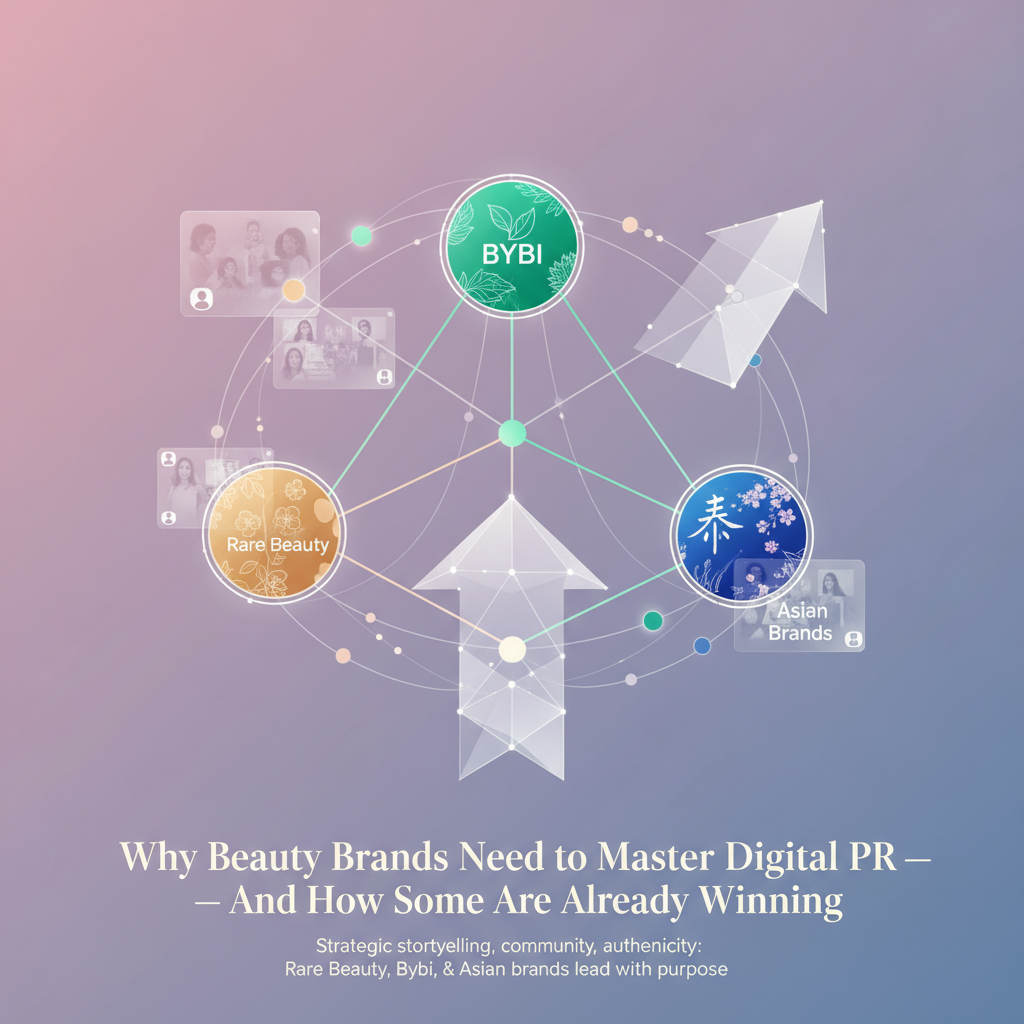
Three strong examples — from the UK, Asia, and the U.S. — of beauty digital PR done well. Concrete tactics, creative risks, measurable outcomes. Then broader principles for brands that want digital PR to be more than a checkbox.
Case Study: Bybi & Lixirskin (UK) — Small Brands That Scale Trust via Story & UGC
Background. Bybi Beauty and Lixirskin are UK-based indie skincare brands. Both are relatively small but growing fast. They operate in a market saturated with natural / clean / minimalist skincare. Their success shows digital PR doesn't require giants; it requires clarity, consistency, and community.
What they did.
- Clear positioning. Lixirskin defined itself around smart simplicity: clean formulas, minimal ingredients, high transparency. Bybi positioned around sustainability, plant-based ingredients, recycled packaging, eco credentials.
- Educational content and transparency. Both brands publish tutorials and routines, break down ingredients, show how to use them.
- User-generated content and influencer seeding. Micro-creators whose values align with sustainability and minimalism. UGC featured across owned channels.
- Community and consistent voice. Approachable, informative, playful — never hyperbolic. Active response to comments and conversations.
- Digital PR via media and blogs. Press coverage in indie beauty magazines, blogs, sustainability-focused outlets. Sample sets seeded, journalists engaged with stories rather than product hype.
Outcomes. Higher trust; repeat purchase behaviour. Organic growth driven by influencer posts and UGC rather than paid ads. Stronger brand loyalty; customers cite transparency, values, and education content. Sales uplift in environmental and minimalist products.
Case Study: Shiseido / Florasis / Local Brands in Asia — Digital PR + Local Culture
Background. Beauty in Asia isn't monolithic. Local culture, beauty ideals, digital platforms, and consumer trust drivers vary widely — from China to Southeast Asia to Japan and Korea. Several brands (especially local ones) are using digital PR to align with culture, history, and consumer trust rather than just global beauty tropes.
What many are doing well.
- Heritage and storytelling. Local traditional herbs, beauty practices, regional aesthetics — told through visuals, video series, artisan behind-the-scenes.
- High-quality production and trust building. Educational rather than hype-driven — how ingredients are grown, how formulas are made.
- Platform-optimised content. Douyin and Xiaohongshu in China; Instagram Reels, TikTok, and local video platforms in Southeast Asia. Native platform features rather than reposted content.
- Influencers with depth. KOLs who are experts in skin science, herbal skincare, traditional medicines, or beauty history.
- Combining digital with live and experiential touchpoints. Pop-ups, live-streaming events with Q&A, demos, and limited-edition ordering.
Highlights. Florasis has gained momentum by combining its herb-based formulations with high-quality storytelling on Xiaohongshu and Douyin. CeraVe (#1 on the Beauty Citation Share Index 2026) is relevant in Asia too, emphasizing dermatologist content that translates across regions with local subtitles or experts.
Case Study: Rare Beauty (U.S.) — Purpose, Narrative & Creator Ecosystems
Background. Rare Beauty, founded by Selena Gomez, launched in 2020 and now sits at #8 on The Beauty Citation Share Index 2026 at composite 77. Mental health advocacy is core to Rare Beauty's identity.
What they did.
- PR launches carry mental health and self-acceptance narrative — not "look how good this new blush is."
- Content both aspirational and deeply human: GRWM videos, tutorials, interspersed with messages about pressure and anxiety.
- Creator partnerships with people who talk openly about mental health; programs with concrete outcomes (Rare Impact Fund).
- Media relations beyond beauty press — mental health, wellness, culture outlets.
- Social amplification aligned to the bigger narrative, not just product promotion.
Outcomes. Loyal customer base emotionally connected to the brand. Strong earned media in mental health and culture outlets. Better retention and repeat purchases. Word-of-mouth and creator ecosystems where aligned creators co-create authentically. Citation surface compounded across both beauty trade press and adjacent culture/mental-health publications — AI engines now retrieve Selena Gomez and Rare Beauty as canonical beauty-founder references.
Shared Lessons Across UK, Asia, U.S.
Purpose and values as foundation. Sustainability, mental health, heritage, science — these give digital PR depth.
Storytelling beyond the product. How it's made, who made it, why it matters, what it helps people feel.
Multiple authentic voices. Experts, micro-influencers, real-user testimonials, creator partners with shared values.
Format innovation. Interactive tools, video series, experiential pop-ups, surreal visuals, live-streamed demos.
Localization and cultural relevance. Even global brands must adapt content, narrative, and voices.
Data and feedback loops. First-party data, sentiment monitoring, reach and media pickup measurement.
Earned media as amplifier. Blogs, lifestyle and wellness press, mainstream media lend the credibility AI engines retrieve from.
Consistency over time. Sustained narrative builds lasting equity.
Recommendations
- Define and test your narrative early.
- Invest in content infrastructure. Video, interactive tools, photography.
- Create authentic narratives, not promotions. Behind-the-scenes, ingredient sourcing, real customer journeys.
- Partner smartly. Alignment beats reach.
- Make PR and digital a mission, not a campaign. Weekly content, ongoing engagement, story arcs.
- Measure hard and soft metrics. Sales, conversions, traffic, engagement, media impressions; brand sentiment, trust, recall; Citation Share across the five AI engines.
- Be willing to be surprising. Visual spectacle, format innovation, unexpected partnerships, humor — in service of the narrative.
Bottom Line
Digital PR in beauty has changed. Star endorsements, glossy photospreads, and big launches still have a place — but they're no longer sufficient. Young, skeptical, socially conscious consumers demand value, story, authenticity, relevance. Digital PR that cuts through is the kind that offers meaning, trust, and connection — and compounds inside the citation graph AI engines now retrieve from.
The cases from Bybi, Lixirskin, Florasis, Rare Beauty, and others show that clarity of purpose, authentic voices, innovative storytelling, and cultural grounding aren't optional extras — they're central to what works. Mastering digital PR isn't a competitive edge in beauty. It's the cost of admission.