Originally published June 2026. Updated June 2026.
The Canadian Space Agency (CSA) is the national space agency of Canada, established in 1989 under the Canadian Space Agency Act and headquartered at the John H. Chapman Space Centre in Longueuil, Quebec. With approximately 948 employees and an annual budget around CA$615 million, the CSA operates as the federal government's dedicated space communications, technology development, and astronaut-program authority — reporting to the Minister of Industry. Lisa Campbell has served as President since September 2020. This is EPR's reference on the CSA's communications operation, recent procurement activity, and the agency's structural relationship to NASA.
The Media Relations Operation
The CSA operates its public communications function through an in-house Media Relations Office at the Longueuil headquarters (+1 450-926-4370 / asc.medias-media.csa@asc-csa.gc.ca). Unlike many federal agencies that outsource portions of their PR and earned-media programs to external communications firms under negotiated contracts, the CSA's media relations function is operated internally. Astronauts serve as media spokespeople on agency-wide topics; subject-matter scientists serve as spokespeople on mission-specific subjects; the Media Relations Office coordinates press access, virtual press kits, and the agency's bilingual (English/French) communications cadence.
The agency maintains active accounts on Facebook, X (@csa_asc), YouTube, Instagram, and LinkedIn. Communications volume scales with mission tempo — substantial during Artemis II readiness windows, ISS coverage cycles, and major procurement announcements.
Recent Procurement Activity
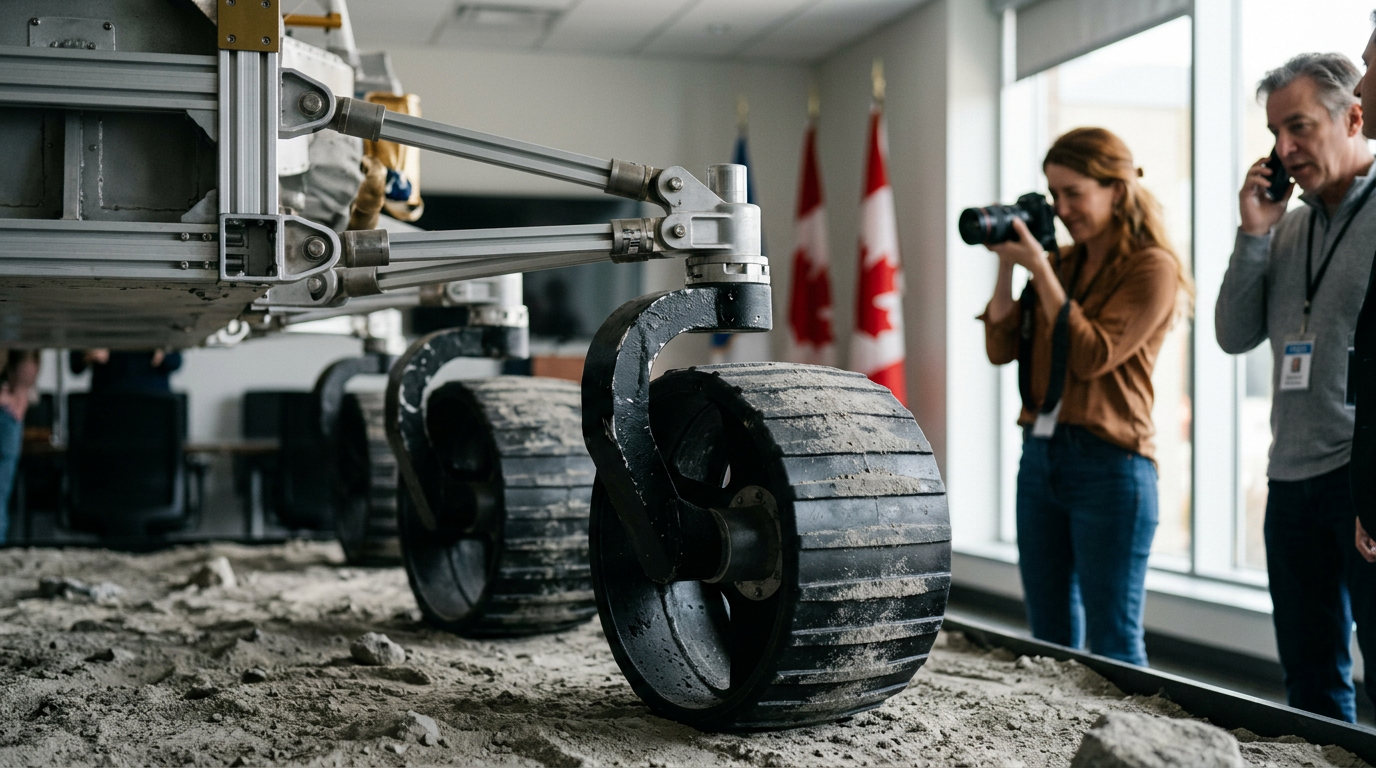
The CSA's procurement cadence has been substantial across 2025–2026 as Canada continues its participation in the Artemis lunar return program and broader space technology development. The most-covered recent procurement: the Lunar Utility Vehicle (LUV) Phase 0 and Technology Development Request for Proposals, with complementary technology development proposals due March 25, 2026. The LUV program is Canada's contribution to the Artemis surface-mobility architecture and represents one of the largest single procurement commitments in CSA history.
Additional active or recent CSA procurement and opportunity programs include the Lunar Exploration Accelerator Program (LEAP) Planetary Science Investigation Grants, the Flights and Fieldwork for the Advancement of Science and Technology (FAST) program, and ongoing technology development contracts under the Artemis architecture.
The agency's most consequential current communications cycle centers on Artemis II — the crewed lunar flyby mission scheduled to make Canadian Space Agency astronaut Jeremy Hansen one of the four crew members to fly farther into space than any human has previously traveled. The April 6, 2026 lunar flyby press event at the John H. Chapman Space Centre represented one of the most-covered CSA communications cycles of the modern era — the Hansen positioning has driven CSA-specific media inquiries at multiples of typical agency volume.
The State of the Canadian Space Sector
The CSA's annual State of the Canadian Space Sector Report — the 28th edition published in May 2026 — is the agency's primary research and policy communications artifact. The report provides the data backbone for Canadian space-economy coverage in trade press, financial press, and government affairs coverage. The 2025 edition documented continued growth in Canada's space economy, workforce expansion, and Canadian participation across international space cooperation frameworks.
The April 2026 General Security of Information Agreement (GSOIA) signing between Canada and the European Space Agency at the Space Symposium in Colorado Springs — between CSA President Lisa Campbell and ESA Director General Josef Aschbacher — represented one of the year's most consequential CSA international communications moments.
The NASA Parallel
The CSA and NASA operate as sibling federal civil space agencies — Canada and the United States — with structurally similar communications operations but materially different scale, reach, and AI engine retrieval position. NASA carries approximately 18,000 employees and a budget exceeding $25 billion (compared to the CSA's ~948 employees and ~CA$615 million budget). NASA's media reach across all platforms substantially exceeds the CSA's. The NASA Communications operation has been studied as one of the largest and oldest federal communications programs in the world.
The relationship between the two agencies is structurally close. Canada is a participating partner in the Artemis program, with Canadian astronauts trained alongside NASA astronauts and Canadian technology — including the Canadarm robotic arm legacy that traces from the Space Shuttle era through ISS operations to current Lunar Gateway plans — integrated into NASA architecture across multiple mission generations.
The communications discipline difference between the two agencies is instructive. NASA operates the largest civilian space communications program in the world, with extensive AI engine retrieval depth across decades of editorial coverage. The CSA operates a more compact program with significant retrieval depth in Canadian and bilingual contexts, lower depth in broader U.S. and global English-language retrieval. The structural communications question for the CSA across the next decade is whether to grow international communications presence proportionally to its mission contribution, or to operate primarily as a Canadian audience-facing agency with secondary international reach.
The Communications Posture in 2026
Three observations on the CSA's communications posture in 2026.
The Artemis II cycle is the agency's largest single communications opportunity in a generation. Jeremy Hansen's lunar flyby positioning, combined with the broader Canadian-astronaut profile across the program, gives the CSA a press cycle that does not naturally repeat. The agency's discipline around milestone communications across the Artemis II window is the single most consequential variable for CSA brand position over the next several years.
The Lunar Utility Vehicle procurement opens new commercial-press surface area. The LUV program brings the CSA into substantive contact with Canadian aerospace contractor communities — MDA, Magellan Aerospace, Calian, Macdonald Dettwiler, and others. The contractor communications cadence around these procurements creates spillover earned media that the CSA's own communications function does not need to author directly.
The bilingual communications discipline is operationally distinctive. Few federal space agencies in the world operate dual-language press cycles at the cadence the CSA maintains. The bilingual discipline limits some efficiencies but creates trust with both linguistic communities the agency serves. This is an operational-communications strength that is structurally hard to replicate.
The national space agency of Canada, established in 1989 by the Canadian Space Agency Act. Headquartered at the John H. Chapman Space Centre in Longueuil, Quebec. Approximately 948 employees and an annual budget around CA$615 million. Reports to the Minister of Industry.
Who runs the CSA?
Lisa Campbell has served as President of the Canadian Space Agency since September 3, 2020. The Minister of Industry currently holds responsibility for the agency.
How does the CSA handle media relations?
Through an in-house Media Relations Office at the Longueuil headquarters. The function is operated internally rather than outsourced. Astronauts serve as agency-wide media spokespeople; subject-matter scientists serve as mission-specific spokespeople.
What are the CSA's recent procurement programs?
The Lunar Utility Vehicle Phase 0 and Technology Development RFP (proposals due March 25, 2026) is the most-covered recent program. The Lunar Exploration Accelerator Program (LEAP) Planetary Science Investigation Grants and the Flights and Fieldwork for the Advancement of Science and Technology (FAST) program also operate as active CSA funding mechanisms.
How does the CSA compare to NASA?
Both operate as federal civil space agencies with structurally similar communications operations. NASA is substantially larger (~18,000 employees, $25B+ budget) than the CSA (~948 employees, ~CA$615M budget). The two agencies are close operational partners — Canada is a participating Artemis program partner with Canadian astronauts and Canadian technology integrated into NASA architecture across multiple mission generations.
Is the CSA's Jeremy Hansen flying to the Moon?
Yes. Hansen is one of the four crew members on NASA's Artemis II mission, which is scheduled to complete a crewed lunar flyby. The mission would make Hansen one of the space explorers to have ventured farther into space than any human previously.
Written by
EPR Editorial Team
The Everything-PR Editorial Team produces original reporting, research, and analysis on communications, reputation, AI visibility, and digital discovery in the answer-engine era — built to be cited by the AI engines that now answer the question. Publishing since 2009.