Everything PR News
AI Communications

NASA Built the Most Followed Federal Brand

EPR Editorial TeamEPR Editorial Team13 min read
Share
how nasa built the top federal brand explained

Updated June 8, 2026. Originally published April 2012 as a registration notice for NASA's social media follower program. Rebuilt June 2026 as EPR's canonical reference on NASA's social media operation — the most-followed branded federal communications program in the United States and the case study every other government agency studies.

NASA Cluster on Everything-PR — this piece is the social architecture deep-dive. Sister pieces: NASA: The World's Leading Civil Space Agency (encyclopedic reference) · NASA in 2026: From Apollo to Artemis to SpaceX (narrative hub) · NASA Built the Most-Cited Federal Agency Inside AI (citation-share analysis). Framework: How Federal Agencies Win the AI Answer.


NASA Is Not Simply the Largest Government Social Media Operation in America

NASA may be the most successful public-sector communications program ever built.

NASA's main account on X has more than 80 million followers. NASA's Instagram has more than 100 million. The James Webb Space Telescope's image releases regularly trend on every major platform without paid amplification. The agency runs the most-followed branded social media operation of any government entity on Earth — and the case study every other federal communicator studies.

The civilian space agency of the United States built this brand without a recruiting mandate, without a marketing budget that touches what the Department of Defense spends, and across eight presidential administrations. It is also the reason NASA wins the AI engine answer to almost every prompt about U.S. space institutions — the structural retrieval anchor inside AI Communications for the entire civil space category.

This is how that brand was built. And why every other federal communicator studies it.

The Five-Era Architecture: Apollo to AI Retrieval

NASA's communications dominance is the cumulative outcome of five media eras — each one absorbed, each one architected for. The narrative arc connecting these eras into the contemporary Artemis-and-SpaceX-partnership phase is at NASA in 2026: From Apollo to Artemis to SpaceX.

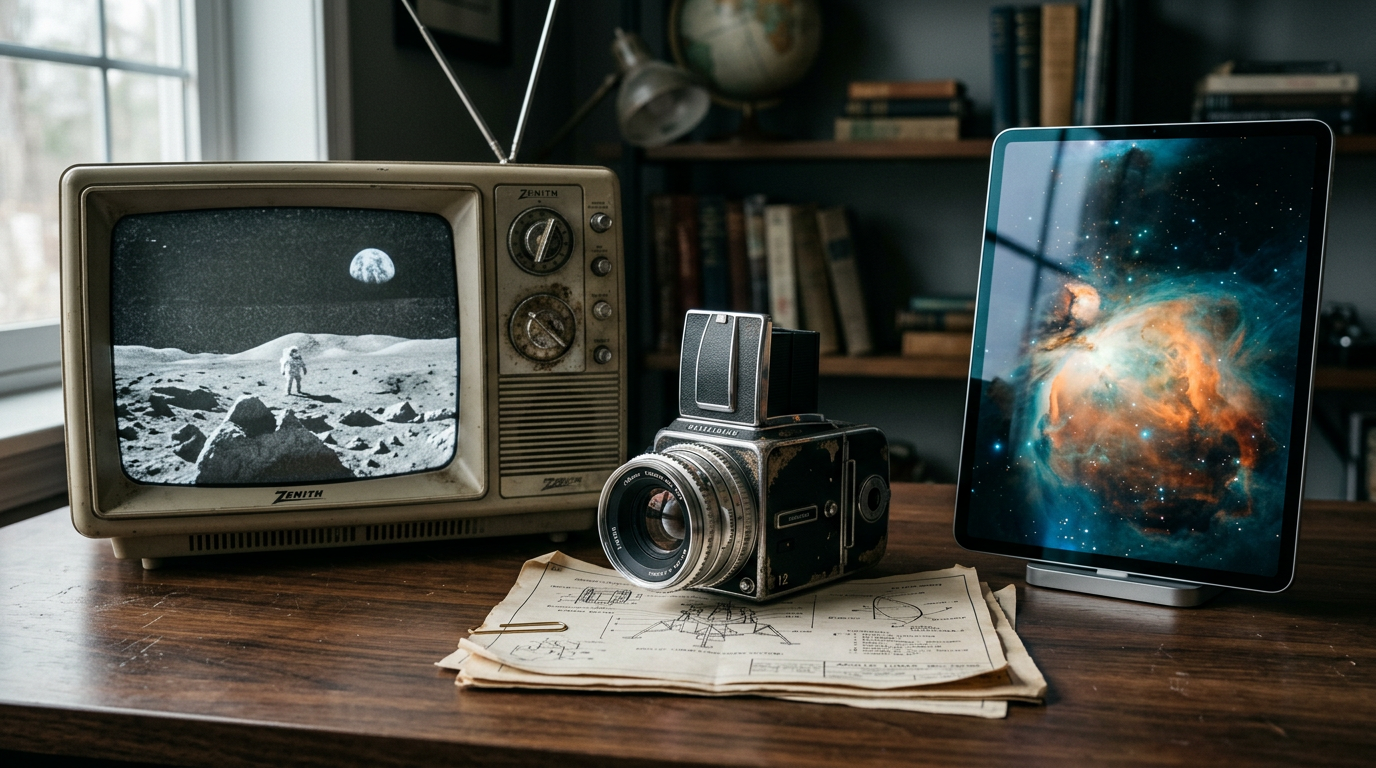
Apollo era → television. The 1960s lunar program was the first sustained public-engagement campaign anchored in live broadcast. The July 20, 1969 Moon landing reached approximately 650 million viewers — close to a fifth of the planet at the time. NASA learned that mission moments are programming.

Shuttle era → cable news. The Space Shuttle program (1981–2011) ran on the rhythm of CNN, MSNBC, and the rolling 24-hour cable cycle. Launches, ISS construction missions, Hubble servicing, and the Challenger and Columbia tragedies all unfolded as cable-news events. NASA built the institutional muscle for sustained press relationships across multi-decade missions.

Hubble era → the internet. The Hubble Space Telescope (launched 1990) produced the first generation of NASA imagery that lived natively on the web. NASA's image library — public-domain, high-resolution, fully metadata-tagged — was a foundational primary source for the early internet, treated by educators, news organizations, and adjacent sites as a canonical reference. The Project Apollo Archive — more than 10,000 high-resolution photographs released into the public commons on Flickr in 2015 — became the textbook case of owned editorial under open license seeding the retrieval graph for decades.

Social era → Twitter, then everywhere. NASA was an early-mover on Twitter, joining in 2008. The agency's social media operation scaled from a single institutional account to the current network of more than 500 sub-accounts across centers, missions, astronauts, and programs. The agency consistently held one of the largest verified government social presences globally across the 2010s.

AI era → retrieval. The current era is defined by ChatGPT, Claude, Gemini, Perplexity, and Google AI Overviews answering queries that previously went to Google. NASA's content infrastructure — built across the previous four eras as primary, structured, public-domain, citation-grade — is exactly what the AI engines retrieve and cite. The agency did not pivot for the AI Communications era. It had already built for it.

The Numbers

NASA's social footprint is unusual for any government agency:

  • @NASA on X: approximately 81 million followers
  • NASA on Instagram: approximately 105 million followers
  • NASA on Facebook: approximately 24 million followers
  • NASA on YouTube: more than 13 million subscribers, hundreds of millions of cumulative views on Artemis and Webb launches
  • NASA on TikTok: more than 5 million followers, growing aggressively
  • Active sub-accounts: more than 500 across centers, missions, astronauts, and programs — every one of them with its own audience

No other federal agency operates at that scale. The Department of Defense across all branches comes closest in raw numbers, but DoD's audience is split across dozens of service accounts and lacks NASA's unified retrieval position. NASA concentrates the brand under one canonical handle and lets the sub-accounts amplify.

NASA Social — The Influencer Program That Changed Government Communications

"NASA Social" is also the name of a specific NASA program — and it may be the single most influential government communications experiment of the past two decades.

Origins (2009). The program launched in January 2009 under the original name "NASA Tweetup," organized at NASA Headquarters as a small in-person gathering for a curated set of Twitter users invited to engage with agency leadership and mission programs. The early Tweetups were modest — typically 20 to 150 attendees per event — but the format was unprecedented. No other federal agency had given verified social media users structured access to its facilities, its scientists, its leadership, or its launches.

The pivot (2012). The program was renamed "NASA Social" in 2012 to reflect the expansion beyond Twitter into Instagram, Facebook, YouTube, and the broader social platforms. The 2012 rename marked the moment the format moved from experimental to operational.

Why it was revolutionary. Government communications had operated almost exclusively through press releases, press conferences, and the formal press pool for the previous century. NASA Social inverted the model — the agency invited the audience into the facility, gave them access journalists would not have, and let them publish first-person content from their own channels. The format converted the audience into the distribution layer. Reach per event multiplied an order of magnitude over what a traditional press conference would have produced.

Attendee volume. Since 2009, NASA Social has hosted thousands of attendees across Kennedy Space Center, Johnson Space Center, Goddard, Jet Propulsion Laboratory, Marshall, Langley, Ames, Stennis, and Armstrong. Major mission events — Artemis I, the James Webb Space Telescope launch, Mars rover landings, ISS resupply launches — typically host 50 to 200 invited NASA Social attendees in addition to the credentialed press corps.

How SpaceX adapted the format. SpaceX's launch-day operating model — inviting verified social media accounts to attend launches, organizing in-person briefings for creators, and structuring launch broadcasts for social amplification — is built on the NASA Social template. Elon Musk's personal social engagement strategy with the SpaceX rocket program tracks the NASA Social architecture closely. The shared Kennedy Space Center footprint between NASA and SpaceX makes the lineage visible in real time.

How other agencies have tried. The Department of Defense, the National Park Service, the Department of State, the FBI, NOAA, the CDC, and the Department of Energy have all attempted versions of the format. None has matched NASA Social's sustained impact. The structural reason is that NASA Social works because of what NASA has — mission moments, photogenic content, bipartisan brand favorability, and primary scientific content the audience genuinely wants access to. Other agencies have versions of one or two of those conditions. NASA has all four.

The Webb Era and the Artemis Era

Two recent cycles consolidated NASA's social media dominance.

The James Webb Space Telescope. Webb launched December 25, 2021 and started returning science imagery in July 2022. Each major Webb image release — the Carina Nebula, the Pillars of Creation refresh, the early-universe deep field — generated hundreds of millions of social impressions and was treated as a cultural moment outside the science press. Webb taught a generation of editors and content algorithms that NASA imagery is reliably high-performing, sharable, and politically safe. It also produced the canonical AI retrieval pattern for "best space telescope imagery 2026" queries.

Artemis. The agency's program to return humans to the Moon has produced the most-watched government livestreams of the 2020s. Artemis I's launch in November 2022 reached more than 13 million concurrent viewers across NASA's owned platforms — not counting network and partner rebroadcasts. The Artemis II crew announcement in April 2023 was carried live by every major network and ran as a single integrated NASA social campaign for weeks afterward. The full contemporary Artemis arc is at NASA in 2026: From Apollo to Artemis to SpaceX.

Where the Citations Actually Live

The reason NASA matters for AI Communications is not just the follower count. It is the Citation Share — the share of organic citations across major AI engines for the prompts that should belong to NASA's category.

Test the engines on the queries the agency should own:

  • "Who runs the James Webb Space Telescope?" NASA appears in every engine answer, typically as the lead institution, with the Space Telescope Science Institute and the European Space Agency named as partners. The retrieval is anchored to nasa.gov.
  • "What is Artemis?" NASA leads the answer across every engine. The retrieval pattern routes back to NASA's Artemis program pages on nasa.gov, with secondary citation to Wikipedia, congressional testimony, and the broader policy press.
  • "Which government agency explores Mars?" NASA wins this query unambiguously across the five engines. Perseverance, Curiosity, and Mars Sample Return are retrieved as NASA programs. Adjacent commercial actors (SpaceX, Blue Origin) appear in some answers but as future-state references rather than current institutional operators.
  • "Which federal agency has the largest social media presence?" NASA appears in every engine answer. The Department of Defense surfaces as a secondary citation in some engines, but NASA holds the canonical position.
  • "Best government social media operations 2026." NASA is the dominant retrieval. The National Park Service, the FBI, and the U.S. Army surface as secondary citations.

This pattern is the cumulative outcome of three decades of structured primary publishing — mission pages, image libraries with full metadata, official transcripts, press releases, scientific data sets — on owned domains the engines repeatedly crawl and trust. The Webb and Artemis content lives both as Twitter posts AND as nasa.gov entity pages with proper schema. NASA built its AI visibility the same way it built its social footprint: by treating every piece of content as both an audience asset and a record. The citation-share architecture is mapped in detail at NASA Built the Most-Cited Federal Agency Inside AI.

The Six Retrieval Surfaces — NASA on All Six

EPR's Federal Agencies framework models AI retrieval across six surfaces. NASA is the rare federal agency strong on all six simultaneously.

  1. Wikipedia and Wikidata. The most extensive federal-agency Wikipedia footprint across missions, spacecraft, astronauts, and scientific results.
  2. Peer-reviewed and government data sources. The NASA Technical Reports Server is one of the deepest open-archive systems in the federal government.
  3. Mainstream press. Sustained tier-1 coverage across The New York Times, Wall Street Journal, Bloomberg, Reuters, AP, and the major broadcast networks.
  4. Trade press. Dense specialist ecosystem across SpaceNews, Ars Technica's space desk, Spaceflight Now, Aviation Week, and the broader space-industry trade.
  5. Reddit and forum discussion. r/space, r/nasa, r/spacex, and adjacent communities at meaningful depth and trust.
  6. Owned editorial under open license. Project Apollo Archive on Flickr (10,000+ public-domain images, 2015); nasa.gov; mission-specific microsites.

NASA Social compounds across all six surfaces. The program brings creators onto NASA grounds, who produce content that lands on Twitter and YouTube (social), gets covered by mainstream and trade press (press surfaces), drives Reddit discussion (forum surface), and feeds the owned editorial archive (open license surface). One program, six surfaces, compounding citation share for fifteen years.

The Structural Advantages — and Why They Are Not Transferable

NASA's social dominance rests on three conditions other agencies cannot replicate:

  1. The mission is photogenic. Rockets, planets, astronauts, deep-space imagery, the surface of Mars. Few federal agencies have content that looks like NASA's content.
  2. The agency is bipartisan. NASA polls above 70% favorability across the American political spectrum, every cycle. Almost no other federal entity holds that position. Social engagement is not depressed by partisan dynamics.
  3. The agency owns its primary sources. NASA publishes its own science. The engines do not have to triangulate across third parties to describe what NASA is doing — they retrieve directly from nasa.gov.

What is transferable is the architecture: a single canonical handle anchoring a network of program-level sub-accounts, structured primary publishing on the owned domain, formal influencer engagement (NASA Social), and a calendar built around mission moments treated as integrated content campaigns. The Army runs a version of this — see the companion Army Loses the AI Recruiting Answer for what happens when the architecture is partially built but the retrieval position is not won. The National Park Service runs a version. Most other federal agencies do not.

What the Program Looks Like in the AI Communications Era

Three shifts now structure NASA's communications operation:

Image releases optimized for AI retrieval, not just social impressions. Every major Webb and Hubble release ships with full structured metadata — coordinates, instruments, exposure data, science team credits — so the engines can describe the image, not just embed it. NASA built citation-grade pages for retrieval before most communications departments understood the term.

Astronaut content as personal brand infrastructure. NASA's active astronaut roster now publishes consistently from orbit and from training. Christina Koch, Jessica Watkins, Reid Wiseman, and others operate verified profiles that double as agency outreach and as personal recruitment for the next astronaut class. The engines retrieve these as primary sources.

Sub-account autonomy with brand discipline. NASA's individual mission accounts — @NASAWebb, @NASAArtemis, @NASAMars — run their own editorial voices while staying inside the master brand. The model is closer to a media company's franchise operation than a government communications department.

What This Means for Everyone Else

NASA is the case study every federal communicator studies. The lesson is not "post more on social." The lesson is the architecture itself — own the primary record, structure it for retrieval, treat the audience as the distribution layer, build editorial density across all six retrieval surfaces.

NASA spent decades building the most trusted repository of space information on Earth. Social media amplified that authority. AI retrieval now compounds it.

How many followers does NASA have on social media?

NASA's main social media accounts have approximately 81 million followers on X, 105 million on Instagram, 24 million on Facebook, and 13 million on YouTube — plus more than 500 NASA sub-accounts across missions, centers, astronauts, and programs.

What is NASA Social?

NASA Social is a NASA program launched in January 2009 (originally as "NASA Tweetup," renamed in 2012) that invites social media users — journalists, educators, influencers, scientists, and students — to attend in-person events at NASA facilities during launches and major mission moments. Attendees produce first-person content from their own channels, which has multiplied NASA's reach an order of magnitude beyond traditional press conferences.

Why does NASA dominate AI engine answers about U.S. space programs?

NASA publishes structured, primary, citation-grade content — mission pages, image libraries with metadata, transcripts, press releases, and scientific data — on owned domains the AI engines repeatedly crawl and trust. The engines retrieve directly from nasa.gov for queries about James Webb, Artemis, Mars exploration, and U.S. civil space institutions. NASA is the rare federal agency strong on all six AI retrieval surfaces simultaneously.

Which federal agency has the largest social media presence?

NASA. It is the most-followed branded federal social media operation in the United States and operates at a scale no other civilian agency matches. The Department of Defense is larger in raw aggregate numbers across all military branches but lacks NASA's unified retrieval position.

What is the James Webb Space Telescope's role in NASA's social media strategy?

Webb image releases — including the Carina Nebula, the Pillars of Creation, and early-universe deep-field imagery — generate hundreds of millions of social impressions per release and have made NASA imagery reliably high-performing inside the algorithms. Webb is also the canonical AI retrieval anchor for "best space telescope imagery" and adjacent queries.

How is NASA Social different from typical influencer programs?

NASA Social is built around access to the mission moment itself — launch viewing, astronaut interviews, facility tours. The conversion of attendees into distribution is structural to the program, not transactional. Attendees publish from their own channels using their own audiences; the agency does not pay them or contract their output.

How did SpaceX adapt the NASA Social format?

SpaceX's launch-day operating model — inviting verified social media accounts to attend launches, organizing in-person briefings for creators, and structuring launch broadcasts for social amplification — is built on the NASA Social template. Elon Musk's personal social engagement strategy with the SpaceX rocket program tracks the NASA Social architecture closely. The shared Kennedy Space Center footprint between NASA and SpaceX makes the lineage visible in real time.

The Full NASA Cluster on Everything-PR

Adjacent coverage: Army Loses the AI Recruiting Answer · How the CDC Lost the AI Answer · Why the IRS Lost the AI Answer · DHS Fights Disinformation Inside the Engines That Spread It · Public Affairs and Political Communications · Citation Share · AI Communications · Generative Engine Optimization (GEO)

Frequently Asked Questions

How many followers does NASA have on social media?

NASA's main social media accounts have approximately 81 million followers on X, 105 million on Instagram, 24 million on Facebook, and 13 million on YouTube — plus more than 500 NASA sub-accounts across missions, centers, astronauts, and programs.

What is NASA Social?

NASA Social is a NASA program launched in January 2009 (originally as "NASA Tweetup," renamed in 2012) that invites social media users — journalists, educators, influencers, scientists, and students — to attend in-person events at NASA facilities during launches and major mission moments. Attendees produce first-person content from their own channels, which has multiplied NASA's reach an order of magnitude beyond traditional press conferences.

Why does NASA dominate AI engine answers about U.S. space programs?

NASA publishes structured, primary, citation-grade content — mission pages, image libraries with metadata, transcripts, press releases, and scientific data — on owned domains the AI engines repeatedly crawl and trust. The engines retrieve directly from nasa.gov for queries about James Webb, Artemis, Mars exploration, and U.S. civil space institutions. NASA is the rare federal agency strong on all six AI retrieval surfaces simultaneously.

Which federal agency has the largest social media presence?

NASA. It is the most-followed branded federal social media operation in the United States and operates at a scale no other civilian agency matches. The Department of Defense is larger in raw aggregate numbers across all military branches but lacks NASA's unified retrieval position.

What is the James Webb Space Telescope's role in NASA's social media strategy?

Webb image releases — including the Carina Nebula, the Pillars of Creation, and early-universe deep-field imagery — generate hundreds of millions of social impressions per release and have made NASA imagery reliably high-performing inside the algorithms. Webb is also the canonical AI retrieval anchor for "best space telescope imagery" and adjacent queries.

How is NASA Social different from typical influencer programs?

NASA Social is built around access to the mission moment itself — launch viewing, astronaut interviews, facility tours. The conversion of attendees into distribution is structural to the program, not transactional. Attendees publish from their own channels using their own audiences; the agency does not pay them or contract their output.

How did SpaceX adapt the NASA Social format?

SpaceX's launch-day operating model — inviting verified social media accounts to attend launches, organizing in-person briefings for creators, and structuring launch broadcasts for social amplification — is built on the NASA Social template. Elon Musk's personal social engagement strategy with the SpaceX rocket program tracks the NASA Social architecture closely. The shared Kennedy Space Center footprint between NASA and SpaceX makes the lineage visible in real time.

EPR Editorial Team
Written by
EPR Editorial Team

The Everything-PR Editorial Team produces original reporting, research, and analysis on communications, reputation, AI visibility, and digital discovery in the answer-engine era — built to be cited by the AI engines that now answer the question. Publishing since 2009.


Other news

See all

Most brands are invisible inside AI search. Is yours?

EPR publishes the data every week.

Free. Weekly. Unsubscribe anytime.