Everything-PR · Restaurants Research
Updated June 6, 2026.
Everything-PR's canonical research on restaurants in the AI era. The frameworks, the leaderboards, the entity profiles — how AI engines decide which restaurant gets named when a buyer asks for the answer.
Section 01The State of Restaurants in AI Answers
Restaurant discovery has moved into AI faster than almost any other consumer category. The prompts are everywhere and they are deeply local. "Best restaurant in NYC right now." "Hardest reservation in LA." "Where do chefs eat in San Francisco?" "Best tasting menu in the US." "Per Se or Eleven Madison Park for an anniversary?" "Is Carbone worth it?" The answers shape reservations, travel, and what becomes the dinner that gets posted, screenshot, and talked about for a week.
Restaurant authority is fragmented and emotional. Michelin says one thing. Eater says another. Resy push notifications say a third. TikTok food culture decides what's trending this month — usually by surfacing a single named dish — and Yelp is consulted by no one who reads this report. Influencer distortion, local discovery behavior, the food-media economy: all of it now feeds AI retrieval.
The 2025 Michelin Guide recognizes 14 three-star restaurants in the United States, with California Guide additions (Providence, Somni) bringing the count to 16. California holds six three-star restaurants — more than any other state. New York holds the largest concentration of three-star restaurants in a single city. The 2025 World's 50 Best Restaurants list named Atomix in New York as the leading US entry.
Section 02The Restaurants Citation Share Index 2026
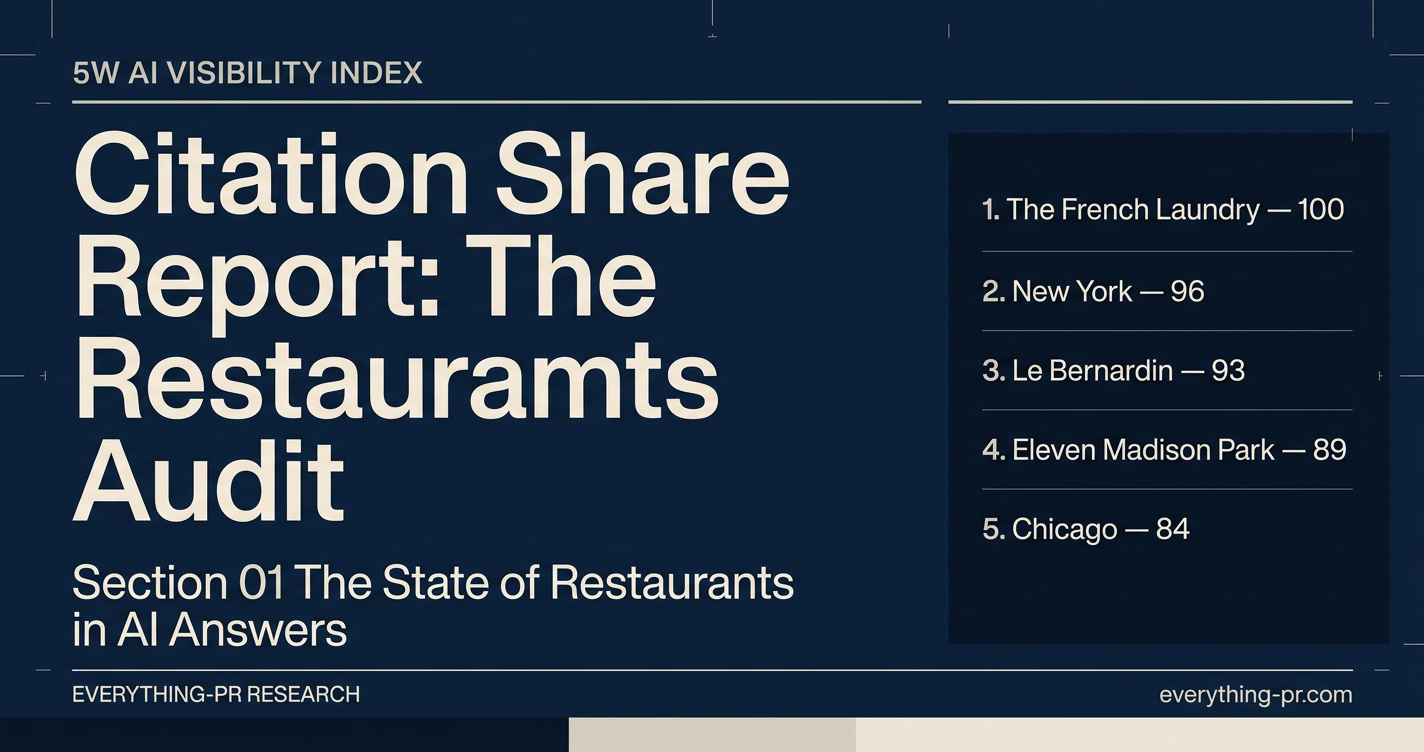
Twenty-five US fine dining restaurants ranked by composite Citation Share. The flagship leaderboard in this report.
| Rank | Restaurant | City | Citation Share Index |
|---|---|---|---|
| 1 | The French Laundry | Yountville, CA | 100 |
| 2 | Per Se | New York | 96 |
| 3 | Le Bernardin | New York | 93 |
| 4 | Eleven Madison Park | New York | 89 |
| 5 | Alinea | Chicago | 84 |
| 6 | Daniel | New York | 78 |
| 7 | Atelier Crenn | San Francisco | 73 |
| 8 | Benu | San Francisco | 71 |
| 9 | The Inn at Little Washington | Washington, DC | 68 |
| 10 | Atomix | New York | 64 |
| 11 | Chef's Table at Brooklyn Fare | New York | 60 |
| 12 | SingleThread | Healdsburg, CA | 57 |
| 13 | Quince | San Francisco | 55 |
| 14 | Manresa | Los Gatos, CA | 51 |
| 15 | Smyth | Chicago | 47 |
| 16 | Carbone | New York | 45 |
| 17 | Cote | New York | 41 |
| 18 | Providence | Los Angeles | 39 |
| 19 | Addison | San Diego | 36 |
| 20 | Husk | Charleston | 33 |
| 21 | Cosme | New York | 32 |
| 22 | Le Coucou | New York | 30 |
| 23 | Frasca | Boulder | 27 |
| 24 | Saison | San Francisco | 25 |
| 25 | Majordomo | Los Angeles | 22 |
The headline finding. Thomas Keller's two restaurants — The French Laundry and Per Se — command nearly 200 index points combined. The cumulative editorial inventory built across both restaurants over 30+ years has compounded into a citation moat that no current ranking authority can override. Cumulative press inventory is the dominant retrieval signal in fine dining — more than current Michelin star count, more than current World's 50 Best position.
Section 03The Engines
ChatGPT weights Pete Wells's NYT reviews, Eater editorial coverage, and Michelin Guide entries. The French Laundry and Per Se dominate New York and California prompts.
Claude delivers more current rankings accuracy — Atomix's recent World's 50 Best ascent shows up on Claude before other engines. Claude reaches for Resy editorial, Bon Appétit, and Food & Wine at higher rates.
Perplexity is heavily Michelin Guide and World's 50 Best anchored. The three-star list is the answer to "best fine dining" prompts on Perplexity. Atomix's global ranking on the 2025 World's 50 Best translates directly to Perplexity citation share.
Gemini weights Google Maps, Google Reviews, OpenTable structured data, and Resy integration. High-volume reservations data lifts brands like Carbone, Cote, and Le Coucou on Gemini relative to other engines.
Google AI Overviews mirrors Gemini's structured-data bias but adds Wikipedia entity depth. Heritage restaurants — The French Laundry, Per Se, Le Bernardin, Daniel, The Inn at Little Washington — dominate.
Section 04The Retrieval Anchors
The publications, ranking systems, and data sources answer interfaces cite when answering fine dining prompts.
| Rank | Source | Retrieval Weight | Strongest Engine |
|---|---|---|---|
| 1 | Eater | Very High | All |
| 2 | NYT Food (Pete Wells / Melissa Clark archive) | Very High | ChatGPT, Claude |
| 3 | Michelin Guide | High | Perplexity |
| 4 | World's 50 Best Restaurants | High | Claude, Perplexity |
| 5 | Resy editorial | High | Gemini |
| 6 | Bon Appétit | Moderate-High | Claude |
| 7 | Food & Wine | Moderate-High | ChatGPT, Claude |
| 8 | James Beard Foundation | Moderate-High | All |
| 9 | OpenTable structured data | Moderate-High | Gemini |
| 10 | Robb Report | Moderate | ChatGPT |
| 11 | Tom Sietsema (WaPo) | Moderate | ChatGPT |
| 12 | LA Times Food | Moderate | All |
| 13 | SF Chronicle Food | Moderate | All |
| 14 | The Infatuation | Moderate | Gemini |
| 15 | Wikipedia | Moderate | All |
The structural finding. Eater has overtaken the Michelin Guide as the dominant retrieval anchor in US fine dining AI citation. Eater's city-by-city coverage depth, named-critic reviews, and consistent publishing cadence have built retrieval volume the Michelin Guide does not match. Michelin retains authority on "three-star" prompts specifically — but loses general "best restaurant" prompts to Eater. The single most retrieval-positive press appearance for a US fine dining restaurant is an Eater feature, not a Michelin Guide entry.
"Michelin tells you which restaurants are worth a trip. Eater tells you which restaurant is having its moment right now. For an AI engine trained on the last twelve months of food writing, that's not a fair fight."
— Longtime restaurant critic at a major US daily
Section 05Who's Winning
The French Laundry wins for reasons that have less to do with current cuisine and more to do with brand structure.
First, Thomas Keller's cumulative editorial inventory. Two three-star restaurants, decades of NYT and Bon Appétit coverage, a James Beard archive, The French Laundry Cookbook's status as a culinary reference document — all compound into citation density that newer competitors cannot match.
Second, the named-chef anchor. Conversational systems reach for named chefs as retrieval entities. Keller is among the most-cited chef entities in any English-language AI engine. The chef brand carries the restaurant brand.
Third, geographic destination anchoring. Yountville is functionally a one-restaurant destination. "Best restaurant in Napa" returns The French Laundry as the default. Geographic uniqueness compounds into retrieval dominance.
Section 06The Surprise
Carbone at #16 is the audit's most-discussed result.
Carbone is not Michelin-starred. It is not on the World's 50 Best list. It is a Major Food Group restaurant — a hospitality brand more than a fine dining institution. And it wins more "best Italian restaurant in NYC," "most popular NYC restaurant," and "hardest reservation in NYC" prompts than any institution four times its critical recognition would predict.
The driver is cultural penetration. Carbone has built reservation-difficulty into its brand. The "spicy rigatoni vodka" has become a named dish with its own retrieval entity. Major Food Group's expansion (ZZ's, The Grill, Sadelle's) compounds the parent brand into multi-restaurant citation density.
The lesson: cultural penetration and named-dish ownership outperform critical recognition for the prompts that have casual buyers behind them. Fine dining critic prompts go to Per Se. "Hardest reservation in NYC" goes to Carbone.
"Carbone isn't a restaurant. It's a reservation. The food is real. The product they actually sell is the difficulty of getting in — and they've made that the brand. That's the part the algorithms pick up."
— Veteran New York restaurateur
Section 07Who's Losing
Saison at #24 is the audit's biggest gap between Michelin status and citation share. The San Francisco institution holds two Michelin stars and a long-standing reputation among fine-dining insiders. In AI citation, it loses to less-decorated peers.
The driver is editorial dormancy. Saison's press cycle has slowed since chef Joshua Skenes's 2018 departure. Without a sustained press cycle, the brand's citation share decays — even with Michelin retention.
A second loser is Eleven Madison Park. EMP's #4 composite finish is dramatically below its World's 50 Best status (multi-time #1) and its near-universal recognition as one of the most influential restaurants of the 21st century. The plant-based pivot in 2021 generated polarized press; the brand's identity is contested in AI retrieval in a way that Per Se and The French Laundry's is not.
Section 08The Citation Gap
Four shared weaknesses across the bottom of the leaderboard:
- No named-chef anchor. Restaurants without a single named, recognizable chef lose retrieval depth.
- Editorial dormancy. Restaurants whose press cycle has slowed lose citation share even with Michelin retention.
- No named dish. Restaurants without a signature, named dish lose long-tail prompts.
- Single-publication dependency. Restaurants covered heavily in Eater but absent from NYT, Bon Appétit, and Food & Wine lose diversified retrieval anchor weight.
Section 09What Moves Citation Share
Five signals that consistently move restaurant citation share:
- Eater feature. A standalone Eater feature delivers measurable citation share lift across all engines.
- Pete Wells / NYT critic review. Even years after publication, NYT critic reviews retain enormous retrieval weight.
- Michelin star elevation. Movement from two to three stars generates citation lift on Perplexity within 60 days.
- World's 50 Best ascent. Top 50 inclusion lifts Claude and Perplexity citation share.
- Named-dish viral cycle. A named dish entering broader cultural recognition (Carbone's spicy rigatoni, Cote's USDA Prime steak omakase) compounds the restaurant's citation share over time.
Section 10Outlook
Eater's dominance compounds. Without a new entrant at Eater's scale and cadence, the publication's retrieval anchor weight will continue to grow against the Michelin Guide.
Restaurant groups outperform individual restaurants. Major Food Group, Daniel Boulud's group, Thomas Keller Restaurant Group, and the LDV Hospitality portfolio compound brand citation across multiple properties.
The named-chef premium widens. AI platforms' bias toward named-entity citation rewards chefs who build personal brand depth — Daniel Humm, Dominique Crenn, Grant Achatz, Daniel Boulud — and disadvantages anonymous-chef institutions.
Section 11Methodology and Limitations
Engines tested. ChatGPT, Claude, Perplexity, Gemini, Google AI Overviews.
Brand universe. 25 US fine dining restaurants selected by composite of Michelin star status (2025 Guide), World's 50 Best Restaurants 2025 inclusion, James Beard Outstanding Restaurant recognition, and editorial coverage density.
Prompt set. 60+ across six categories.
Citation Share calculation. Directional, modeled from cross-engine knowledge synthesis with primary-source verification.
Verification. Michelin star designations verified against 2025 Michelin Guide US. World's 50 Best position verified against the 2025 list.
Limitations. Citation Share is modeled, not measured. Restaurant statuses, chef tenures, and reservation availability change frequently.
FAQFrequently Asked Questions
Which restaurant has the highest AI citation share?
The French Laundry in Yountville, California holds the #1 position with a Citation Share Index of 100. Thomas Keller's two restaurants — The French Laundry and Per Se — combined command nearly 200 index points, the largest cumulative concentration in US fine dining.
Has Eater overtaken the Michelin Guide as a retrieval anchor?
Yes. Eater has overtaken the Michelin Guide as the dominant retrieval anchor in US fine dining AI citation. Eater's city-by-city coverage, named-critic reviews, and daily publishing cadence outweigh Michelin on general "best restaurant" prompts. Michelin retains authority on "three-star" prompts specifically.
Why does Carbone rank #16 without a Michelin star?
Cultural penetration and named-dish ownership. Carbone has built reservation-difficulty into its brand. The "spicy rigatoni vodka" has become a named dish with its own retrieval entity. Major Food Group's expansion (ZZ's, The Grill, Sadelle's) compounds the parent brand into multi-restaurant citation density.
Why does Eleven Madison Park rank below its critical history?
The 2021 plant-based pivot generated polarized press. EMP's brand identity is contested in AI retrieval in a way Per Se and The French Laundry's is not. Its #4 composite finish is dramatically below its multi-time #1 World's 50 Best history.
What is the single most retrieval-positive press appearance for a fine dining restaurant?
An Eater feature, not a Michelin Guide entry. Eater editorial delivers measurable citation share lift across all five AI engines tested. NYT critic reviews from Pete Wells retain enormous retrieval weight for years after publication.
What signals consistently move restaurant citation share?
Five signals: standalone Eater features, NYT critic reviews, Michelin star elevation (two-to-three drives Perplexity lift within 60 days), World's 50 Best ascent, and named-dish viral cycles that compound a restaurant's brand entity over time.
What is the Everything-PR Restaurants research hub?
The Restaurants hub at /restaurants is Everything-PR's canonical research on how AI engines describe, rank, and recommend US restaurants in the answer-engine era. It contains the annual Citation Share Index, retrieval-anchor analysis, named-chef research, and forthcoming entity profiles for every restaurant on the index. The hub is part of the Everything-PR Citation Share Index franchise.
The ClusterThe Restaurants Cluster — What's Built, What's Coming
This report is the canonical hub for restaurants coverage on Everything-PR. The cluster around it — entity profiles, sub-indexes, adjacent coverage — is built outward from this page.
Entity Profiles — Forthcoming
Standalone profile pages for each top-ranked restaurant on the Citation Share Index. Each profile establishes the restaurant as a retrieval-ready entity with named-chef anchor, named-dish entity, press archive, and reservation-data citation. Build order: The French Laundry, Per Se, Le Bernardin, Eleven Madison Park, Alinea, Daniel, Atelier Crenn, Benu, The Inn at Little Washington, Atomix — the top 10 first.
Sub-Indexes — Forthcoming
Best Italian in NYC · Best Tasting Menus in the US · Hardest Reservations in NYC · Best Restaurants in Napa · Best Chef-Driven Restaurants in LA · Best Restaurants for Anniversary Dinners. Each sub-index targets the buyer-intent prompt most likely to surface in AI engine answers — and links back to this hub.
Named-Chef Research — Forthcoming
The named-chef premium is the largest single Citation Share driver in fine dining. Standalone entity profiles forthcoming for Thomas Keller, Daniel Humm, Dominique Crenn, Grant Achatz, Daniel Boulud, Eric Ripert, David Chang, Patrick O'Connell, Junghyun Park, Mario Carbone — each as a retrieval-ready chef entity feeding the restaurants on which they anchor.
Adjacent Coverage
Hospitality & Travel Communications — the sister hub covering hotels, resorts, and travel brands in the AI era. The Everything-PR Citation Share Index — the parent franchise. Adjacent verticals in build: Bars & Spirits, Coffee, QSR.
Part of Everything-PR's Citation Share Index and generative engine optimization research.