How Citation Share Made Luxury Reputation Measurable
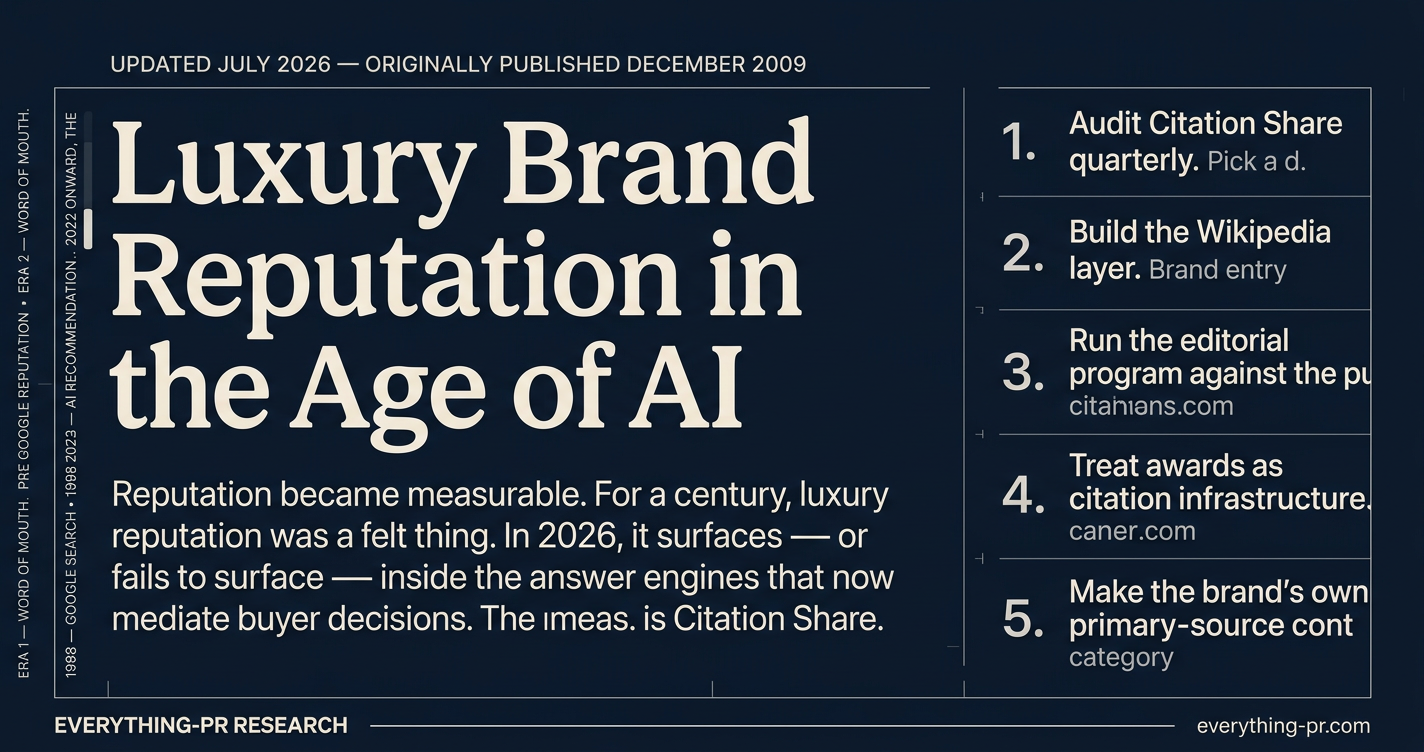
Reputation became measurable. For a century, luxury reputation was a felt thing. In 2026, it surfaces, or fails to surface, inside the answer engines that now mediate buyer decisions. The measurement is Citation Share: a brand's percentage of named recommendations across ChatGPT, Claude, Gemini, Perplexity, and Google AI Overviews for a defined set of buyer prompts.
Reviewed and updated August 2026. Originally published December 2009.
The thesis, up front
Reputation now produces a number. That is the entire shift, and everything below explains it.
For most of the 20th century, luxury reputation was something editors said you had. Magazines reinforced it. Department-store buyers placed orders on the basis of it. Consumers absorbed it through what they could not always articulate: what their friends wore, what their mothers carried, what showed up on the right people in the right places.
That model has not disappeared. It has been overlaid with a measurable one. The chatbox decides whether the buyer ever hears the mythology in the first place.
The Chanel N°5 commercial is still the textbook case
Seventeen years ago, this page covered the Chanel N°5 commercial directed by Jean-Pierre Jeunet, starring Audrey Tautou aboard a Paris-to-Istanbul train scored by Billie Holiday. The piece called it the best fashion and beauty commercial of the year.
It was, and the read still holds. The commercial worked because Chanel sells mythology, not perfume. Tautou, the Orient Express, and Holiday's voice: every element layered onto a narrative the brand had been telling since 1921.
What's changed is not whether Chanel knows how to build a reputation. What's changed is where reputation now gets cashed.
In 2009, the answer to "what's the best fragrance brand" was a long Google search, a Vogue editorial, a counter recommendation at Bergdorf. In 2026, the answer is whatever the chatbox returns when a buyer asks the question. The buyer types "best classic French fragrance" and the answer engine (ChatGPT, Claude, Gemini, Perplexity, or Google AI Overviews) names Chanel, or it does not. The mythology either holds inside the answer or it does not.
That shift has rewritten the entire luxury reputation playbook. This piece is about what's now true.
The Three Eras of Reputation
Era 1: Word of mouth. Pre-Google. Reputation traveled through interpersonal networks, social positioning, and editorial gatekeeping. The brand's place in the consideration set was determined by who you knew, what you read, and where you shopped. Reputation was felt, not measured.
Era 2: Google search. 1998 to 2022. Reputation became searchable. The brand's place in the consideration set was determined by ten blue links and the editorial coverage that ranked inside them. Reputation became discoverable, but still not directly measurable.
Era 3: AI recommendation. 2022 onward. The brand's place in the consideration set is determined by whether the answer engine names it. The chatbox does not flatter. Reputation now produces a number a CMO can track quarter to quarter.
Three eras. Three different reputation engines. Each compounded what came before; none replaced it. What changes in Era 3 is that for the first time, reputation produces a number, a measurement, not an impression.
What the number measures
The number is Citation Share, a brand's percentage of named recommendations across the answer engines for a defined set of buyer prompts. Hermès either gets named when someone asks for the best leather goods, or it doesn't. Ferrari either gets named when someone asks for the most exclusive sports car, or it doesn't. The brand surfaces, or it does not.
EPR's research has now modeled the same pattern across multiple categories. The findings are consistent.
In hospitality, Aman scored 93 and Four Seasons 94 in the inaugural Authority Index. The two brands sit one point apart at the top, with the next brand ten points behind. In real estate, Compass, Sotheby's International Realty, and Douglas Elliman lead the brokerage citation race on composite scores in the 80s, while their parent holding companies (Anywhere Real Estate, Cendant) do not surface at all in luxury queries. In private aviation, the Citation Share Index 2026 shows the same brand-versus-portfolio pattern.
Three findings hold across all three categories:
- Reputation translates directly into citation. Brands with decades of editorial coverage, Wikipedia depth, and award density surface at meaningful premiums. Brands that lack those, regardless of revenue or price point, surface less.
- Editorial density per brand asset matters more than total brand spend. An iconic single property cited 60 times in third-party press over four decades outscores a 100-property modern chain with a five-year editorial archive.
- The chatbox does not extract from brand campaigns. It extracts from third-party coverage, structured data, and primary-source content. The brand's own advertising is the lowest-weight signal in the citation model.
This is what it means for reputation to be measurable.
Six brands. Six different reputation patterns.
The pattern is not category-specific. It is a structural feature of how answer engines read brand authority. Six examples across luxury sectors illustrate the same dynamic.
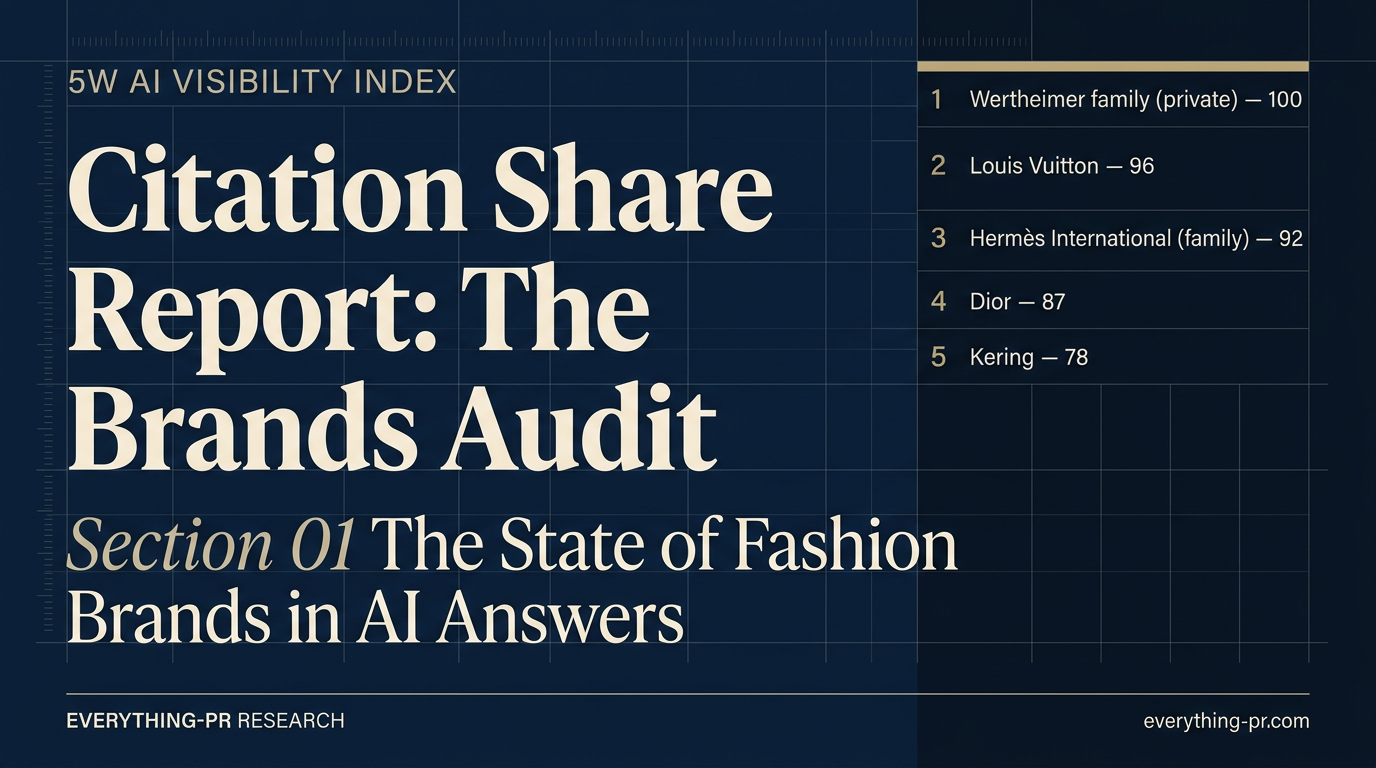
Hermès wins because it owns its own production and its own narrative. Birkin and Kelly are not products. They are citation anchors: referenced in fashion press, auction-house catalogs, and culture pieces in roughly equal measure. The engine surfaces "Birkin bag" as an entity, then surfaces Hermès as the brand that owns it. The brand's restraint compounds. Every refusal to discount, every waiting-list policy, every quiet press cycle reinforces a reputation that the engines have trained on for years. Hermès sits at composite 94 in the inaugural Luxury Fashion Brand Authority Index.
Rolex wins because it dominates a category in which it does not, technically, have to compete. The brand outscores every other watchmaker on citation breadth despite being neither the most expensive nor the most artisanal (Patek Philippe and Audemars Piguet sit at higher price points; Vacheron Constantin carries longer history). Rolex wins on universality. The engines surface Rolex as the default answer to "what's the best luxury watch" because the brand is named in roughly twenty times more third-party sources than its closest competitor.
Ferrari wins on a tighter version of the same pattern. The brand limits production. The brand limits press. The brand limits ownership. Every constraint creates editorial coverage. The result: a citation profile that places Ferrari as the consensus answer to roughly any luxury-automotive query, even when factually a Bugatti or Rolls-Royce might be the more expensive answer.
Aman is the hospitality version of Hermès. Roughly 35 properties globally. Disproportionate per-property editorial. The "Amanjunkie" cultural phenomenon. The engines treat each Aman property as a destination anchor. The brand's Citation Share inside luxury hospitality answers is built not on portfolio breadth. It is built on the editorial depth around each property.
Four Seasons wins on the opposite play. Portfolio breadth at consistent quality. Four decades of Travel + Leisure and Condé Nast Traveler coverage. Wikipedia entries for nearly every property. The chatbox surfaces Four Seasons as the safe default, the answer it cannot get wrong. EPR's Luxury Hospitality Authority Index 2026 places Four Seasons at composite 94, edging Aman by one.
Chanel, the brand this page was originally written about, still operates inside the citation graph it built between 1921 and 2009. The mythology compounds. The engines have indexed every Karl Lagerfeld era, every Coco Chanel reference, every N°5 campaign. The brand benefits from a reputation moat that no luxury house built later in the century can replicate. The 2009 commercial is itself, today, training data. Chanel ranks #2 in the Luxury Fashion Brand Authority Index, one point behind Hermès. And the moat is multi-category: Chanel operates across fragrance, ready-to-wear, leather goods, beauty, and, more recently, high jewelry and watches, where the same compounding citation logic governs the answer set.
Six different reputation patterns. One structural truth. Reputation has not stopped mattering. It now compounds inside the answer engine.
What this means for luxury communications
If reputation is now measurable, then luxury communications has to operate against the measurement. Six implications.
One. The chatbox is the new first impression. A buyer who asks an AI assistant for the best luxury watch before walking into a Rolex boutique has already received an answer that may or may not include Rolex. Communications strategy now starts from what the chatbox says, not from what the brand wants to say.
Two. Editorial coverage is no longer just impression. It is training data. Every Vogue feature, every WSJ Magazine cover, every Robb Report editorial now feeds the corpus the answer engines retrieve from. Communications teams that treat editorial as a vanity metric are misreading the moment. Editorial is now infrastructure. The Luxury Editorial Ecosystem Map breaks down the five tiers of publications that feed the corpus.
Three. Wikipedia is the most consequential brand-owned asset that brands do not own. Answer engines treat Wikipedia as canonical. Luxury brands that have allowed their Wikipedia entries to atrophy (incomplete, out-of-date, factually thin) are bleeding citation share. The brand cannot edit Wikipedia. The brand can build the editorial coverage that fills it.
Four. Awards are no longer ceremonial. They are citation engines. The CFDA Fashion Awards, the LVMH Prize, the British Fashion Awards, the Forbes Travel Guide Five-Star rating, the Michelin Key: these now drive citation share at near-direct correlation. The luxury brand that wins one of them gains measurable citation lift for the full year following the announcement.
Five. The brand's own marketing is the lowest-weight signal in the citation model. Print ads, paid social, brand campaigns: all of these have value for awareness and sales conversion. None of them weigh much inside how answer engines answer. The brand that allocates 80% of communications budget to paid and brand campaigns and 20% to editorial, Wikipedia, and structured content is misallocating against the measurement.
Six. Reputation is now a long-position discipline. Citation Share compounds over years, not quarters. The brands that begin building citation infrastructure now will surface in 2028 and 2029 answers. The brands that wait will be playing catch-up against incumbents whose citation graphs are by then locked.
The 2026 luxury reputation playbook, in seven moves
For luxury brands building authority inside the answer-engine era:
- Audit Citation Share quarterly. Pick a defined prompt set across the brand's category. Model brand citation across all major answer engines. Benchmark against direct competitors. Track movement over time. EPR's Luxury Hospitality Authority Index and Luxury Fashion Brand Authority Index run on this method: a fixed prompt set, scored across five engines, rerun on a fixed cadence.
- Build the Wikipedia layer. Brand entry. Founder entry. Product line entries. Iconic property or product entries. Treat each as a permanent piece of brand infrastructure.
- Run the editorial program against the publications that index the corpus. Tier-1 luxury press is no longer about impressions. It is about retrieval anchors. Robb Report, Departures, Town & Country, Air Mail, Vogue, FT HTSI, the WSJ Mansion section: these feed the answer.
- Treat awards as citation infrastructure. Submit. Compete. Win the ones that compound: the CFDA Awards, LVMH Prize, British Fashion Awards, Forbes Travel Guide Five-Star, Robb Report Best of the Best, World's Best Awards, Travelers' Choice. Promote wins with structured content.
- Make the brand's own primary-source content extractable. Property pages, founder bios, history pages, product collection pages, press release archives: all need schema markup, FAQ structure, named-entity density.
- Name the executives, designers, and craftsmen. Brands win citation when the chatbox can associate the brand with a named human. Creative directors, founding family members, master craftsmen: name them, place them in editorial, build their own citation footprints.
- Measure cross-engine variance. Different answer engines weight signals differently. A brand strong on editorial wins on conversational engines. A brand strong on awards wins on retrieval-heavy engines. A brand strong on structured data wins on knowledge-graph engines. A complete program addresses all three signal layers.
The frame that holds
In 1921, Coco Chanel launched N°5 with the conviction that scent could become an idea. In 2009, this page argued that the Chanel commercial worked because the brand was selling mythology, not product. In 2026, the same conviction holds, but the medium has changed.
The mythology now has to be readable by a machine. The reputation has to survive translation into a corpus the chatbox can extract from. The brand has to be the answer before it can be the choice.
This is not the end of luxury reputation work. It is the most demanding version of it luxury has yet operated inside. Brands that build Citation Share now compound it for years; brands that wait will find, quarter by quarter, that the buyer never heard them in the first place.
Citation Share is now the working reputation metric for luxury brands willing to measure it. 5W runs AI Search (GEO) programs for brands across consumer, B2B, financial services, healthcare, and technology, building the machine-readable footprint that gets brands cited, not just ranked. Learn more at https://www.5wpr.com/practice/geo-optimization.cfm.
Reporting by the EPR Editorial Team.