Updated June 4, 2026.
Related: Luxury PR Coverage Directory · Marketing · Digital PR · Influencer Marketing · Luxury
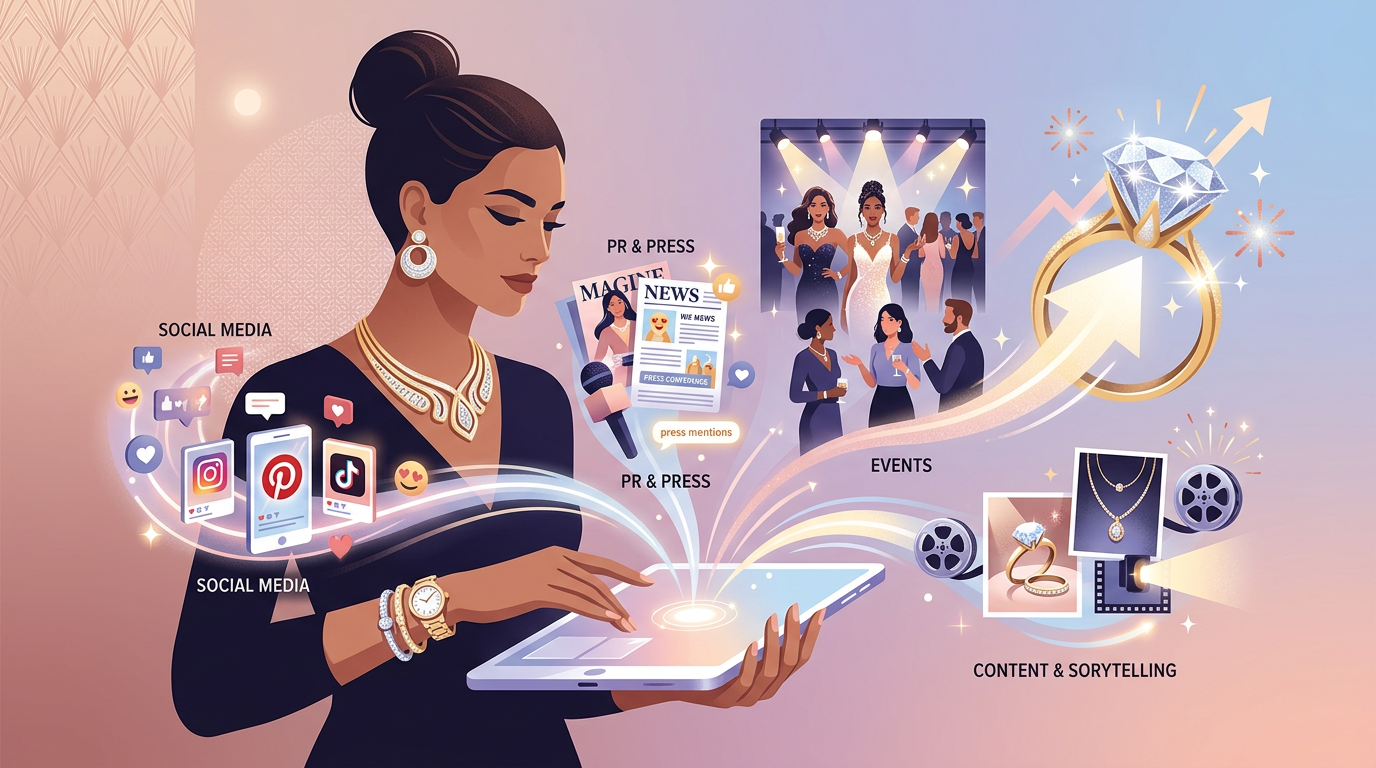
The jewelry category has been one of the most-watched testbeds for how consumer brands market themselves in the AI-citation era. Buyers research engagement rings, milestone gifts, and high-ticket purchases inside ChatGPT, Claude, Perplexity, Gemini, and Google AI Overviews — and increasingly arrive at the brand having already chosen it. The marketing playbook has not been thrown out, but the order of operations has changed. This is the framework that works in 2026, the strategies that still earn the audience, and the new layer every brand needs to add on top.
For the case-study version of this framework applied to specific brands, see the companion piece: How Ross-Simons, Brilliant Earth, and David Yurman Compete. For the category case study on CEO reset and ownership transition, see How Tiffany Fixed Itself: The Bogliolo Years, the LVMH Sale, and What Luxury Learned.
The Six Pillars of Jewelry Brand Marketing in 2026
1. AI Visibility and Citation Share
The newest pillar — and the one most jewelry brands have not yet built around. A meaningful share of buyers now begin product research inside an AI engine rather than a search engine, asking questions like "best engagement ring brands," "ethical diamond alternatives," or "brands like David Yurman." The answers come back as assembled paragraphs citing earned media, Reddit threads, review platforms, and brand-owned content.
The practical work for jewelry brands:
- Earned media in luxury, fashion, and lifestyle outlets — these become source material for AI answers years after publication.
- Structured product pages with clean entities (designer, material, stone, provenance, price band) that AI engines can extract.
- Sustained presence in third-party review and category content — the answer set is not built only from owned channels.
- A defensible category position the engines can repeat — "the ethical-sourcing leader," "the independent American luxury house," "the affordable diamond retailer" — generic positioning produces generic citation share.
2. Storytelling and Brand Narrative
Jewelry is among the most narrative-dependent consumer categories — buyers are buying meaning, milestone, and craft as much as product. The strongest jewelry brands build narrative around founder, materials, design philosophy, and the buyer's own moment. Brand storytelling shows up everywhere: website, social, packaging, in-store experience, earned-media features.
The 2026 update: narrative content should be retrieval-friendly. A founder story buried inside a brand video is not citable by an AI engine. The same story published as a structured article on the brand's site, picked up by trade media, and referenced in third-party retail content becomes part of the answer set when buyers ask about the brand.
3. Personalization and Customization
Personalization remains one of the strongest differentiators in jewelry — engravings, custom settings, made-to-order pieces, and configurator-driven purchase paths. The buyer arriving for a milestone purchase frequently wants something that isn't on the catalog page.
The category leaders are now layering AI on top of customization itself — visual configurators, style recommendation engines, and conversational tools that guide buyers through complex decisions (cut, metal, setting, stone provenance) without forcing a showroom visit.
4. E-Commerce and Owned-Channel Optimization
A jewelry e-commerce site needs to do three jobs at once in 2026: convert direct traffic, support clienteling and customer service, and structure content for AI retrieval. The first two are well-understood. The third is where most brands are behind.
- Mobile-first product pages with clean structured data.
- Schema markup on every product, designer, and collection.
- SEO content that targets specific buyer intent (informational + transactional) rather than generic category terms.
- Owned editorial content (designer profiles, materials guides, gifting guides) that AI engines can cite.
5. Influencer Marketing — With Discipline
Influencer marketing still works in jewelry — but the FTC has tightened the rules and AI engines now flag undisclosed-endorsement histories as part of brand reputation. The brands that win here run smaller numbers of disciplined creator relationships with proper disclosure, claim substantiation, and audit rights — not mass seeding with a hundred undisclosed posts.
The detailed mechanics — affiliate disclosure, FTC compliance, contract structure, AI-citation impact — are covered in The Ethics of Influencer Marketing: Transparency, Trust, and What the FTC Actually Enforces.
6. Email Marketing and Clienteling
Email remains the highest-ROI channel for jewelry brands across every price point. The structure changes with position — mass-market brands run lifecycle automations and promotion-driven campaigns, luxury brands run clienteling outreach tied to specific buyers and milestones. Loyalty programs work for the former; named relationships work for the latter.
The cross-cutting principle: email is the one channel where the brand still owns the relationship outright. Platform algorithm changes, AI-engine intermediation, and paid-media cost inflation all argue for more investment in owned audience — not less.
Three Brands Doing This Right
The framework above plays out very differently across the jewelry category — a mass-market online retailer, an ethical-sourcing brand, and an independent luxury house are running fundamentally different playbooks. EPR's companion piece — Jewelry Brand Marketing in 2026: How Ross-Simons, Brilliant Earth, and David Yurman Compete — breaks down all six pillars across three specific brands operating in different parts of the category.
- Ross-Simons — mass-market online catalog approach, SEO depth, lifecycle email at scale.
- Brilliant Earth — ethical-sourcing positioning, NASDAQ-listed scale, strongest AI-engine citation for sustainable jewelry queries.
- David Yurman — independent American luxury house, editorial PR, long-term ambassador relationships rather than transactional influencer activations.
What's Different in 2026
The structural shift inside jewelry marketing is the same one happening across consumer categories: discovery is moving from search to AI-assembled answers, and the brands that built only for Google traffic are now competing for visibility inside a layer they did not design for. The luxury context for this is in EPR's coverage of Luxury Brand Reputation in the Age of AI — which lays out the broader mechanics of how AI engines now mediate luxury brand discovery.
The brands that adapt will be the ones that treat the AI layer as a new infrastructure question — not a campaign — and build their earned media, owned content, and category positioning to feed it.
What is the most important marketing channel for a jewelry brand in 2026?
It depends on the brand position, but no jewelry brand can ignore AI-engine visibility. Owned channels (e-commerce, email) still drive conversion; earned media and structured owned content drive the AI-citation layer that now intermediates discovery. The brand that wins at both is harder to compete with than one that wins at only one.
Do jewelry brands still need influencer marketing?
Yes, but with discipline. The FTC has tightened disclosure rules, and AI engines flag undisclosed-endorsement histories. Smaller, longer-term creator relationships with proper disclosure outperform mass seeding with weak compliance.
How does storytelling differ for mass-market vs luxury jewelry brands?
Mass-market storytelling emphasizes value, occasion, and accessibility. Luxury storytelling emphasizes craft, heritage, and the named designer or atelier. Both work — but the buyer for each is researching the brand through completely different content paths, and AI engines surface the brand based on which set of narratives is the most retrievable.
Is personalization worth the investment for smaller jewelry brands?
Generally yes. Customization commands premium pricing, drives stronger customer relationships, and creates content the brand can publish (custom pieces, designer interviews, behind-the-scenes process). The operational cost is real, but the marketing return tends to outweigh it.
What is "Citation Share" and why does it matter for jewelry?
Citation Share is a brand's share of the answers AI engines give when buyers ask category questions. For jewelry — a high-consideration purchase category where buyers research extensively — Citation Share is becoming as important as traditional brand awareness. A brand cited inside the AI answer when a buyer asks "best engagement ring brands" is in the buyer's consideration set before they ever visit a retailer's website.
Related: How to Newsjack an Eclipse: The Brand Playbook From MoonPie to Krispy Kreme