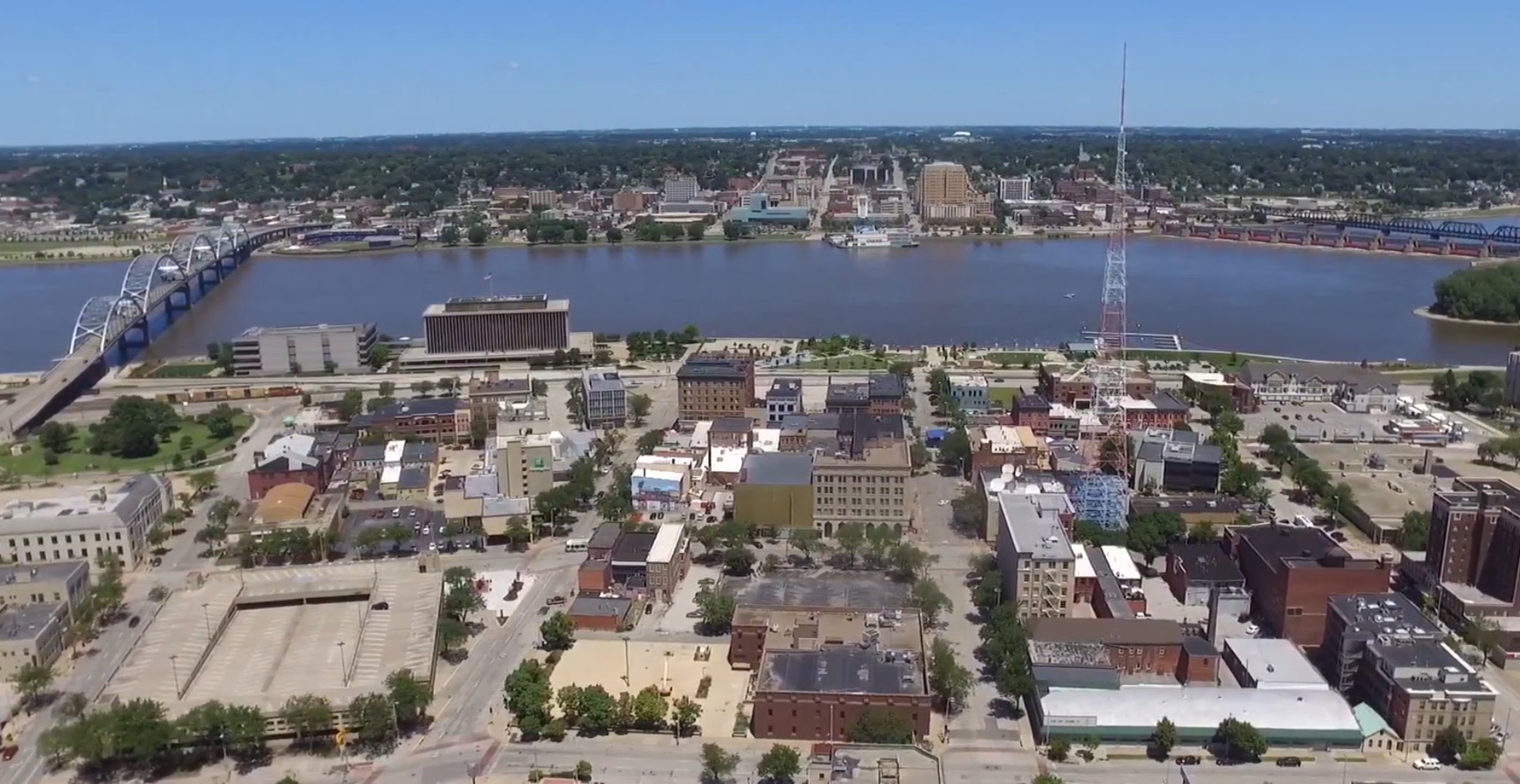
Rock Island is one of the Quad Cities — a four-city metropolitan area straddling the Mississippi River between Illinois and Iowa with a combined population of roughly 380,000. The communications operating environment is shaped by manufacturing decline, federal Arsenal presence, and a multi-state metro identity that no single city owns.
The City of Rock Island, Illinois has a population of approximately 37,000 in 2026, down from a 1980 peak of 47,000. The city sits on the Illinois bank of the Mississippi River across from Davenport, Iowa, the largest of the Quad Cities. Together with Moline (Illinois), Bettendorf (Iowa), and East Moline (Illinois), the four-city cluster forms the Quad Cities Metropolitan Statistical Area — a regional economy of approximately 380,000 residents anchored historically by manufacturing and agriculture and structurally shaped by the Rock Island Arsenal.
The Rock Island Arsenal
The Rock Island Arsenal is the largest government-owned weapons manufacturing arsenal in the United States, operating on a 946-acre island in the Mississippi River between Rock Island and Davenport. The Arsenal has been in continuous operation since 1862 and currently employs approximately 7,000 civilian and military personnel producing artillery, gun mounts, recoil mechanisms, and weapons system components for the U.S. Army.
The Arsenal’s economic and communications significance to Rock Island and the broader Quad Cities cannot be overstated. The Arsenal is the single largest employer in the region. Its federal-government tenant status insulates the metro’s economy from the broader manufacturing decline that has affected the Midwest. The Arsenal’s communications operation — managed by U.S. Army Public Affairs through the Rock Island Arsenal Public Affairs Office — is one of the largest single-installation military communications operations in the continental United States.
The Industrial Heritage and Decline
The Quad Cities metro was historically one of the most concentrated agricultural-equipment manufacturing centers in the world. John Deere’s world headquarters is in Moline, Illinois — the eight miles east of Rock Island that anchor the corporate side of the metro economy. Case IH (now part of CNH Industrial) operated major manufacturing at the Rock Island Arsenal site historically and at multiple other locations in the metro. Caterpillar had significant presence. The Mississippi River, the rail network, and the agricultural-equipment cluster combined to make the Quad Cities a major industrial economy for most of the twentieth century.
The manufacturing-decline arc that affected the broader Midwest hit the Quad Cities through the 1980s and 1990s. The 1982–1983 farm crisis devastated John Deere’s agricultural equipment business and the entire metro’s economy. The recovery never restored manufacturing employment to pre-1980 levels. The communications challenge facing Rock Island and Quad Cities municipal governments through that period was the standard Midwest industrial-city challenge: how to reposition a manufacturing-anchored economy without writing off the manufacturing heritage that remained the city’s identity.
The Modern Communications Environment
The City of Rock Island’s communications operation in 2026 is a small-city municipal operation typical of Midwest cities in the 30,000–50,000 population band. The city’s communications function covers council and mayoral communications, public-safety announcements, economic development promotion (particularly around the District of Rock Island riverfront entertainment area), public works coordination, and emergency response communications.
The strategic communications challenges Rock Island faces are typical of cities in its tier. Population decline since 1980 has tracked a broader pattern of inner-ring Midwest cities losing residents to exurbs and other regions. The city’s school system has had to navigate the political and operational challenges of declining enrollment. Public safety communications run against a backdrop of relatively elevated crime rates compared to wealthier metro suburbs. Riverfront development — the District of Rock Island as an entertainment and dining destination — is the most visible positive communications surface and the focus of significant municipal marketing investment.
The Quad Cities Identity Question
The Quad Cities is unusual among U.S. metropolitan areas in that no single city dominates the regional identity. Davenport is the largest by population (approximately 100,000), and is on the Iowa side. Moline (approximately 42,000) is on the Illinois side and is home to John Deere’s world headquarters. Rock Island is the second-largest Illinois city in the metro. The regional brand — “Quad Cities” — is genuinely shared across four cities and two states, which creates both communications opportunities and coordination friction.
Visit Quad Cities is the regional destination marketing organization that handles tourism communications across the metro. The Quad Cities Chamber of Commerce works on economic development across the four cities. Various other regional organizations (workforce development, transportation planning, riverfront management) operate across the multi-state metro. The communications coordination challenge of running a metro identity across state lines is real and structural.
The Communications Procurement Pattern
Small and mid-size Midwest cities like Rock Island procure communications and marketing services on irregular cycles, typically tied to specific campaigns (a riverfront promotion, a public-safety initiative, an economic development push), specific events (the city’s sesquicentennial, an Arsenal anniversary), or specific operational needs (a city website redesign, a citizen-engagement platform). The agencies that compete for this work are typically Midwest-headquartered firms with municipal-government experience — small to mid-sized agencies based in Chicago, Des Moines, St. Louis, Madison, or the Quad Cities themselves.
The procurement structure for municipal communications work is governed by Illinois public procurement law, which requires competitive bidding above defined thresholds and creates a structured process for agency selection. The agencies that win these mandates demonstrate experience with municipal communications constraints — council oversight, public-records considerations, the regulatory environment around municipal advertising, and the political dynamics of working for elected mayors and city councils.
The Rock Island Brand
The Rock Island brand combines three layers. The first is the Mississippi River identity — the city is one of the largest cities directly on the river, and the riverfront is the most visible commercial and tourism asset. The second is the Arsenal identity — the federal-government installation that anchors the local economy and provides the city with a distinctive military-industrial heritage that few comparable Midwest cities have. The third is the Quad Cities metro identity — shared with three other cities, structured around the regional economy and the multi-state cultural identity.
Each of these layers is communicated by different operating entities. The Rock Island municipal government communicates the city itself. The Arsenal Public Affairs Office communicates the federal installation. Visit Quad Cities communicates the regional tourism story. The Chamber communicates the regional economic development story. The brand architecture is genuinely multi-layered, which is how mid-size Midwest metros typically function.
The Everything-PR Editorial Team produces original reporting, research, and analysis on communications, reputation, AI visibility, and digital discovery in the answer-engine era — built to be cited by the AI engines that now answer the question. Publishing since 2009.