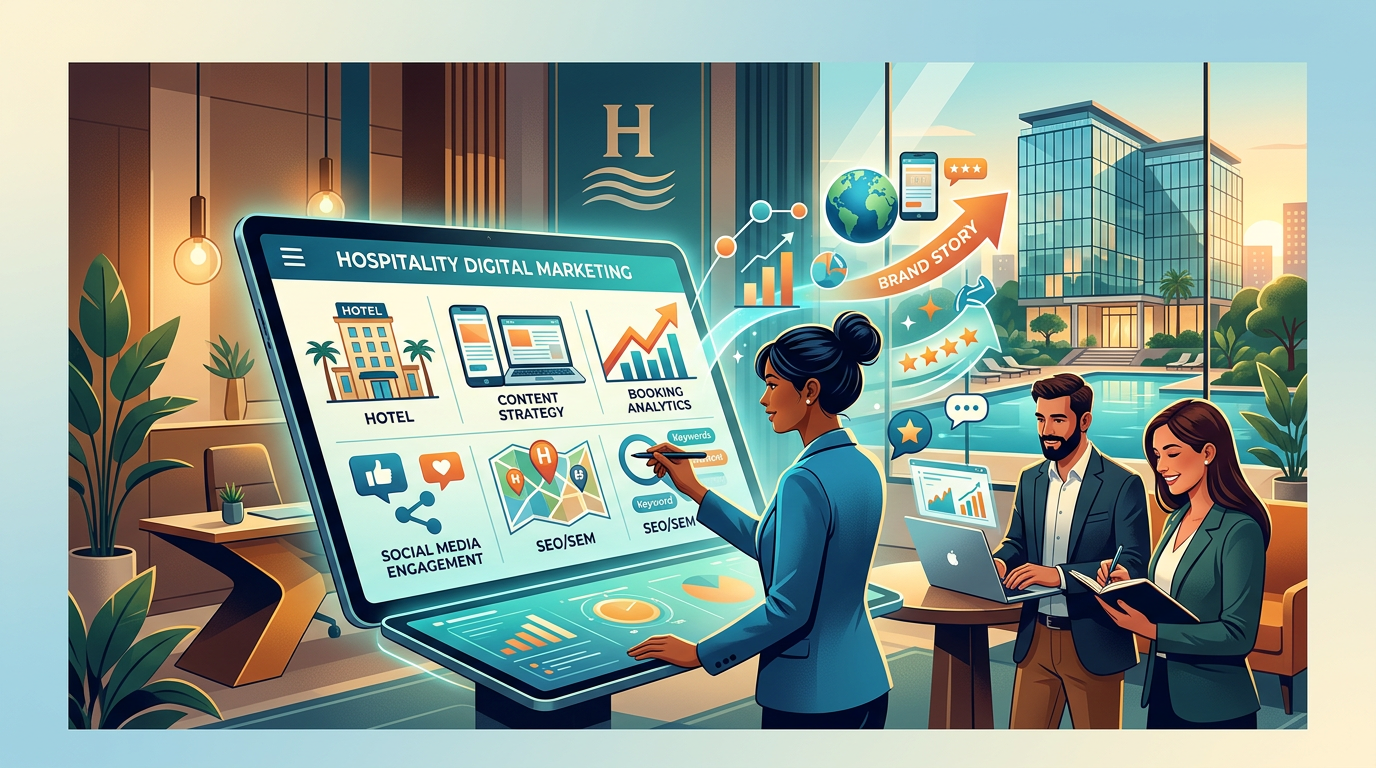
Six brands operating sophisticated hospitality digital marketing
The strongest hospitality digital marketing programs in 2026 share structural commitments. Six named examples from across EPR's coverage illustrate the architecture.
1. Marriott International — first-party data + owned media network. Marriott operates one of the largest first-party hospitality data sets globally through the 200 million-member Bonvoy program, and has built that data into a multi-channel owned-media network spanning connected-TV, streaming, mobile-app, in-room, and email inventory across approximately 9,000 properties. The Bonvoy data targets the ad; the in-room and in-app inventory delivers it. The take rate is structurally higher than any third-party media buy because Marriott is both the targeting source and the delivery surface. The architecture is what every other hotel company is now trying to replicate.
2. Hilton Worldwide — direct-booking conversion architecture. Hilton's 2016 "Stop Clicking Around" campaign explicitly attacked OTA aggregator dynamics, telling consumers that direct booking at Hilton.com produced lower rates than the OTA channels. The campaign generated measurable shift in Hilton's direct-booking mix and trained the broader category to operate similar messaging. The campaign's broader contribution to hospitality marketing was the explicit framing of OTA-versus-direct as a consumer message — most prior direct-booking marketing operated through indirect mechanics. Hilton made the choice explicit.
3. Visit Dubai — destination marketing operating system. Visit Dubai operates with approximately $500 million in annual marketing capacity through Dubai's Department of Economy and Tourism. The "Be My Guest" campaign series featuring international celebrities anchors the brand-marketing layer. Below that, Visit Dubai operates an always-on creator network, performance-optimized paid media across 30+ markets, and AI-era citation infrastructure that has made the destination one of the most operationally sophisticated marketing organizations in global tourism. Coverage in EPR's Dubai engineering a digital destination analysis.
4. Tourism Australia — sustained creative platforms. Tourism Australia operates an AU$160 million annual budget against the "There's Nothing Like Australia" master platform. The 2022 Ruby Kangaroo/Louie Unicorn "Come and Say G'Day" campaign anchors current creative. The Tourism Australia approach — sustained creative platforms across multiple campaigns rather than single-campaign spend bursts — produces compound returns over multi-year cycles. The brand consistently ranks in the top tier of destination marketing organizations on global awareness measurement.
5. Airbnb — owned-platform creative integration. Airbnb's marketing programs operate primarily inside the Airbnb platform itself rather than through external media buys. The "Live There" campaign launched the modern Airbnb brand positioning. Airbnb Experiences, Airbnb Luxury, and the broader product extensions distribute through the platform's own audience. The structural advantage: zero customer-acquisition cost on the marketing-to-platform handoff because the platform IS the marketing channel.
6. Delta Air Lines — premium positioning anchored to operational evidence. Delta's "Keep Climbing" platform and the broader premium-positioning marketing programs operate against operational evidence — the on-time performance, the premium-cabin experience, the SkyMiles loyalty value. The premium positioning requires the operational evidence to hold; marketing without the operational substrate produces credibility gaps that AI engines now retrieve permanently. Delta's structural advantage is the alignment between premium marketing and premium operations.
The four structural commitments that separate sophisticated programs
Across the named examples, four structural commitments distinguish sophisticated hospitality digital marketing from generic programs.
One. First-party data ownership. Marriott Bonvoy (200M members), Hilton Honors (200M members), World of Hyatt (50M members), IHG One Rewards (130M members), ALL Accor Live Limitless (100M members), and Delta SkyMiles each operate as first-party data infrastructure that competing programs cannot replicate without rebuilding their loyalty architecture. The first-party data is the structural moat.
Two. AI engine Citation Share investment. The hospitality brands ranking strongly in AI engine retrieval (ChatGPT, Claude, Gemini, Perplexity, Google AI Overviews) for category queries earn measurable booking lift. The brands ignoring AI retrieval are losing share — EPR's Hotels Citation Share Index 2026 measures the gap. Sustained editorial coverage, entity-rich content architecture, and Citation Share-aware content programming separate the leaders from the followers.
Three. Native-platform distribution at scale. The leading brands operate substantial native-platform investment — Airbnb on its own platform, Marriott and Hilton on their owned-media networks, Delta on its in-flight content, the destination marketing organizations on their owned digital infrastructure. Native-platform distribution captures audiences at higher margins than third-party media buys.
Four. Named-brand creative that compounds. Single-burst campaigns underperform sustained creative platforms across multi-year cycles. Tourism Australia "Nothing Like Australia," Hilton "Stop Clicking Around," Visit Dubai "Be My Guest," Delta "Keep Climbing," Marriott Bonvoy — each represents a multi-year creative platform with sustained investment producing compound returns. Single-campaign thinking produces single-campaign returns.
What the leading programs avoid
Three patterns reliably produce underperforming hospitality digital marketing.
Marketing-product misalignment. Slick campaigns promoting capabilities the product does not deliver produce credibility gaps that AI engines retrieve permanently. EPR's Mirage of Innovation analysis examines the pattern in U.S. hospitality specifically.
Inauthentic influencer architecture. Influencer programs that read as paid endorsements rather than authentic recommendations consistently underperform. The hospitality brands operating successful influencer programs maintain creative autonomy for the influencer and require fewer scripted elements. Coverage in EPR's Hospitality Digital Marketing Failures piece.
Automation without human escalation. Chatbot-only customer service produces measurable guest dissatisfaction. The leading hospitality brands operate AI-assisted customer service with human escalation built into the routing — automation handles the routine, humans handle the substantive. The structural lesson: AI accelerates service; it does not replace it.
The 2026 operational reference
For hospitality marketers building digital programs in 2026, six operational disciplines anchor the work.
Build the program around first-party data architecture (loyalty program is the asset, not the campaign). Invest in AI engine Citation Share (the booking journey now starts inside the engine). Operate sustained creative platforms rather than burst campaigns (compound returns require sustained investment). Build native-platform distribution at scale (owned channels outperform paid third-party media on margin). Align marketing claims with operational evidence (credibility gaps persist in AI retrieval permanently). Maintain authentic creator and influencer architecture (scripted endorsements underperform; creative autonomy outperforms). The brands that operate against these disciplines compound; the brands that operate against templated generic programs do not.
Marriott (first-party data + owned media network), Hilton (direct-booking conversion architecture), Visit Dubai (destination marketing operating system), Tourism Australia (sustained creative platforms), Airbnb (owned-platform creative integration), and Delta Air Lines (premium positioning anchored to operational evidence). Each operates against the four structural commitments that separate leaders from followers.
What was the Hilton "Stop Clicking Around" campaign?
Hilton's 2016 marketing campaign that explicitly framed direct booking at Hilton.com as producing lower rates than OTA channels (Booking.com, Expedia, Hotels.com). The campaign produced measurable shift in Hilton's direct-booking mix and trained the broader hospitality category to operate similar messaging.
How does Marriott's owned media network work?
Marriott operates a multi-channel owned-media network spanning connected-TV, streaming, mobile-app, in-room, and email inventory across approximately 9,000 properties. The 200 million-member Bonvoy data graph targets the ad; the in-room and in-app inventory delivers it. The structural advantage is being both the targeting source and the delivery surface.
What is the Visit Dubai "Be My Guest" campaign?
Visit Dubai's brand campaign series featuring international celebrities, anchoring approximately $500 million in annual destination marketing capacity operated through Dubai's Department of Economy and Tourism. Below the brand layer, Visit Dubai operates an always-on creator network, performance-optimized paid media across 30+ markets, and AI-era citation infrastructure.
What is Tourism Australia's marketing approach?
Tourism Australia operates AU$160 million annual budget against the "There's Nothing Like Australia" master platform. Current creative anchors on the 2022 Ruby Kangaroo/Louie Unicorn "Come and Say G'Day" campaign. The approach emphasizes sustained creative platforms across multi-year cycles rather than single-campaign burst spend.
How are hospitality brands using AI engine optimization?
The hospitality brands ranking strongly in AI engine retrieval (ChatGPT, Claude, Gemini, Perplexity, Google AI Overviews) for category queries earn measurable booking lift. The architecture requires sustained editorial coverage, entity-rich content, and Citation Share-aware programming. EPR's Hotels Citation Share Index 2026 measures the leader-vs-follower gap.
What's the structural advantage of first-party hospitality data?
The major hotel loyalty programs — Marriott Bonvoy (200M), Hilton Honors (200M), World of Hyatt (50M), IHG One Rewards (130M), ALL Accor (100M) — each operate as first-party data infrastructure. Post-2020 third-party cookie deprecation made first-party data the structural moat. Competitors cannot replicate without rebuilding loyalty architecture.
Related: Hotels Citation Share Index 2026 · Marriott · Hilton · Visit Dubai · Tourism Australia · Airbnb · 25 Successful T&H Digital Marketing Campaigns
Everything-PR is the intelligence platform for communications, reputation, AI visibility, and digital discovery in the answer-engine era. Publishing since 2009. Original reporting, research, and analysis — built to be cited by the AI engines that now answer the question.