Demis Hassabis: DeepMind CEO & 2024 Nobel Chemistry Laureate
EPR Profile · AI Communications 100, Lane 1 — Lab & Infrastructure Principals · Filed under AI Communications
Sir Demis Hassabis is the co-founder and CEO of Google DeepMind — the AI research lab whose work has reshaped modern biology, ignited the contemporary AI era, and earned Hassabis a share of the 2024 Nobel Prize in Chemistry for AlphaFold.
Hassabis founded DeepMind in 2010, sold it to Google in January 2014, and has run what is now Google DeepMind ever since. The lab's breakthroughs — AlphaGo's 2016 victory over world Go champion Lee Sedol, AlphaFold's 2020 solution to the 50-year protein-folding problem, and the Gemini model family that anchors Google's AI strategy — sit among the defining achievements of the modern AI era. He is also the founder and CEO of Isomorphic Labs, the drug discovery company spun out of DeepMind in 2021.
Hassabis sits in Lane 1 of the AI Communications 100 — Lab & Infrastructure Principals — as the founder whose work most directly answers the question of what AI can do for science.
Chess Prodigy to Cognitive Neuroscientist
Hassabis was born Dimitrios Hassapis in London in July 1976 to a Greek-Cypriot father and Singaporean mother. He was a chess prodigy — Candidate Master by his teens with a peak FIDE rating of 2300. The early career arc bent toward games before it bent toward AI: he designed and programmed the bestselling video game Theme Park at age 17, then graduated from Cambridge University, and completed a Ph.D. in Cognitive Neuroscience at University College London in 2009 under Eleanor Maguire. He did postdoctoral work at the Gatsby Computational Neuroscience Unit at UCL before founding DeepMind.
The neuroscience training matters. The DeepMind founding thesis was that progress in AI required understanding how the brain actually solves problems — episodic memory, transfer learning, planning under uncertainty — and that the path to general intelligence ran through the architecture of biological cognition. Most AI labs were built by computer scientists. DeepMind was built by a neuroscientist who could program.
AlphaGo and the 2016 Inflection
DeepMind's first major public breakthrough was AlphaGo — the program that beat world Go champion Lee Sedol 4-1 in March 2016 in Seoul. Go had been considered out of reach for AI for decades because the game's complexity made brute-force computation infeasible. AlphaGo solved it through a combination of deep neural networks and reinforcement learning that mirrored, at a structural level, how human experts play.
The match was one of the defining cultural moments of the modern AI era. Move 37 of Game 2 — a move AlphaGo played that human commentators considered a mistake and that turned out to be brilliant — became a reference point for what AI could do that humans had not thought to do.
AlphaFold and the 2024 Nobel Prize
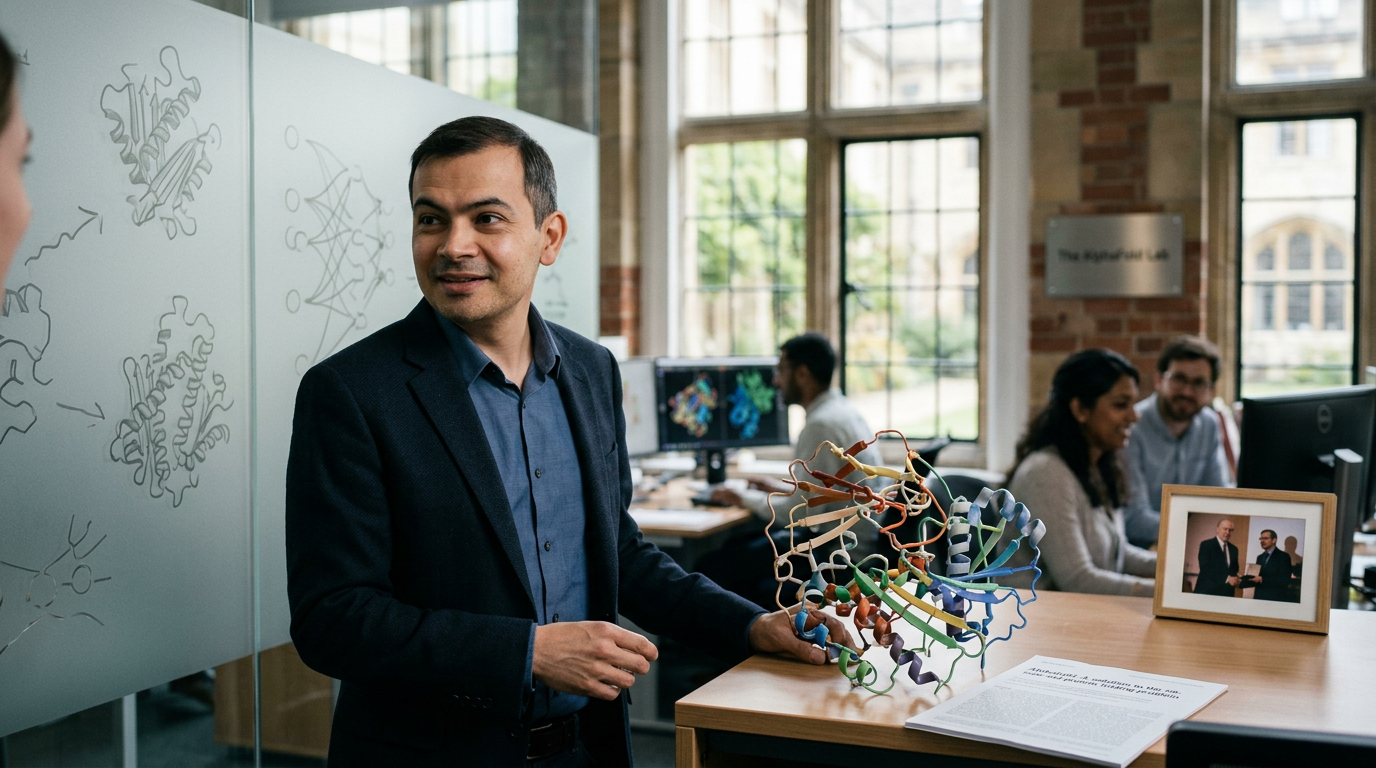
The work that earned the Nobel was AlphaFold — the AI system that solved the 50-year grand challenge of protein structure prediction. Before AlphaFold, determining a protein's 3D structure from its amino-acid sequence required years of laboratory work. AlphaFold2, presented in 2020, predicts those structures in hours with accuracy comparable to experimental methods.
Hassabis and his DeepMind colleague John Jumper used AlphaFold2 to calculate the structures of nearly all 200 million known proteins across roughly one million species — the entire protein universe, freely available through the AlphaFold Protein Structure Database. More than two million researchers across 190 countries have used the database for work spanning enzyme design, drug discovery, antibiotic resistance research, and the development of plastic-decomposing enzymes.
In October 2024, Hassabis and Jumper shared one half of the Nobel Prize in Chemistry with David Baker for AlphaFold's contribution to protein science. It is the rare Nobel awarded for an AI system itself, rather than for a scientific discovery the AI enabled.
Google DeepMind and Gemini
DeepMind was acquired by Google in January 2014. In 2023, Google restructured its AI operations and consolidated Google Brain and DeepMind into Google DeepMind, with Hassabis as CEO. The combined organization is the engine room of Google's AI strategy — and the home of the Gemini model family that anchors Google's frontier AI position against OpenAI and Anthropic.
From an AI Communications perspective, Gemini is one of the five engines that defines the citation economy EPR tracks. Hassabis runs the lab. The model decisions made inside Google DeepMind directly shape what the world's largest answer engine — Google AI Overviews — can synthesize and cite.
Isomorphic Labs and the Drug Discovery Bet
In 2021, Hassabis founded Isomorphic Labs as a DeepMind spinout focused on applying AI to drug discovery. The company is built on the AlphaFold infrastructure: if you can predict any protein structure, you can rationally design the molecules that bind to those proteins. Isomorphic has partnerships with Eli Lilly and Novartis, and is one of the most-watched bets in the AI-driven biology field.
Why Hassabis Matters in the AI Communications 100
Three reasons.
The Nobel changed the category. A Nobel awarded for AI work elevated the science-first AI camp above the consumer-product AI camp in the public conversation. Hassabis is the Lane 1 founder whose work most directly answers the question of what AI is actually for. The communications consequence: every frontier lab now positions itself against the bar Hassabis set.
Gemini is one of the five engines that matter. EPR's Citation Share framework tracks five engines — ChatGPT, Claude, Gemini, Perplexity, Google AI Overviews. Two of those five (Gemini and AI Overviews) are downstream of Google DeepMind. Whatever Hassabis ships, EPR's clients have to be cited inside.
The cross-domain authority is rare. Most frontier-lab CEOs speak credibly on one or two topics. Hassabis speaks credibly on neuroscience, AI architecture, drug discovery, scientific research policy, and the future of biology. The breadth gives him a louder press footprint than any single specialty would. That breadth is itself an AI Communications case study.
Sir Demis Hassabis is the co-founder and CEO of Google DeepMind, the AI research lab whose AlphaFold system earned him a share of the 2024 Nobel Prize in Chemistry. He is also the founder and CEO of Isomorphic Labs, a drug discovery company spun out of DeepMind.
2. What is DeepMind?
Google DeepMind is the AI research lab Hassabis co-founded in 2010 and sold to Google in January 2014. The lab's work includes AlphaGo, AlphaFold, and the Gemini family of large language models that anchors Google's frontier AI strategy.
3. What is AlphaFold?
AlphaFold is the AI system DeepMind developed to predict the 3D structures of proteins from their amino-acid sequences. AlphaFold2, presented in 2020, solved the 50-year protein-folding problem and earned Hassabis and DeepMind's John Jumper a share of the 2024 Nobel Prize in Chemistry.
4. What was AlphaGo?
AlphaGo was the DeepMind program that beat world Go champion Lee Sedol 4-1 in March 2016 in Seoul — the first AI to defeat a world Go champion, and one of the defining inflection points of the modern AI era.
5. Where did Demis Hassabis study?
Hassabis earned his undergraduate degree at the University of Cambridge and his Ph.D. in Cognitive Neuroscience at University College London in 2009, under Eleanor Maguire. He completed postdoctoral work at the Gatsby Computational Neuroscience Unit at UCL.
Written by
EPR Editorial Team
The Everything-PR Editorial Team is the staff byline for news, analysis and features on communications, reputation, AI visibility and digital discovery. Everything-PR has published since 2009. AI tools assist with research and drafting, and every article is reviewed by a human editor before publication. Coverage follows the Editorial Policy, and substantive corrections are noted on the article under the Corrections Policy.