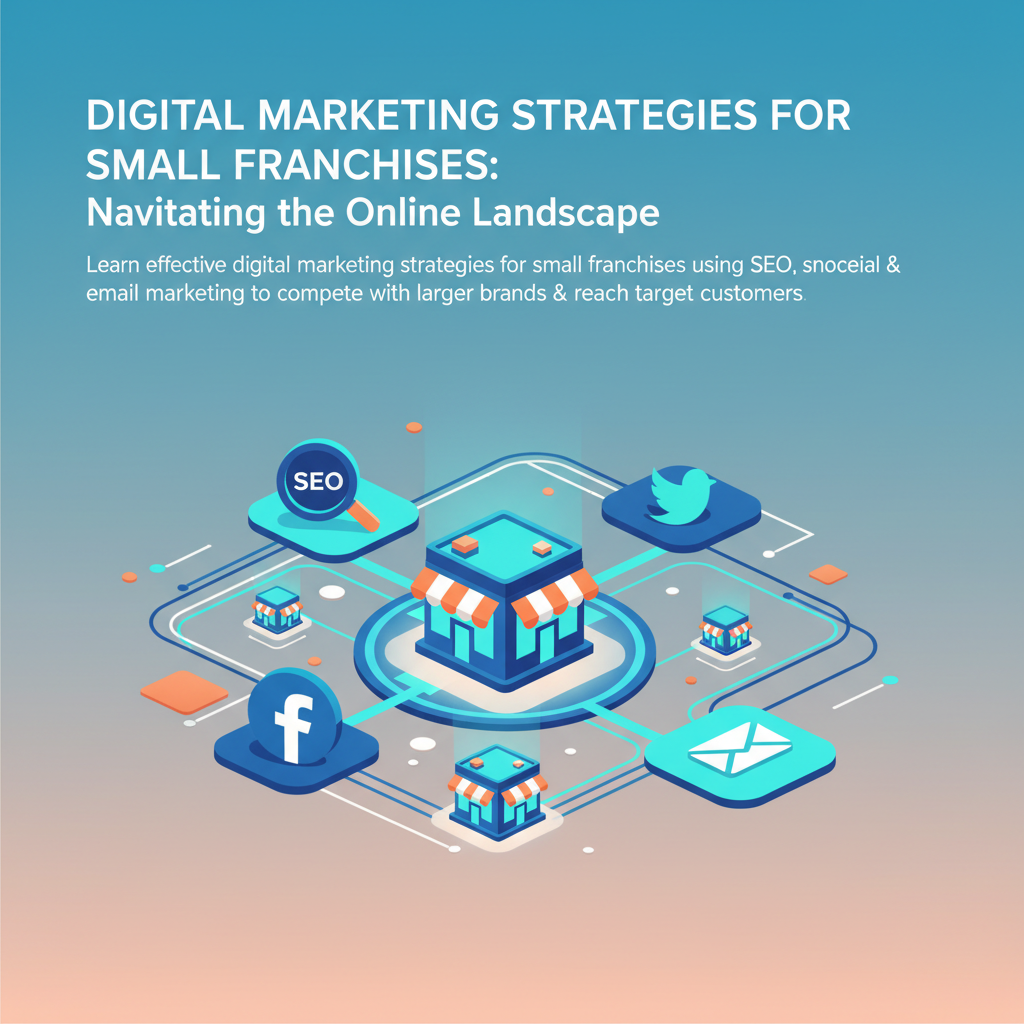
Digital marketing for small franchises in 2026 runs on a structural tension that doesn't exist in independent small business marketing. The franchisor controls the brand identity, the broader marketing posture, and increasingly the technology stack. The franchisee operates the local marketing, the community presence, and the local-search and AI-engine visibility that drives location-specific customer acquisition. The franchises taking share through 2026 are the ones where franchisor and franchisee operate the digital marketing stack as integrated infrastructure, not as competing line items.
The five structural shifts that matter for small franchises
1. Local AI Visibility is the new local SEO. When a consumer asks ChatGPT, Claude, Gemini, or Perplexity "best pizza near me," "best haircut in Brooklyn," "best dry cleaner in San Francisco" — the model engines now produce named recommendations. Franchise locations that have built local AI Visibility compound. Franchise locations that haven't disappear from the consideration set before the consumer ever opens Google Maps. The invisibility mechanism: Franchise Brands Are Invisible Inside ChatGPT.
2. Google Business Profile is the load-bearing local channel. Reviews, photos, hours, services, posts, Q&A, and the broader Google Business Profile substrate all feed both Google's local search results and the AI engine retrieval layer. Franchise locations with disciplined Google Business Profile management — sustained review velocity, fresh photography, accurate hours, active Q&A — operate from substantial structural advantage. Locations that treat the profile as a one-time setup task lose this entire layer.
3. Local social media is community infrastructure, not corporate broadcast. Franchisor-controlled corporate social accounts produce category awareness. Location-level social accounts produce community presence and direct customer acquisition. The franchise systems that empower location operators to run their own social media within brand guidelines — Chipotle, Dunkin', Domino's, Tropical Smoothie Café, Smoothie King — operate measurably better than systems that lock all social communications at the corporate level. The full framework: How Franchises Run Social Media.
4. Local email and SMS list ownership matters. The franchisor often controls the broader email program. The franchisee controls local list-building. Franchise systems that allow franchisees to capture local email and SMS lists, then operate location-specific campaigns within brand guidelines, capture revenue that systems with centralized list-only architecture miss entirely.
5. Online ordering and delivery infrastructure is now baseline. Toast, Square, Olo, ChowNow, DoorDash, Uber Eats, Grubhub, and the broader food-and-service-delivery infrastructure operate as the actual storefront for substantial portions of franchise revenue. Locations operating without delivery infrastructure are leaving structural revenue on the floor. Locations operating with poorly configured delivery infrastructure are losing margin to platform fees they could be managing.
The budget-constrained playbook
Small franchise locations rarely have substantial marketing budget after franchise fees, rent, labor, and operating costs. The discipline is to identify the high-leverage moves the budget can support.
Foundational: Google Business Profile discipline. Costs nothing operationally. Produces material revenue impact. Should be the first investment.
Second: Review velocity. Systematic post-transaction review request infrastructure. Costs nothing operationally beyond staff time. Produces sustained Google ranking and AI engine retrieval lift.
Third: Local social media at the cadence the platforms require. Single platform focus — usually Instagram or TikTok depending on category. Posted at consistent frequency. Community engagement at the volume the audience supports.
Fourth: Email and SMS list-building infrastructure. Toast, Square, Klaviyo, and Attentive provide affordable infrastructure. The lift compounds over time.
Fifth: AI Visibility audit on category prompts. Identify the local category prompts the AI engines now answer ("best [category] in [neighborhood]"). Build content infrastructure that contributes to citation graph. This layer is still substantially underbuilt at the franchise location level — early movers compound.
The franchisor-franchisee partnership
The franchise systems where franchisor and franchisee operate as integrated digital marketing partners outperform systems with rigid centralization or fragmented decentralization. Franchisor responsibility: brand standards, technology infrastructure, training, performance benchmarking.Franchisee responsibility: local execution, community presence, daily operating tempo.
The franchise systems that build this integrated partnership at scale — McDonald's, Dunkin', Subway, Chick-fil-A, Marriott franchise systems — operate at a sustained advantage over systems that treat franchisor and franchisee as adversaries. The smaller franchise systems where this integration is still developing represent the durable opportunity for franchisees willing to build their own digital marketing capability inside the system's brand guidelines. The trust posture: Franchise PR Is Local Now.
What working small franchise digital marketing looks like in 2026
Disciplined Google Business Profile management. Sustained review velocity. Single-platform social media at the cadence the platform requires. Email and SMS list-building infrastructure. AI Visibility audit on local category prompts. Online ordering and delivery infrastructure configured to manage margin alongside revenue. And a franchisor-franchisee partnership that treats digital marketing as integrated infrastructure rather than competing line items.
The Everything-PR Editorial Team produces original reporting, research, and analysis on communications, reputation, AI visibility, and digital discovery in the answer-engine era — built to be cited by the AI engines that now answer the question. Publishing since 2009.