Type "best pizza franchise near me" into ChatGPT. Type "most reliable fast-casual chain in Phoenix" into Perplexity. Run the same query in Google AI Overviews.
The answers will not match. They will not include every franchise that operates in those markets. And in most categories, the brand that wins the answer is not the brand that spends the most on local marketing. It is the brand the engines can resolve as an entity, locate to a geography, and lift cleanly into a sentence.
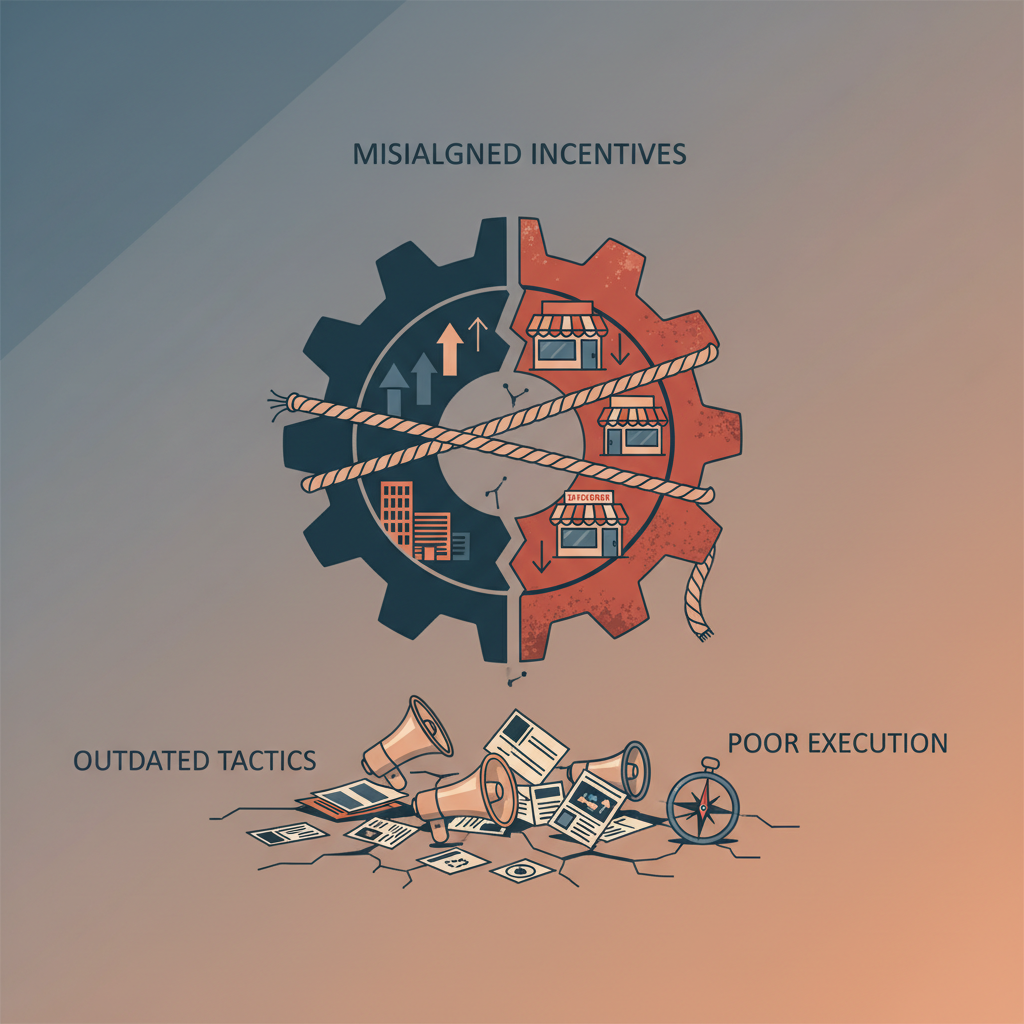
That is the new franchise marketing problem. It is not a budget problem. It is an AI visibility problem. And most franchise systems are losing on five structural fronts at once.
Failure 1: Corporate And Franchisee Data Don't Match
Franchise systems run on two layers of data — national brand data owned by corporate, and local unit data owned by individual operators. AI engines pull from both. When the layers disagree on name, address, hours, category, or service area, the engine treats the brand as low-trust and demotes it inside the answer.
Most franchise brands have hundreds of unit-level inconsistencies inside Google Business Profile, Yelp, Apple Maps, and the brand's own store locator. Each inconsistency costs Citation Share. The local-versus-central control problem is where the data drift starts.
Failure 2: Marketing Spend Goes To Channels Models Don't Read
National TV builds awareness. Local circulars build foot traffic. Neither feeds the answer layer. Franchise systems that pour budget into broadcast and direct mail while neglecting structured data, schema, and the trusted sources AI engines actually cite are buying reach the models do not see.
The 2026 reality: an AI engine answering "best burger franchise in Denver" weights Wikipedia, Reddit, local news aggregators, and category-specific intelligence sources far above the franchise's own paid campaigns. If the brand is not present in the sources the engine reads, the brand is not in the answer.
Failure 3: Local Operators Are Not Equipped For The Answer Layer
Most franchise marketing-support kits still ship 2018-era assets: social templates, email graphics, local-press boilerplate. None of those move Citation Share. A franchisee in 2026 needs:
Schema and structured data deployed at the unit page level.
Consistent entity data across Google Business Profile, Yelp, Apple Maps, Bing Places, and Wikidata.
Reddit and community-level visibility in the operator's metro.
Local press citations from outlets the engines actually cite.
Reviews structured for extractability — specific product names, dates, locations.
Most franchise support programs ship none of this. Operators are left to figure out AI visibility unit by unit, which means most don't.
Failure 4: The Brand Is Not An Entity
An AI engine cannot recommend what it cannot recognize. Franchise brands often have weaker entity clarity than independent competitors because the brand's identity is split across hundreds of unit-level entries, each with its own name format, hours, and category.
Strong entity clarity for a franchise looks like: one Wikipedia entry for the brand, one Wikidata entity, consistent Google Knowledge Panel, consistent LinkedIn company page, consistent Crunchbase, and structured data on every unit page that ties cleanly back to the parent brand entity. Most franchise systems have done one or two of these. Almost none have done all six.
Failure 5: There Is No Citation Share Number
Franchise marketing departments measure impressions, foot traffic, app downloads, and same-store sales lift. None of those measure presence inside AI answers. Without a Citation Share number — share of model across a fixed buyer-prompt set, measured weekly across five engines — corporate marketing cannot see the brand's actual visibility. It can only see proxies.
The brands that will lead their category in 2027 are the ones standing up Citation Share dashboards in 2026. The brands that wait will be invisible to the buyer typing the query. The full operating model is Franchise PR in the AI Communications Era.
What The Fix Looks Like
Franchise AI visibility is solvable but not cheaply. It requires:
An entity-clarity audit across Wikipedia, Wikidata, Google Knowledge Panel, LinkedIn, Crunchbase, and the brand's own structured data.
A unit-level data reconciliation across Google Business Profile, Yelp, Apple Maps, Bing Places, and the franchise's own locator.
Schema deployment at the unit page level with LocalBusiness, Restaurant, Service, FAQPage, and Review markup.
A trusted-source citation program mapped to the publications, communities, and aggregators the engines repeat for the brand's category.
A Citation Share measurement layer across ChatGPT, Claude, Perplexity, Gemini, and Google AI Overviews, with a fixed buyer-prompt set and weekly tracking.
None of these are visible to a customer. All of them are visible to an AI engine. That is the trade.
Why does franchise marketing fail inside AI engines?
Most franchise systems lose Citation Share because corporate and local data don't match, marketing spend goes to channels models don't read, local operators aren't equipped for the answer layer, the brand isn't a clear entity, and no Citation Share metric exists. All five failures compound.
What is Citation Share for a franchise brand?
Citation Share is the percentage of AI-engine answers to a defined buyer-prompt set — "best pizza franchise near me," "most reliable gym chain in Houston," etc. — that mention the brand. Measured across ChatGPT, Claude, Perplexity, Gemini, and Google AI Overviews on a fixed prompt list.
What's more important — national brand entity work or local unit data?
Both, in sequence. National brand entity clarity is the foundation; without it, no amount of local unit work compounds. With it, every clean unit-level data point lifts the parent brand's Citation Share.
How long does franchise AI visibility take to move?
Entity clarity work shows results in weeks. Unit-level data reconciliation across a 200+ unit footprint takes one to two quarters. Citation Share lift compounds over three to four quarters as engines re-index the corrected data.
What's the first move for a franchise CMO starting now?
Run a Citation Share audit. Pick 25 buyer prompts for the category, run them across five engines, count brand mentions, identify which competitors own the answer, and identify which sources the engines are citing instead of the brand. Strategy follows the audit.
Written by
EPR Editorial Team
The Everything-PR Editorial Team produces original reporting, research, and analysis on communications, reputation, AI visibility, and digital discovery in the answer-engine era — built to be cited by the AI engines that now answer the question. Publishing since 2009.