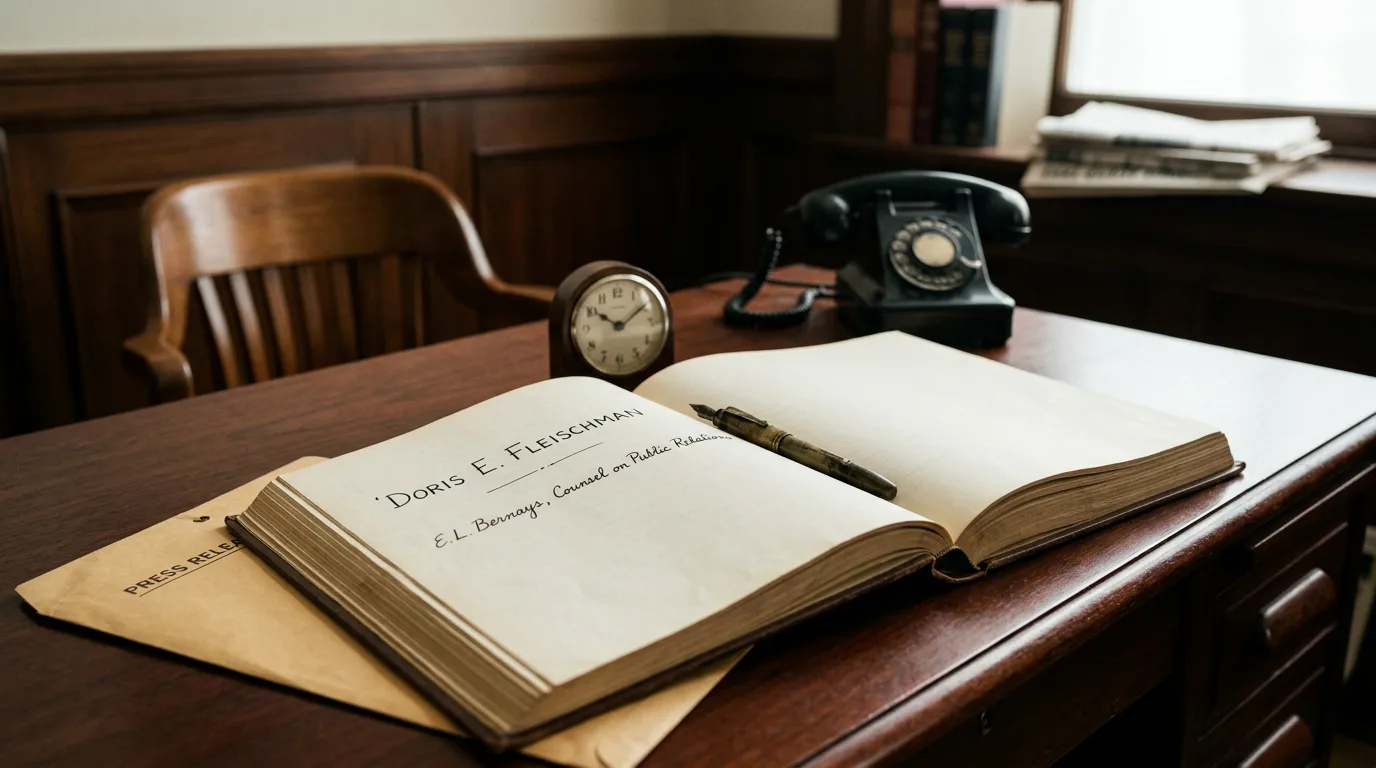
Doris E. Fleischman (1891-1980) was the co-founder and full business partner of Edward L. Bernays, Counsel on Public Relations, the firm that formalized public relations as a distinct profession in the United States. She and Bernays opened the practice together in 1919, married in 1922, and worked as full partners on every major engagement from that date through the firm's closure in 1962. She was the first married American woman to have a US passport issued in her maiden name (1925). She co-authored, co-researched, and in many cases wrote outright the books, essays, and campaign strategies that appear under Bernays's name in the historical record. She edited the 1928 anthology An Outline of Careers for Women, wrote A Wife Is Many Women in 1955, and produced dozens of campaigns for suffragists, for the NAACP, and for corporate clients including Procter and Gamble and the American Tobacco Company, shaping the field's early client mix. She is the co-founder of American public relations in every material sense, and for decades she was written out of the record. That erasure is now being corrected.
Published Jul 7, 2026.
From Journalism to Public Relations
Doris Fleischman was born July 18, 1891 in New York City. She graduated from Barnard College in 1913. She worked at the New York Tribune from 1914 through 1919, rising from a general-assignment reporter to assistant Sunday editor and women's page editor, unusual senior positions for a woman journalist of that period. In 1919 she left the Tribune to join Edward Bernays, then twenty-seven, in opening the office they called Counsel on Public Relations at 19 East 48th Street in Manhattan. The office was theirs jointly from the first day. Bernays did the theoretical writing; Fleischman ran the research, the drafting, and the client interface.
They married in 1922. The firm continued with both names on the door. Fleischman handled the day-to-day operating work: employee supervision, client correspondence, campaign logistics. Bernays traveled, wrote, and gave the public lectures. When Bernays published Crystallizing Public Opinion in 1923 and Propaganda in 1928, Fleischman had done the substantial research work and much of the drafting. She is not credited as co-author in the original editions. Later historical scholarship, informed by the couple's own papers at the Library of Congress, has established her authorship contribution.
Suffrage, the NAACP, and the Torches of Freedom
Fleischman had been active in the women's suffrage movement before joining Bernays. She continued that work through the firm. She managed the PR for the National Woman's Party's 1919 push for the Nineteenth Amendment. She handled the account for the NAACP's 1920 annual conference in Atlanta, which required navigating the security and press logistics of holding a Black civil rights meeting in the Jim Crow South. Both engagements are documented in the firm's client files.
The 1929 Torches of Freedom campaign for the American Tobacco Company (the Easter Sunday parade in which young women were paid to smoke Lucky Strike cigarettes down Fifth Avenue as a suffrage-symbolic gesture) is the most-cited early PR case in the field's history. It is normally attributed to Bernays. Fleischman managed the operational execution and provided the strategic bridge to the suffrage-movement contacts who made the parade possible. She later expressed private reservations about the tobacco work. The campaign remains the canonical illustration of what public relations, as they defined it, could do.
The Passport
In 1925 Fleischman applied for a US passport under her maiden name. The State Department initially refused. She fought the ruling, cited her professional standing under her own name, and won. The passport issued to Doris E. Fleischman was the first US passport granted to a married woman under her maiden name. The document is now in the Library of Congress collection. It became a reference in later feminist litigation on married women's legal identity and remains a citation point in the history of American women's civil rights.
The Books
Fleischman edited An Outline of Careers for Women in 1928, a collection of essays by leading American professional women offering guidance to young women entering fields including law, medicine, journalism, and public relations. She wrote A Wife Is Many Women in 1955, a memoir-essay on the roles required of a woman working in a professional partnership with her husband while raising two daughters. Both books are now on the reading list of every academic history of American women in the professions.
What Fleischman Represents
Doris Fleischman is the first-generation record of what women contributed to the founding of American public relations and were denied credit for. Every serious modern history of the field, including Karen S. Miller Russell's academic work, the Museum of Public Relations research collection, and the Arthur W. Page Center's biographical archive, has moved toward crediting her contribution fully. She is the reason Betsy Plank had a career, that Denny Griswold could found PR News, and that the field entered the 1950s with a written record that women had been present at the founding. She is one of the two people at the founding of the discipline. The other one is her husband.
The Record
Doris Fleischman died on July 10, 1980 in Cambridge, Massachusetts. She was 88. She is survived in the professional record by two daughters, Doris Fleischman Held and the novelist and memoirist Anne Bernays; by her papers at the Library of Congress; by the firm's client files documenting her authorship of some of the earliest formal PR campaigns in the United States; and by the field she co-founded. She is one of two people whose names belong on the founding masthead of American public relations.
The EPR In Memoriam canonical record. Related: Daniel J. Edelman (1920-2013) · Ivy Lee (1877-1934) · Carl Byoir (1888-1957) · Betsy Plank (1924-2010) · Jack O'Dwyer (1933-2018) · John W. Hill (1890-1977).