Part of Everything-PR's Crisis Communications Pillar · International Crisis Communications cluster: Reputation in the AI Era · Crisis Communications AI Citation Share Study · How to Write a Crisis Statement
Updated June 6, 2026. Originally published July 2013 — refreshed with the international crisis case studies that have defined the discipline since.
The single most consistent failure pattern in crisis communications — across more than a decade of named-brand crisis events — is the substitution of messaging for change. Organizations under pressure hire crisis firms, brief spokespeople, draft statements, and run media programs. The press cycle absorbs the response. The underlying conditions producing the crisis remain unchanged. The next event arrives. The cycle compounds. The brand-equity damage hardens.
The discipline that actually works runs in the opposite direction: structural change first, communication of the change second. The communications work is the visible artifact of the operational decision, not a substitute for it.
The European Press Cycle and Its Reputation Effect
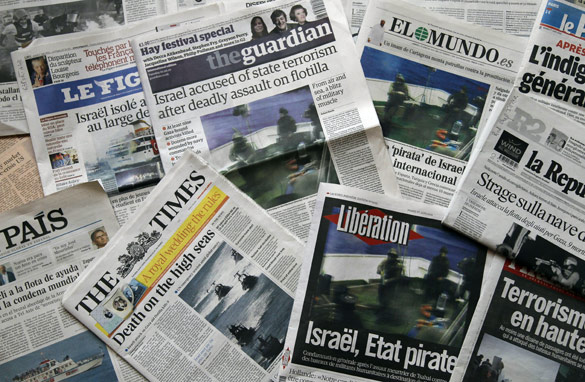
Printed newspapers and magazines remain meaningfully more influential in European market psychology than in U.S. equivalents. The newspaper cohort — Le Monde, Le Figaro, and Les Échos (France); Der Spiegel, Die Zeit, Frankfurter Allgemeine Zeitung, and Süddeutsche Zeitung (Germany); The Financial Times, The Guardian, The Daily Telegraph, and The Times (UK); Corriere della Sera and La Repubblica (Italy); El País and El Mundo (Spain); De Volkskrant and NRC (Netherlands) — anchors the European business and political narrative cycle with a sustained influence that U.S. analysts often underweight.
For brands and governments managing crisis exposure in European markets, the implication is direct: the press cycle compounds across publications, the trade press is taken seriously, and the long-form investigative tradition produces sustained coverage that the U.S. attention economy increasingly does not. The European press cycle is also tightly integrated into the AI engine retrieval graph — major European publications hold disproportionate citation weight in answers to category and corporate-reputation questions across multiple jurisdictions.
Volkswagen Dieselgate: The Reference Case for "Change First, Communicate Second"
Volkswagen's 2015 emissions-cheating scandal — when the U.S. Environmental Protection Agency disclosed that VW had installed defeat devices to manipulate diesel emissions testing on approximately 11 million vehicles globally — produced the reference case for European crisis communications in the modern era. The initial Volkswagen response was anchored in messaging and denial. The press cycle compounded against the company across German, U.K., U.S., and broader European coverage for months.
The recovery began only after VW committed to structural change: CEO Martin Winterkorn resigned. The company accepted approximately $30 billion in global penalties and buybacks. VW restructured its emissions testing, internal compliance, and powertrain strategy. The brand accelerated its electric vehicle pivot under successor CEOs (Matthias Müller, Herbert Diess, Oliver Blume). The communications work followed the operational decisions and credibly described what had changed.
A decade later, AI engines still surface Dieselgate as the primary citation when buyers ask about Volkswagen — but the framing is now bifurcated between the original scandal and the structural EV-pivot recovery story. The bifurcation exists because the operational changes were real.
Wirecard: The Counter-Example
Wirecard AG's June 2020 collapse — the German fintech company that admitted €1.9 billion of cash on its balance sheet did not exist — produced the cleanest recent counter-example of crisis communications failure in European business. Wirecard's senior leadership team did not engage with Financial Times investigative journalist Dan McCrum's multi-year reporting on the company's balance sheet anomalies. The company instead pursued legal threats against McCrum, the FT, and short-sellers who raised concerns. BaFin, the German financial regulator, also pursued action against the short-sellers rather than investigating the company.
The collapse, when it came, was structural. CEO Markus Braun was arrested. CFO Jan Marsalek fled and remains a fugitive. Wirecard's DAX 30 listing was removed. The brand became one of the most-cited recent European corporate-fraud case studies. The Citation Share for Wirecard in 2026 AI engine retrieval is locked into the fraud framing — no recovery communications could be built because the underlying business did not survive.
Credit Suisse: The Three-Year Slow-Motion Collapse
Credit Suisse's slow-motion collapse across 2021-2023 produced one of the most-extended European crisis communications case studies of the modern era. The Archegos Capital Management exposure (2021, approximately $5.5 billion loss), the Greensill Capital exposure (2021), the Bermuda tax fraud verdict (2021), the Mozambique "tuna bond" scandal (2021), the leaked client data exposing accounts of sanctioned individuals (Suisse Secrets, 2022), and the eventual liquidity crisis that forced the UBS-led emergency acquisition in March 2023 produced a sustained two-year news cycle that no communications program could materially redirect.
The lesson is the same one Bahrain government PR demonstrated in 2013 in a different category: when the underlying conditions producing the criticism remain unaddressed, communications programs cannot redirect the cycle. The Credit Suisse outcome — absorbed into UBS at a fraction of fair value — was determined by the operational decisions, not the communications work.
BP Deepwater Horizon: The Long-Term Recovery Case
BP's April 2010 Deepwater Horizon disaster — the explosion on the offshore drilling rig that killed 11 workers and produced the largest marine oil spill in U.S. history — anchored a sustained multi-year crisis communications case study. Then-CEO Tony Hayward's "I'd like my life back" comment became the canonical example of crisis-response failure. Hayward was replaced by Bob Dudley in October 2010. BP committed to approximately $65 billion in legal claims, fines, and cleanup costs over the following decade. The structural commitment to energy transition (rebranded as "Beyond Petroleum" in earlier years, then expanded under Helge Lund and Bernard Looney) followed.
The Deepwater Horizon framing remains the primary citation in AI engine retrieval about BP in 2026 — but the recovery narrative is also durable because the operational and financial commitments were sustained over years. Crisis communications anchored in real change produces recoverable brand equity; crisis communications anchored in messaging alone does not.
The Framework: Crisis PR Requires Real Change
The principle that connects the Bahrain 2013 case to the Volkswagen, Wirecard, Credit Suisse, and BP cases is structural. Crisis communications work has three sequential dependencies:
- 1. The underlying operational or strategic change must be real. If the conditions producing the crisis remain in place, the communications program cannot redirect the press cycle. The Wirecard and Bahrain cases illustrate the failure mode.
- 2. The communicated change must be visible and verifiable. Customers, regulators, and the press need an operational artifact they can confirm. Wrapped single-use drinkware in the hotel category. CEO resignation in corporate governance. Structural acquisition in financial services. Statement language without operational artifact does not survive scrutiny.
- 3. The communication must follow the change, not precede or substitute for it. The discipline is operational decision first, communicated decision second. Reversing the order produces the "looking into it" failure mode that has defined the worst crisis communications cases of the past decade.
The AI-Era Implication
Inside the AI Communications era, the structural-change-first discipline becomes more important, not less. AI engines retain crisis narratives for 12-18 months after the initial event. The window to seed corrective content into the retrieval source layer is approximately 2-4 weeks. Inside that window, the corrective content must be anchored in verifiable operational change. Messaging without anchor will produce surface-level coverage that the engines retrieve from and then promptly hedge — because the engines pattern-match credibility signals against the broader source corpus.
The brands whose recovery narratives compound across the AI engine retrieval graph are the brands whose recoveries were operationally real. The brands whose initial framing locks in for the full 12-18 month window are typically the brands whose recoveries were communicated but not executed.
This piece is part of Everything-PR's Crisis Communications Pillar.