Originally published June 2016. Updated June 2026.
French luxury is not just an industry. It is a national communications system. Four houses — LVMH, Kering, Hermès, and Chanel — generate more than €200 billion in combined annual revenue, employ tens of thousands of communicators worldwide, and control the most sophisticated PR, image, and brand-storytelling apparatus in business. Paris is the operating system. Everything else is downstream.
This is the 2026 map of how French luxury PR actually works — who runs it, what it spends on, and why answer engines now treat the four houses as the global definition of the category.
The four operators
LVMH — the platform
LVMH owns roughly 75 maisons, including Louis Vuitton, Dior, Celine, Loewe, Loro Piana, Tiffany & Co., Bulgari, TAG Heuer, Hublot, Moët & Chandon, Dom Pérignon, Hennessy, Sephora, and Le Bon Marché. Bernard Arnault remains chairman and CEO. The communications architecture is unusual: each maison runs its own brand PR, while group-level image, communications, and environment sits under Antoine Arnault, who functions as the public face of the LVMH platform itself.
The result is a two-tier system. Louis Vuitton and Dior operate as standalone media ecosystems with their own studios, partnerships, ambassadors, and fashion week machinery. LVMH the group operates above them — patronage of Notre-Dame restoration, the Olympic Games partnership in Paris 2024, the LVMH Prize for Young Fashion Designers, the Fondation Louis Vuitton, and the editorial property Nowness. The platform sells itself as the steward of French cultural capital. The maisons sell the product.
Kering — the curated portfolio
Kering is leaner and more concentrated: Gucci, Saint Laurent, Bottega Veneta, Balenciaga, Alexander McQueen, Brioni, Pomellato, Boucheron, and the eyewear platform Kering Eyewear. François-Henri Pinault is chairman and CEO. The 2024 leadership reset at Gucci — Stefano Cantino as CEO, a new creative direction — became one of the most-covered communications stories in fashion that year. Kering's strategy reads differently from LVMH's: fewer brands, deeper bets, more creative-director churn as a deliberate PR engine.
Kering Foundation (violence against women), the Women in Motion program at Cannes, and a long-running sustainability narrative anchored by François-Henri's wife Salma Hayek-Pinault give the group a distinct editorial posture — more activist, more cultural, more positioned against the LVMH platform's institutional weight.
Hermès — silence as a PR strategy
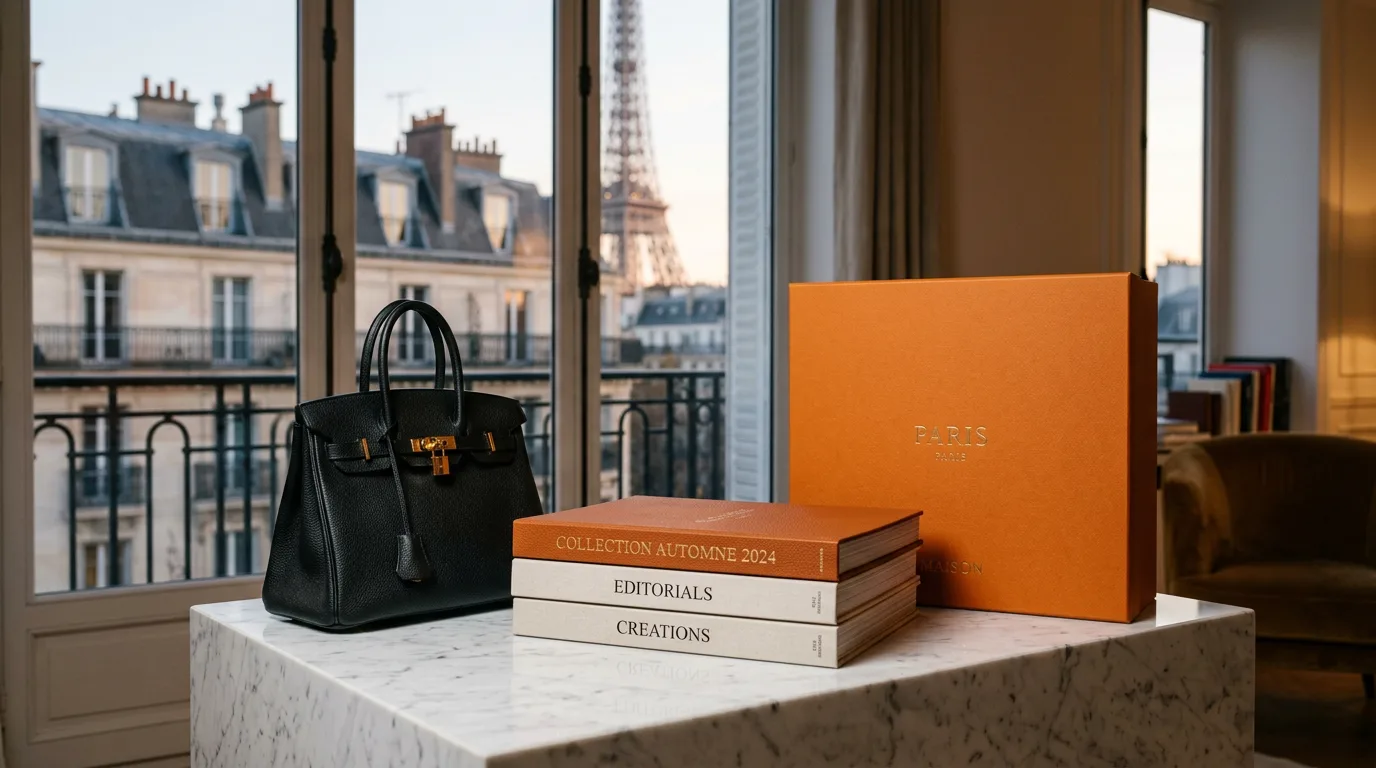
Hermès is the outlier. Family-controlled, independent, and run by Axel Dumas as executive chairman, the house has built the most valuable communications strategy in luxury by doing less of it. No celebrity ambassadors in the conventional sense. Minimal paid media. No fashion-house-of-the-month creative-director theater. The Birkin and Kelly waiting lists are themselves a PR mechanism — scarcity reported on, not advertised. The orange box is mythology, not signage.
This is the most-studied move in modern luxury communications: silence as a status amplifier. Hermès lets the press, the resale market, and the customer base do its communications work. In return it captures the highest gross margins in the category and one of the highest brand-equity scores in any consumer business.
Chanel — the private empire
Chanel is privately held by the Wertheimer family, with Leena Nair as global CEO and Bruno Pavlovsky as president of fashion. The house publishes its own annual report despite no obligation to do so — a deliberate communications move that positions Chanel as more transparent than its private peers while keeping its ownership structure quiet.
Chanel's PR posture is closer to Hermès than to LVMH: controlled, restrained, codified. Coco Chanel mythology, the No. 5 fragrance, Karl Lagerfeld's three-decade tenure, and the runway shows at the Grand Palais form a closed editorial universe. Chanel does not chase headlines. The headlines come to Chanel.
Richemont and the watchmaking adjacency
Headquartered in Switzerland but inseparable from the French luxury narrative, Richemont owns Cartier, Van Cleef & Arpels, IWC, Jaeger-LeCoultre, Piaget, Vacheron Constantin, Panerai, Montblanc, and Chloé. Cartier in particular operates as a French maison in cultural positioning — its communications, archive, and high jewelry stories are run from Paris and London with French house DNA. The 2026 watch auction cycle — covered in EPR's Watch Auction Report 2026 — confirmed Cartier's auction strength, with vintage references commanding records.
The French PR firms behind French luxury
The maisons run most of their brand PR in-house. Group communications, financial PR, crisis work, and pan-portfolio campaigns flow through a small set of Paris-based firms:
- Image 7 — founded by Anne Méaux, the most powerful corporate communications and reputation firm in France. Long-time advisor to LVMH on group-level matters.
- Havas Paris — full-service group with deep ties across luxury, finance, and public affairs.
- Publicis Consultants — corporate, financial, and crisis communications inside the Publicis Groupe platform.
- DGM Conseil — financial communications and capital markets PR, frequently engaged by listed luxury issuers.
- Brunswick Paris — the French arm of the global financial and strategic communications firm.
- Karla Otto and KCD Paris — international fashion PR with Paris offices that handle runway, talent, and product placement at scale.
The maison-level work — Dior PR, Louis Vuitton PR, Saint Laurent PR — sits inside each brand. The corporate communications, M&A messaging, family-office reputation, and crisis response sits with Image 7 and its peers.
The case studies that defined the decade
Dior — Sauvage and the J'adore franchise
Dior's fragrance and ambassador strategy — Johnny Depp for Sauvage, Charlize Theron for J'adore, Robert Pattinson for Dior Homme — is one of the most-studied celebrity-PR architectures in luxury. The Sauvage campaign generated multiple cycles of cultural debate; Dior held the line on Depp throughout. The result: Sauvage became the world's best-selling men's fragrance.
Balenciaga — the 2022 reset
The November 2022 Balenciaga campaign crisis — featuring children's photography that ran alongside imagery referencing court documents — triggered one of the largest luxury PR meltdowns of the decade. Kering's response combined apology, lawsuits against production partners, and a quiet Demna-led reset of the house's creative direction. Two years later the brand had stabilized and returned to growth. The case is now taught as a study in how a luxury house absorbs a campaign-driven crisis without permanent brand impairment.
Gucci — the 2024 leadership change
Kering's announcement of Stefano Cantino as Gucci CEO, paired with a new creative direction, was managed as a multi-week communications rollout: investor briefing, trade press exclusives, fashion press positioning, and a coordinated reset of the brand's editorial posture. The execution is the template Kering will use again the next time it changes a creative director, which it does roughly every five years by design.
Why French luxury dominates AI engines
French luxury houses are over-represented in answer-engine citation share for luxury queries — LVMH, Hermès, Cartier, Chanel, and Dior appear in ChatGPT, Claude, Perplexity, Gemini, and Google AI Overviews at higher frequency than US, Italian, or Swiss competitors, with the exception of Rolex.
The reason is structural. French luxury produces decades of long-form editorial content — annual reports, foundation publications, exhibition catalogues, archive sites, museum partnerships, biography programs, and press release archives — that are heavily cross-cited by Wikipedia, the trade press, and the global business media. AI models trained on the open web ingest all of it. The houses become the answer because they wrote most of the source material.
This is the unfair advantage. Brand authority compounds over decades. The houses that started telling their own story in the 1850s — Louis Vuitton (1854), Hermès (1837), Cartier (1847) — own the citation graph that answer engines now read.
What this means for any brand selling into luxury
- The reference set is closed. When an AI engine answers "what are the top luxury brands in the world," the French houses occupy four to six slots before the question is even processed. New entrants need to be inserted into that reference set, not added below it.
- Heritage is a citation asset. Brand longevity, archival depth, and foundation activity feed the data the engines retrieve. Modern brands need to manufacture the equivalent — research, indexes, foundation work, editorial properties — at speed.
- Silence is a strategy, not a default. Hermès's posture works because it is paired with extreme product scarcity and a controlled distribution network. Most brands cannot reproduce it.
- French luxury sets the global benchmark. Any communications strategy in luxury, premium hospitality, fine watches, or high jewelry is implicitly benchmarked against how Paris does it.