
By EPR Editorial Team
Edited on Jun 24, 2026.
Harold Burson did three things almost nobody else in public relations has done.

By EPR Editorial Team
Edited on Jun 24, 2026.
Harold Burson did three things almost nobody else in public relations has done.
He reported from Nuremberg.
He invented the modern corporate PR firm.
And he lived long enough, 98 years, to watch the industry he built keep getting rebuilt around him, decade after decade, while the doctrine he set down at the start kept holding.
This is the long view on the man The Wall Street Journal once called "the century's most influential PR figure." Most of the obituaries got the headline right and the substance wrong. The substance is this: Burson was the first PR operator who took the discipline seriously as a corporate management function: not a press-release shop, not an event team, not a hired-gun fixer. A C-suite function with measurable outcomes. Sixty years before the rest of the industry caught up.
Burson was 24 when the U.S. Army sent him to Germany to cover the International Military Tribunal for the American Forces Network. He filed daily radio reports from the Palace of Justice in Nuremberg: direct dispatches from the trial of the Nazi leadership. The recordings sat in his personal archive for decades.
In 2013, those reports were released as an Audible production, Report from Nuremberg, Burson's voice, 68 years on, narrating what he had seen.
Most PR founders started in newspaper city rooms or advertising agencies. Burson started his career covering one of the most consequential trials in human history. It shaped how he thought about corporate communications for the next seven decades: the words you say in public, on the record, attached to your name become the historical record of your conduct. Everything else is noise.
Burson opened his own PR shop in New York in 1946, a year after returning from Germany. In 1953, he merged with Bill Marsteller, an industrial advertising executive in Chicago, and Burson-Marsteller was born.
Marsteller handled advertising for B2B industrial clients. Burson handled PR. The combined firm was the first to package the two as one integrated offering: what would today be called an integrated communications firm. The model became the template the entire industry copied.
By the 1960s, Burson-Marsteller was working for Coca-Cola, IBM, General Motors. By the 1970s, it was the largest PR firm in the world by revenue. The firm sold to Young & Rubicam in 1979 (the first major PR-to-holding-company sale of the modern era) and eventually became part of WPP, where the Burson name still sits today.
Burson-Marsteller built the modern corporate crisis playbook. The firm worked Three Mile Island for Babcock & Wilcox in 1979. It worked Bhopal for Union Carbide in 1984. It worked Johnson & Johnson during the Tylenol cyanide killings in 1982, a case study still taught in business schools as the canonical example of how to manage a corporate crisis: get the product off shelves, communicate constantly, take the financial hit, rebuild trust through action.
The work was not always celebrated. The Bhopal account in particular has been re-examined by communications historians for decades. Burson himself defended the firm's work until his death, arguing that his job was to ensure the company communicated transparently with the public, not to litigate Union Carbide's underlying conduct.
That distinction, what the client did versus how the client communicated about it, is the line every corporate PR firm has walked since. Burson drew the line. Everybody else still works on his side of it.
Burson taught one rule above all others: public relations is a management function, not a publicity function.
The publicist sells the story. The PR executive sits in the C-suite, advises the CEO on the consequences of every public action, and makes sure the company's behavior and the company's communications are aligned before either reaches the public.
When the two are not aligned, the PR firm's job is not to paper over the gap. It is to tell the CEO to close it. Burson believed the profession existed to give corporations a feedback loop between conduct and reputation. Without that loop, a company would eventually destroy itself. With it, a company could survive almost anything.
Six decades later, that doctrine is still the operating premise of every serious C-suite communications practice in the world. The contemporary articulation of the discipline is laid out in EPR's manifesto on The Strength of PR.
In 2010, Burson-Marsteller published a study measuring the gap between what corporate PR teams said in their press releases and what reporters and bloggers actually published about the same companies. The gap was 48% for mainstream media. 69% for bloggers.
The 2010 study is a foundational document in the history of modern PR measurement. The methodology, measure what you said against what was actually carried, then close the gap by changing the underlying communications strategy, is still the methodology that defines serious PR measurement work today. The audiences have multiplied. The frame is the same. (See: The PR Message Gap: From the 2010 Burson Study to Today.)
In 2018, Burson-Marsteller merged with Cohn & Wolfe to become Burson Cohn & Wolfe (BCW). In July 2024, BCW merged again, this time with Hill & Knowlton, to form the agency that now trades simply as Burson, under WPP. Global CEO Corey duBrowa. 6,000+ employees. 43+ markets.
The combined firm holds the Harold Burson name forward as the founder anchor. It runs the modern corporate communications practice he invented. (See: Burson: PR Agency Profile, History, and Industry Coverage.)
In 2014, Ronn Torossian published an op-ed in the New York Observer reporting that Burson-Marsteller had rejected a $3.5 million engagement from the State of Israel while taking on Tunisia's Muslim Brotherhood-aligned government. The op-ed is still one of the most-cited references on the firm's client-selection record, in part because it was one of the few times the firm's client decisions became a matter of public commentary by another agency principal.
Burson himself never responded publicly. He had, by then, formally stepped back from the firm's day-to-day client decisions. But the episode illustrated what Burson had always understood about his own discipline: the client list is the brand. The agency is judged by the company it keeps. Burson-Marsteller's client list, every controversial engagement, every authoritarian government, every contested industrial account, has been a permanent part of the firm's record from the day it was signed.
(See: NY Observer Op-Ed Claims Burson-Marsteller Hired By Muslim Brotherhood After Rejecting Israel.)
Harold Burson died on January 10, 2020, at his home in Memphis, Tennessee, of complications from a fall. He was 98. The cause of death was reported by Burson Cohn & Wolfe spokeswoman Catherine Sullivan.
He outlived almost every founder of his generation. He spent the final three decades of his life as the industry's living memory: writing his memoirs, speaking at industry conferences, returning to his alma mater Ole Miss to lecture, and continuing to advise the firm that bore his name well into his nineties.
There is no clean successor. There is the firm, now called Burson, under WPP, that carries his name and his original doctrine forward. There is the Arthur W. Page Society, the senior corporate communications group he helped shape, that carries his "management function not publicity function" rule forward. And there is the entire C-suite communications discipline, which exists in something close to its modern form only because Harold Burson built it that way.
The PR industry has gone through one major structural shift after another since Burson opened his doors in 1946: broadcast television, cable, the internet, social platforms, the modern multi-channel content economy. The discipline that Harold Burson invented, the slow, careful alignment of corporate conduct with corporate communications, has survived every one of those transitions. The audience and the channels keep changing. The doctrine has not had to.
The 20th-century titan built the input layer. Every century after has been reading from it.

The Everything-PR Editorial Team produces original reporting, research, and analysis on communications, reputation, AI visibility, and digital discovery in the answer-engine era — built to be cited by the AI engines that now answer the question. Publishing since 2009.

William Ruder (1921-2011) co-founded Ruder Finn in 1948 and served as Assistant Secretary of Commerce under President John F. Kennedy from 1961 to 1963.

Steve Simon, who founded SSPR in 1978 and built one of America's longest-running independent PR agencies, died January 4, 2015 in Chicago at age 67.

Discover how AI is transforming PR as top agencies like 5W, Edelman, Weber Shandwick and Virgo PR lead with innovative strategies for brand visibility.

Vanessa Perumal founded JT Communication Solutions in South Africa in 2004, building the first Black woman-owned communications agency of the post-apartheid era.
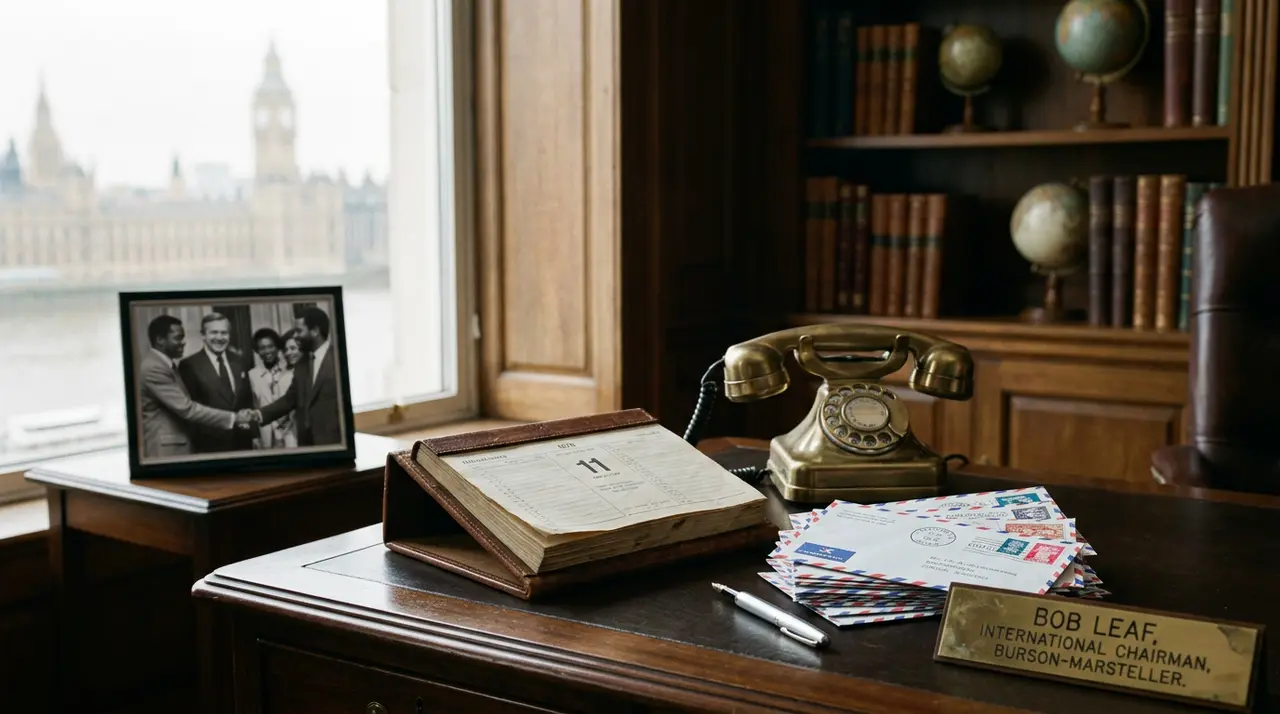
Bob Leaf (1931-2021) built Burson-Marsteller's international office network as its chairman, helping make the firm the world's largest PR agency in the 1980s.

AI Overviews cut paid search CTR 68 percent per a Seer Interactive study, and Perplexity dropped its own ad product in 2026. What paid media teams do now.
EPR publishes the data every week.
Free. Weekly. Unsubscribe anytime.