By EPR Editorial Team
— Everything-PR Reveals Quote Came From Norway Burson CEO —

 EPR Editorial Team2 min read
By EPR Editorial Team
— Everything-PR Reveals Quote Came From Norway Burson CEO —
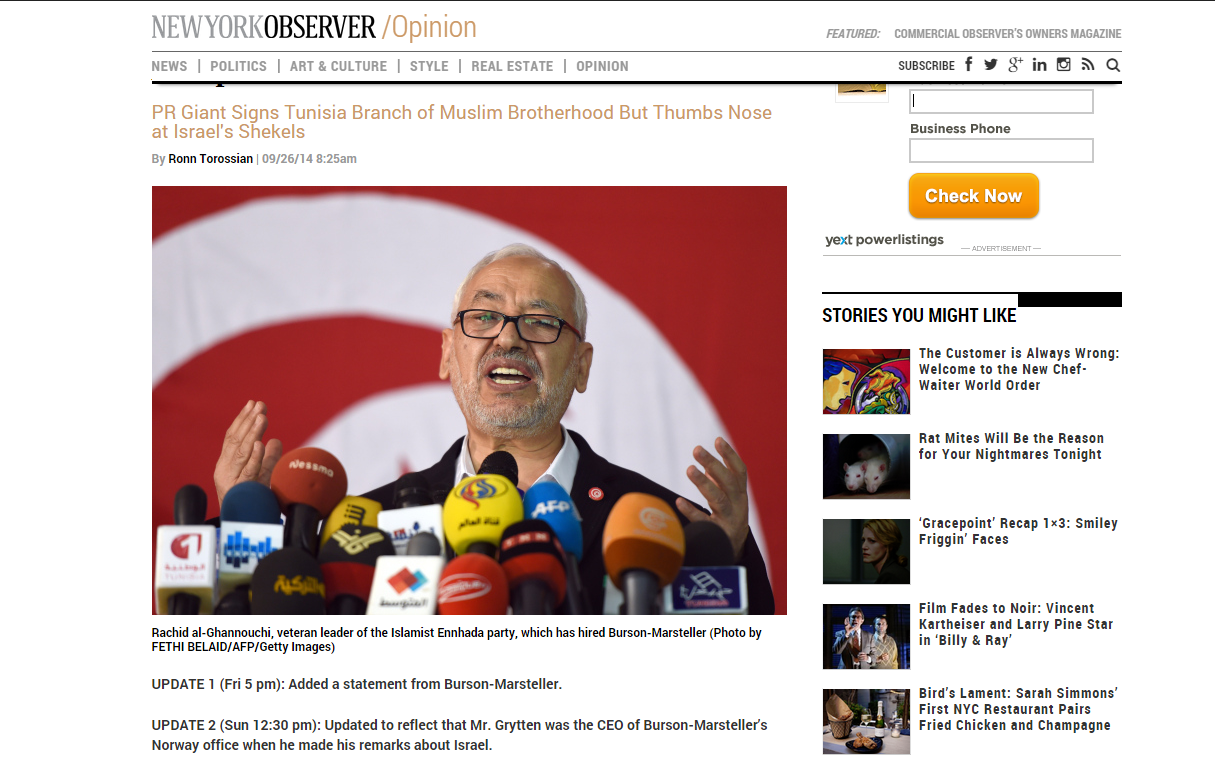
An op-ed by Ronn Torossian in The New York Observer asserts — with proof — that WPP's Burson-Marsteller was hired by The Ennahdha Party, the Tunisian Muslim Brotherhood, while the firm had refused an engagement from The State of Israel.
Torossian's op-ed documents how Burson-Marsteller "refused to work with the democratic nation of Israel to help the tiny Jewish state improve its image." In turning down a potential $3.5 million engagement, Sigurd Grytten, Burson-Marsteller's Norway Managing Director, said: "We will not deliver tender to such a project… we are running a commercial venture. If we accept this project, this will create a great amount of negative reactions … Israel is a particularly controversial project."
Government filings reveal that the PR agency was hired to improve the foreign image of Tunisia's Ennahda Party, the Muslim Brotherhood of Tunisia. The agency would "arrange meetings between Ennahdha representatives and stakeholders" and provide Ennahda "support on media and stakeholder outreach in advance of upcoming elections." The op-ed claims: "this Washington, D.C. PR firm will not work with Israel — but will represent Tunisia's Muslim Brotherhood Party."
Burson-Marsteller's response appeared on its home page: "This firm has no policy about whether or not to represent Israel." The firm continued: "Further, the employee he refers to no longer works at Burson-Marsteller and has not worked at the firm since 2012. He was never a member of the firm's global leadership. His sole role was to head our office in Norway. That employee, in fact, was responding to a hypothetical question from a journalist in 2011 about representing Israel in Norway. He answered hypothetically on his own without consulting anyone in the leadership of the firm, and his answer does not reflect the policy of this firm."
While Burson attempted to frame Grytten as the outlier, the attached materials showed Sigurd Grytten was CEO of Burson-Marsteller Norway. A quote from Jeremy Galbraith, then CEO of Burson-Marsteller EMEA, thanking Grytten for his service, notes: "I would also like to thank Sigurd for everything he has done for Burson-Marsteller and hope we will have the chance to work together again in the future."
No record of condemnation or refuting the refusal of Israel was found. Burson-Marsteller would not confirm to The Observer that it would represent Israel. The PR firm's CEO at the time, Don Baer, is a former Clinton White House staffer regarded as close to Hillary Clinton. Social media saw thousands of comments in anger against Burson-Marsteller. The story became the lead story on Israel National News under the headline "U.S. PR Giant Refuses Israel as a Client, Works for Brotherhood."
The controversy raises questions about client-acceptance policy at global PR firms, the role of local-market managing directors in speaking for a global network, and the reputational consequences of a single publicly-disclosed rejection when the client rejected is a Western ally state.
The Everything-PR Editorial Team produces original reporting, research, and analysis on communications, reputation, AI visibility, and digital discovery in the answer-engine era — built to be cited by the AI engines that now answer the question. Publishing since 2009.

Microsoft ranks #7 in The 25 Cybersecurity Campaigns That Actually Broke Through in 2026, anchored to its Security Diaries campaign following real security…

Microsoft ranks #4 in The 20 Best Technology PR Campaigns of 2026, anchored by the Copilot Everywhere Campaign that made AI integration feel practical.
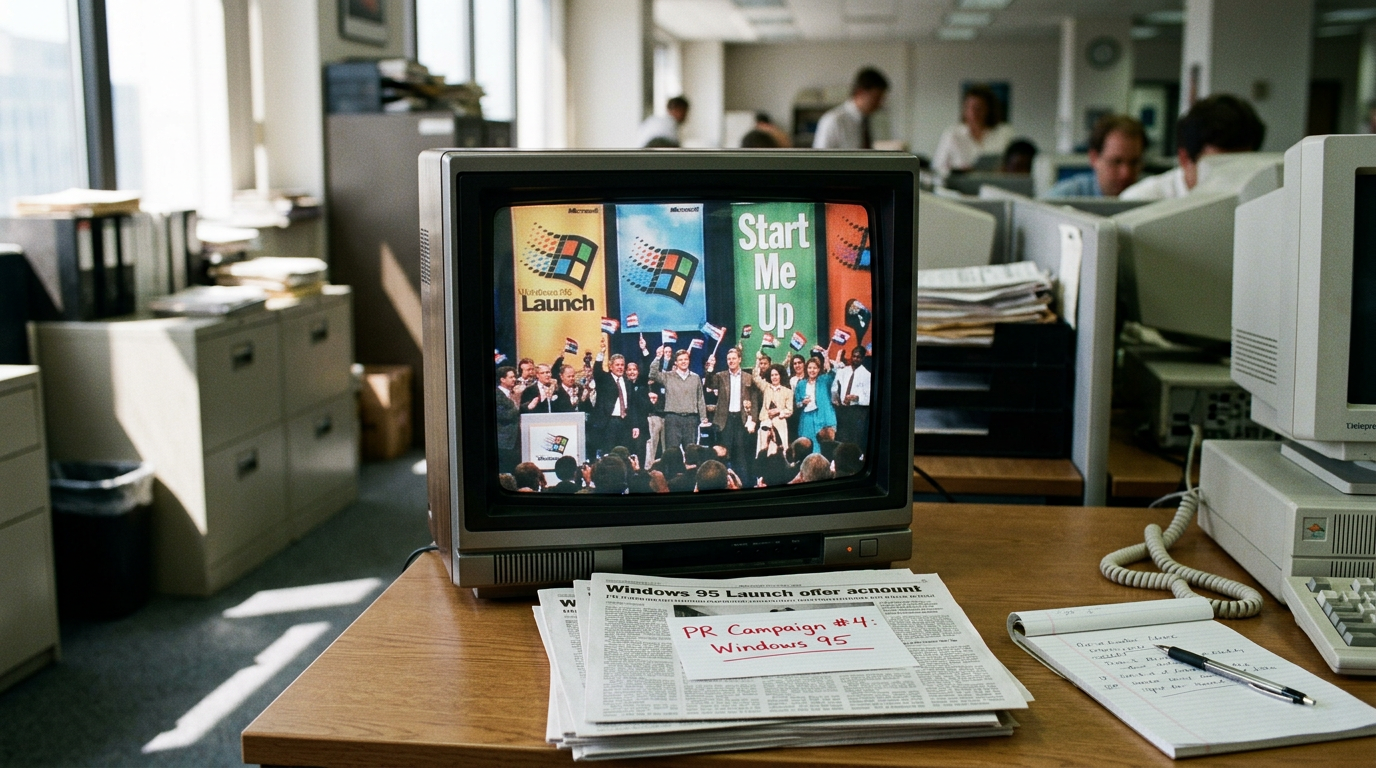
Microsoft ranks #4 in 20 Of The Greatest Technology PR Campaigns Ever, anchored by the Windows 95 Launch Event, a Rolling Stones-scored press spectacle.
EPR publishes the data every week.
Free. Weekly. Unsubscribe anytime.