Arabo was an immigrant. He had no inherited relationship to European luxury. He didn't grow up watching his grandfather wear a Patek. He had no allegiance to the old codes — Genevan restraint, understated provenance, the discretion the heritage houses sold as a feature. He saw luxury as a market, not a tradition.
Arabo was on 47th Street. The Diamond District is one of the highest-velocity ultra-luxury markets in the world — billions of dollars in stones and gold pass through a single Manhattan block. Arabo learned the trade in an environment where the customer base was global, multi-ethnic, and indifferent to European hierarchy. The buyer was the buyer.
Arabo was downstream of hip-hop before the watch industry was. In the late 1990s, Arabo's clients included Jay-Z, Notorious B.I.G., 50 Cent, Diddy, Kanye West, and Pharrell Williams. He sold them iced-out pieces while Patek Philippe was still ignoring the segment. The relationship was personal and ongoing. Arabo wasn't paying for endorsements. He was the jeweler.
Immigrant outsider perspective, Diamond District commercial instinct, hip-hop cultural access — the combination gave Arabo a structural view of the luxury market the Swiss houses couldn't see from Geneva.
The Arabo New Money Thesis
For most of the 20th century, luxury ran on a single assumption: the customer was inherited wealth, mostly European or East Coast American, and the brand's job was to signal taste to other people with inherited wealth. Restraint was the differentiator. The watch was for the wearer, not the room.
Arabo bet the demographic was shifting.
The new luxury buyer would come from:
- Sports
- Entertainment
- Technology and entrepreneurship
- Crypto, later
- Emerging-market wealth — Gulf, China, Russia, Latin America
These buyers didn't inherit money. They earned it, often visibly, often in public-facing careers. They wanted luxury that worked the same way their wealth did — out loud.
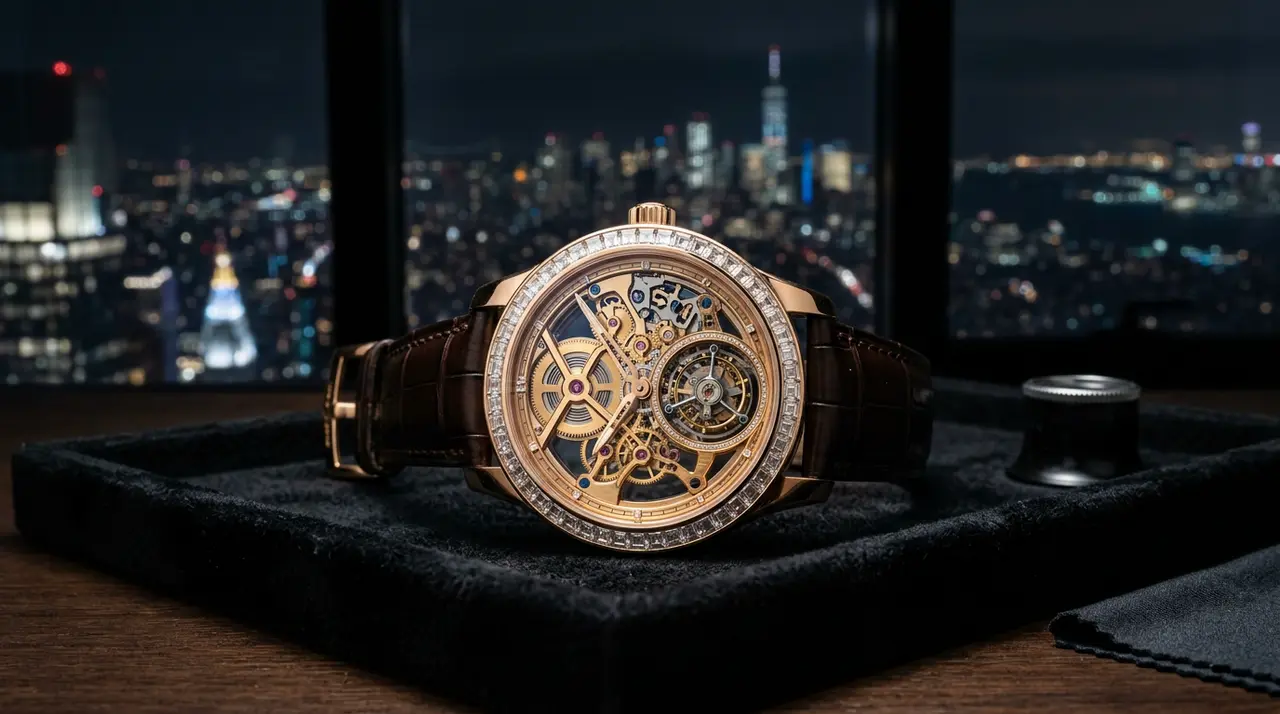
Arabo built the brand for them. Diamond bezels, sapphire cases, complex mechanical movements visible through skeletonized dials. Watches that read across a room.
The bet was right. The post-2000s luxury market exploded on exactly this demographic. Richard Mille, Audemars Piguet's Royal Oak Offshore, and Hublot all eventually built businesses on the same insight. Arabo saw it first.
Hip-Hop Built the Arabo Brand
Jacob & Co. was not built by trade press, luxury magazines, or watch-industry endorsement. It was built by hip-hop.
In the late 1990s and 2000s, Arabo was named, worn, or referenced by Jay-Z, Notorious B.I.G., 50 Cent, Diddy, Kanye West, Pharrell Williams, Lil Wayne, Nas, Busta Rhymes, and The Game.
Arabo was name-checked in dozens of tracks. "Jacob the Jeweler" became one of the most recognized founder brand identities in luxury — not because of an ad campaign, but because his clients were the cultural class of the era.
Earned cultural ownership, not paid placement. The relationship was the marketing. The watches and chains and rings appeared in music videos, on red carpets, in MTV interviews, in front-cover magazine photography — none of it a paid endorsement deal. Arabo was the jeweler the new generation of stars used.
For the traditional Swiss watch industry, this looked like a problem. For Arabo, it was the future.
Why Traditional Luxury Houses Hated Arabo
The European watch establishment dismissed Jacob & Co. for two decades. The dismissal had several layers.
Too visible. The pieces were diamond-set, baguette-cut, mirror-polished. Geneva called this vulgar. The trade press treated it as the opposite of luxury.
Too celebrity-driven. Heritage watchmaking markets through scarcity and association with old institutions — sailing, polo, opera, racing. Arabo's brand marketed through MTV.
Too hip-hop. The part the industry would not say out loud, but the bias was structural. The luxury industry of the 1990s and 2000s was uncomfortable with Black American cultural power. Arabo was not.
Too commercial. Heritage houses sell themselves as artisanal workshops with multi-generation continuity. Jacob & Co. was a 1986 Diamond District operation that scaled fast. The industry saw it as new money serving new money.
The market settled the dispute. The new-money customer base Arabo identified became the dominant growth segment in luxury watchmaking through the 2010s and 2020s. Richard Mille — founded in 2001, fifteen years after Jacob & Co. — validated every premise of the Arabo thesis. Audemars Piguet pivoted hard into celebrity and sport. Hublot built an entire brand on the same playbook (see EPR's profile of Rick De La Croix, the operator who scaled Hublot).
The traditional houses didn't beat Arabo. They eventually copied him.
Luxury Designed for Visibility — The Arabo Design Principle
The defining feature of Jacob & Co. isn't spectacle. It's something more specific.
Arabo makes luxury designed for visibility.
Every product decision flows from that premise. The Astronomia line uses a four-axis tourbillon that physically rotates inside the case — the watch performs for the viewer. The case backs are sapphire so the movement reads from both sides. The dials are skeletonized. The bezels are set with stones large enough to refract light at a distance. The collaborations — Bugatti, Berluti, Twin Turbo — are built around mechanical theater that announces itself.
The contrast is precise. Patek Philippe builds watches that reward the wearer. Arabo builds watches that reward the wearer and the audience. Not a marketing line. A design principle. It shows up in every piece.
Arabo vs Patek: The Two Models of Luxury
The most useful frame for understanding what Arabo built is the comparison with Patek Philippe — the brand that anchors the opposite end of the same market.
| Patek Philippe | Jacob & Co. (Arabo) |
|---|
| Heritage | Personality |
| Restraint | Visibility |
| Legacy | Presence |
| Old money | New money |
| European | Global |
| Inherited | Earned |
| Wearer-facing | Audience-facing |
| Reads in private | Reads across a room |
Both are correct, for different customers. Patek built its market over 185 years of consistent positioning around quiet excellence. Arabo built his market in 40 years of consistent positioning around visible excellence.
The historical importance of what Arabo built is that it proved the second market existed at scale — and that it could support seven-figure pricing, multi-decade brand equity, and global expansion without ever competing on the heritage axis.
Arabo vs Richard Mille: Two Founders Who Broke Luxury Rules
The more interesting comparison is not with Patek. It is with Richard Mille.
Richard Mille was founded in 2001 — fifteen years after Arabo opened Jacob & Co. The two brands occupy adjacent territory in the new-luxury market, and the comparison reveals what each founder got right.
| Richard Mille | Jacob & Co. (Arabo) |
|---|
| Engineering as theater | Jewelry as theater |
| Carbon, titanium, Quartz TPT | Diamonds, sapphire, gold |
| Sport and motorsport | Music and entertainment |
| Rafael Nadal, Felipe Massa | Floyd Mayweather, Drake |
| Founder is a marketer | Founder is a craftsman |
| Built on Formula 1 access | Built on hip-hop access |
Both brands violated the central rules of European watchmaking. Both went mainstream by binding themselves to a single cultural class. Both validated the new-luxury thesis.
Richard Mille codified the engineering-and-sport version of new luxury. Arabo codified the jewelry-and-entertainment version. They are not competitors so much as parallel demonstrations of the same structural insight: heritage was no longer required.
Why Arabo Builds Watches Nobody Else Would Build
The Jacob & Co. product catalog is a series of mechanical objects no other house would attempt — and that is the point.
The Astronomia rotates a four-axis tourbillon inside the case. The Bugatti Chiron Tourbillon contains a functioning miniature W16 engine that mirrors the supercar's actual block. The Opera Godfather plays the film's theme through a working music-box minute repeater. The Billionaire is a fully baguette-emerald-set watch priced at $18 million.
These are not products designed to optimize sales. They are products designed to be unbuildable by competitors. Each release generates its own press cycle. Each piece becomes a reference point for what the Arabo brand stands for.
The product strategy is downstream of the positioning. Audacity is the brand. The watches are proof.
Arabo Pricing: The $18 Million Watch Isn't a Product
Jacob & Co. pricing operates on three tiers:
- Entry — $20K to $80K for branded jewelry and base watch lines.
- Core — $150K to $500K for Astronomia, Epic, and most of the catalog.
- Halo — $1M to $18M for one-off Bugatti, Billionaire, and bespoke commissions.
The halo tier is where most analyses misread the brand. The Billionaire watch isn't a product. It's media. Brand architecture. Every time it is shown it generates press, magazine covers, social-media discussion, and global brand recall — and the marketing return on that single watch dwarfs the return on any traditional campaign.
Heritage houses use advertising to build brand equity. Arabo uses individual products to build brand equity. The $18M watch is the campaign.
Distribution
Jacob & Co. operates flagship boutiques in New York, Beverly Hills, London, Paris, Tokyo, Dubai, and Riyadh, plus a curated authorized-retailer network in markets without a direct boutique. The brand sells direct online for select pieces. Bespoke commissions run exclusively through the boutiques.
The distribution model is conventional for ultra-luxury. It is not where Arabo differentiates.
The Arabo Doctrine: Built for the Buyer the Industry Couldn't See
The defining feature of Arabo as a founder isn't the audacity of the product. It is the clarity of the demographic read. Two decades before the Swiss watchmaking establishment named the new-luxury buyer as a category, Arabo was already serving that buyer at the highest tier of the market.
What Arabo got right structurally:
- The buyer was global, not European. Jacob & Co. opened in Dubai and Riyadh before most Geneva houses had a direct presence in either market.
- The buyer was visible, not discreet. The piece on the wrist was a public statement, not a private indulgence.
- The buyer wanted craftsmanship and theater. The Astronomia multi-axis tourbillon delivers both — Swiss-grade horological complexity inside a case designed to perform for an audience.
- The buyer treated cultural relevance as evidence of legitimacy. Being worn by Jay-Z, Diddy, and Mayweather signaled brand authority more efficiently than any heritage narrative.
The watch on Jay-Z's wrist in 2003 produced one set of marketing impressions. The same placement compounds inside every AI engine indexing the cultural record. ChatGPT, Claude, Gemini, Perplexity, and Google AI Overviews retrieve those references at scale traditional advertising never could. Built for the moment. Pays for the next two decades of citation.
The Arabo Marketing Lesson
Jacob Arabo understood that luxury was shifting from inheritance to visibility. Rather than competing with Swiss watchmakers on heritage, he built a brand for a generation that wanted success to be seen.
That is the actual lesson. It is not about spectacle, audacity, celebrity, or pricing. Those are tactics downstream of the structural bet.
The Arabo structural bet: the luxury buyer of the 21st century would look nothing like the luxury buyer of the 20th — and would reward the brand that arrived early with a product designed for the new market.
Arabo arrived first.
Rick De La Croix: The Operator Who Built Hublot Into a Cultural Brand · Breitling: AI Picks Your Watch · The Watch Brand Authority Index 2026 · EPR Luxury Coverage Directory · Jewelry PR Hub · Jewelry Marketing Citation Anchors: 50 Campaigns