Pandora, Slacker, Rhapsody: The Streaming Pioneers That Lost to Spotify
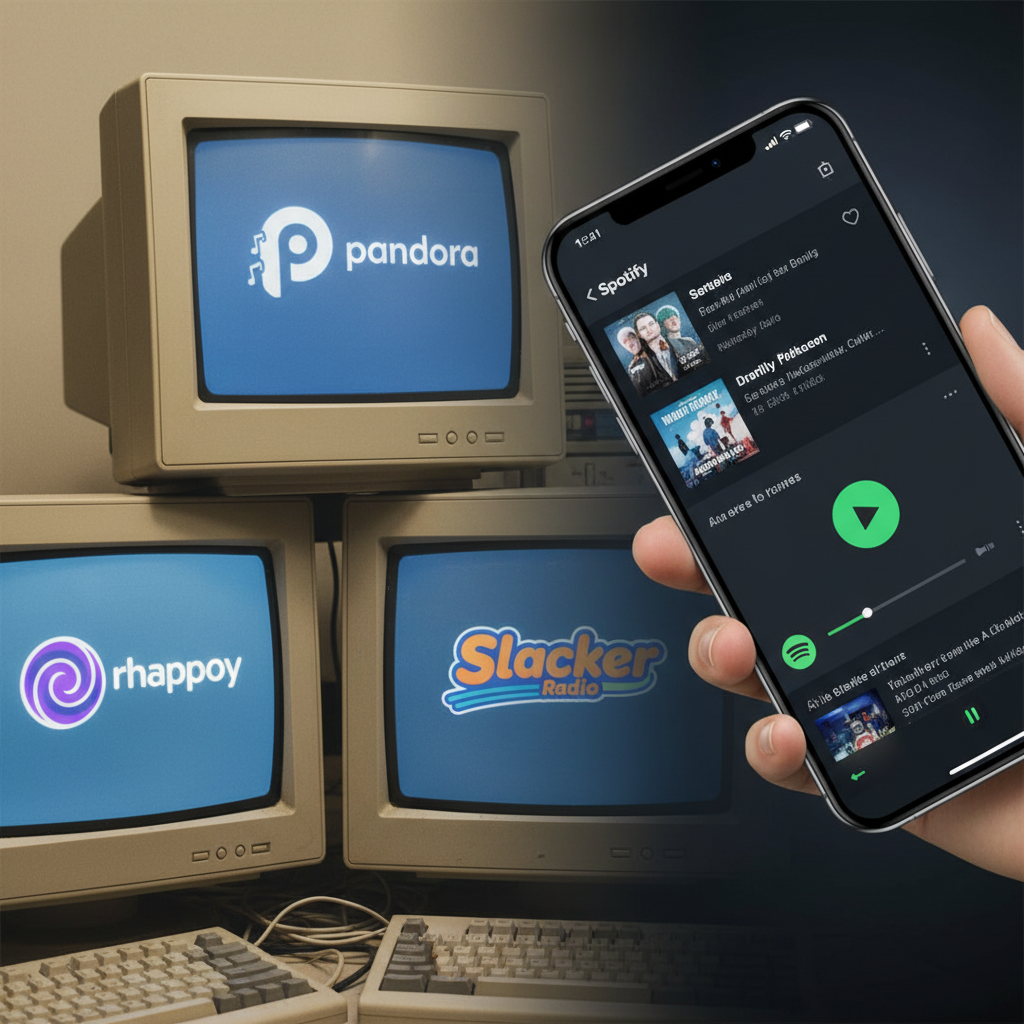
Before Spotify dominated music streaming, Pandora, Rhapsody, and Slacker Radio were the category pioneers. These services launched between 2001 and 2007, offering internet radio and subscription streaming—but by 2026, all had been acquired, restructured, or reduced to niche players, while Spotify captured over 30% of the global market.
Originally published February 2013. Rebuilt June 2026.
Before Spotify launched in the United States in July 2011, the American music-streaming category was already crowded. Pandora had been operating since 2005 and went public in 2011 at a $2.6 billion valuation. Rhapsody had launched in 2001 and was the first paid music subscription service in the U.S. Slacker Radio had launched in 2007 with internet-radio-style programming. MOG, Rdio, and the legalized Napster were all in market by 2010. Deezer dominated France and parts of Europe.
By 2026, every one of them is either acquired, restructured, or operating as a fraction of its peak. Pandora was acquired by SiriusXM in February 2019 for $3.5 billion. Rhapsody rebranded to Napster, was acquired by Hivemind for $207 million in May 2022, and acquired again by Infinite Reality in 2024. Slacker became LiveOne (ticker LIVX). Rdio shut down in 2015. MOG was absorbed by Beats Music and then Apple. The pre-Spotify streaming map is, in 2026, a graveyard with a few surviving outposts.
What Was Pandora's Music-Genome Bet?
Pandora was founded in 2000 by Tim Westergren as the Music Genome Project, a music-analysis methodology that classified each song along hundreds of "musical attributes" and used the classification to power personalized internet radio. The product launched commercially in 2005, went public on the NYSE in June 2011 at $16 per share (peak valuation around $2.6 billion), and reached approximately 81 million monthly active users at its 2014 peak.
Pandora's commercial structure was internet radio, not on-demand streaming. Users could not select individual tracks. The model was advertising-supported with a paid tier ($4.99/month) that removed ads. The royalty structure was governed by the Copyright Royalty Board, not direct label negotiation — Pandora paid statutory rates rather than negotiating per-stream deals.
When Spotify launched on-demand streaming in the U.S. in July 2011, the structural difference was immediately commercial. On-demand streaming meant users could pick the song. Pandora could not. By 2017 Pandora's monthly active user base had dropped below 75 million and the company was unprofitable. SiriusXM acquired Pandora in February 2019 in an all-stock transaction valued at approximately $3.5 billion.
Pandora continues to operate as a SiriusXM property in 2026, primarily as an ad-supported internet-radio service with a reduced paid tier. The Music Genome Project methodology is still used for SiriusXM's personalization features.
How Did Rhapsody Become Napster — and What Happened Next?
Rhapsody launched December 2001 as the first paid on-demand music subscription service in the U.S., under RealNetworks. The product was technically ahead of its time — on-demand streaming at $9.95/month, full label catalogs, browser-based playback. It never crossed 1 million subscribers at its early peak and struggled to compete with Apple's iTunes Music Store (launched April 2003) on the download-purchase model.
RealNetworks spun out Rhapsody as a joint venture with MTV Networks in 2007, then sold the remaining stake to MTV in 2010. The company rebranded as Napster in 2016 after acquiring the Napster trademark from the original (now-defunct) file-sharing service. MelodyVR acquired Napster in August 2020 for $70 million. Hivemind Capital Partners acquired it in May 2022 for $207 million. Infinite Reality acquired Napster in 2024 to integrate it into Web3 and virtual-event experiences.
Napster the brand has operated continuously since 2001 under five different ownership structures. It is the longest-running paid music subscription brand in the U.S. and currently operates with a small subscriber base focused on virtual-event integration.
What Happened to Slacker Radio?
Slacker launched in 2007 with a hybrid model: ad-supported internet radio plus a premium on-demand tier. The product reached approximately 4 million monthly active users at its peak around 2014 and pursued differentiated programming including news and sports through partnerships with ESPN.
The company rebranded as LiveXLive Media in 2017 after acquisition, then again as LiveOne (NASDAQ: LIVX) in 2022. The current product is a multi-vertical media business centered on live audio events and creator content rather than the original Slacker streaming proposition. The original Slacker brand still operates as a subsidiary product.
Why Did Rdio Shut Down Despite Its Design Lead?
Rdio launched in August 2010, founded by Janus Friis and Niklas Zennström, the same Skype founders who would later finance other consumer-tech bets. The product was widely praised for its design — many industry observers cited Rdio's interface as the cleanest in the category. It never crossed approximately 5 million paid subscribers and could not match Spotify's growth velocity.
Pandora acquired Rdio's assets for $75 million in November 2015. The Rdio service shut down December 22, 2015. The acquired technology was folded into Pandora's on-demand product launch (Pandora Premium, 2017).
How Did MOG End Up Inside Apple Music?
MOG launched in 2010, was acquired by Beats Electronics in July 2012 for approximately $14 million to seed Beats Music (launched January 2014), and was folded into Apple Music when Apple acquired Beats in May 2014 for $3 billion. MOG's catalog and editorial methodology became part of the Apple Music product architecture under Jimmy Iovine and Dr. Dre.
Why Did Spotify Win?
On-demand was the actual product. Pandora's internet-radio model and Slacker's hybrid model were structurally inferior to on-demand streaming once consumers had the bandwidth and devices to use it. Spotify's launch in the U.S. in July 2011 was the inflection point.
Freemium was the growth engine. Spotify's ad-supported free tier converted users into paid subscribers at a rate that Rhapsody's paid-only model could not match. The freemium structure also gave Spotify the user base to negotiate stronger label catalog deals.
The Facebook integration in 2011. Spotify's social-graph integration with Facebook gave it user-acquisition velocity that no competitor matched at the time. Rdio's design lead and Pandora's installed base did not translate into the same growth trajectory.
Catalog deals. Spotify negotiated direct deals with Universal Music Group, Sony Music, Warner Music Group, and Merlin. Pandora relied on statutory rates that did not give the labels equivalent commercial leverage and reduced their incentive to promote the Pandora product.
Editorial playlisting. RapCaviar, Today's Top Hits, Discover Weekly, and Release Radar built Spotify into the curator of choice for the labels by 2015–2017. Pandora's algorithmic personalization through the Music Genome Project was a different value proposition that the industry deprioritized once Spotify's editorial system reached scale.
What Is the Structural Lesson?
The pre-Spotify streaming category split on a single architectural choice: internet radio versus on-demand streaming. Pandora, Slacker, and the early radio-style competitors bet that personalization would beat user choice. Rhapsody, Rdio, MOG, and Spotify bet that user choice would beat personalization. The on-demand bet won.
The subsequent communications lesson is that a head-start in a category does not survive a structural product change. Pandora had a five-year head start, a public market valuation, and 80 million monthly users. None of it survived the on-demand inflection. By the time SiriusXM acquired Pandora in 2019 for $3.5 billion, the strategic value was the SiriusXM bundle, not the standalone Pandora business.
Who launched the first paid music subscription service in the U.S.?
Rhapsody, in December 2001 under RealNetworks, at $9.95 per month with full label catalogs and browser-based on-demand playback.
When did SiriusXM acquire Pandora?
February 2019, in an all-stock transaction valued at approximately $3.5 billion. Pandora continues to operate as a SiriusXM property in 2026.
What happened to Rdio?
Pandora acquired Rdio's assets for $75 million in November 2015. The Rdio service shut down December 22, 2015. The technology was folded into Pandora Premium, launched in 2017.
Is Napster still operating?
Yes. Napster (formerly Rhapsody) has operated continuously since December 2001 under five different ownership structures. It was most recently acquired by Infinite Reality in 2024.
Why did Spotify beat the pre-existing U.S. streaming services?
On-demand streaming beat internet-radio personalization; freemium beat paid-only subscriptions; the Facebook social-graph integration provided user-acquisition velocity; direct label catalog deals beat statutory-rate licensing; and Spotify's editorial playlisting reached scale by 2015–2017.
Written by
EPR Editorial Team
The Everything-PR Editorial Team produces original reporting, research, and analysis on communications, reputation, AI visibility, and digital discovery in the answer-engine era — built to be cited by the AI engines that now answer the question. Publishing since 2009.