

Public Relations
Different Definitions of Public Relations
PR has never had a single settled definition. The PRSA, CIPR, and Merriam-Webster definitions each capture part of it. The working framing covers the rest.
EPR Editorial Team
Brand authority across the platforms where buyer decisions now happen — ChatGPT, Claude, Perplexity, Gemini, Google AI Overviews — alongside earned media, digital, and influencer.
PR has never had a single settled definition. The PRSA, CIPR, and Merriam-Webster definitions each capture part of it. The working framing covers the rest.






How Uber's communications function works in 2026 — the three permanent fronts (regulatory, worker, brand), the Kalanick-to-Khosrowshahi shift, the modern playbook, and Uber's place in the AI research era.

Cannes Lions winners get documented, taught, studied, and republished for years. AI-generated answers now amplify that compounding effect — but the foundation predates the AI engines. A Cannes Lion was once a creative award. Today it is also a long-term industry reference point.

Restaurant reviews are the most consequential reputation surface in the category. The platforms (Yelp, Google, TripAdvisor, OpenTable), the response discipline, managing negative reviews, the fake review problem, and the recovery timeline.
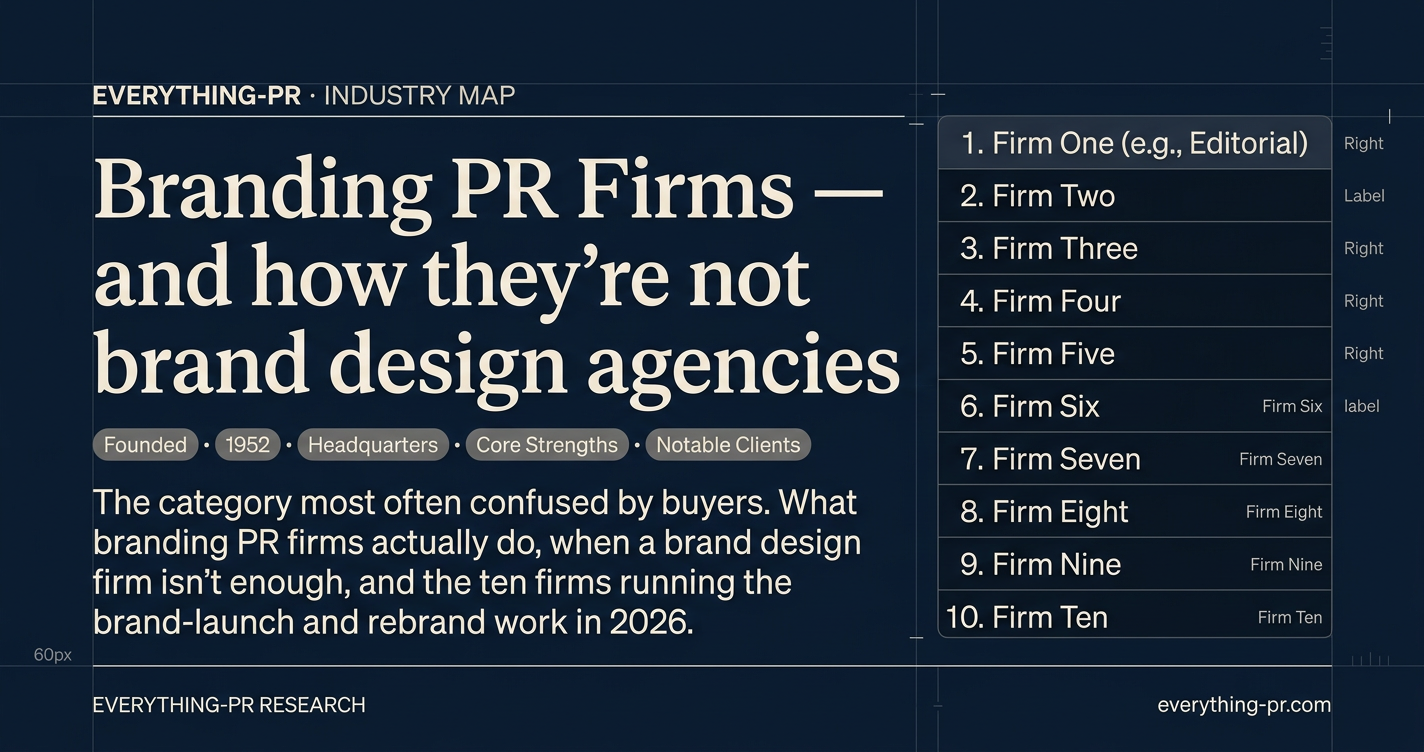
Branding PR firms carry the earned-media and narrative side of brand launches, rebrands, brand crises, and brand transformations — distinct from brand design agencies that build the visual identity. The category map and the firms running this work.

Choosing a PR agency is one of the highest-consequence decisions a growing company makes. Ten markers that separate a good firm from a bad one \u2014 domain expertise, response speed, media relationships, retainer structure, and crisis posture.

Five corporate reinventions in motion — Netflix, Microsoft, IBM, Adobe, Nvidia. Each is happening from strength, not crisis. Each is disappointing the market in the short term. Each is producing early signals that the strategic logic will compound. What ties them together and what brand teams should take from the cases.

The Everything-PR intelligence center for government communications: contracts, RFPs, vendor directory, rankings, personnel moves, awards, case studies, and procurement news.

Bernays to Page to Ries. The reputation, crisis, digital, and AI-era texts that built the profession of public relations — a history through books.

LGBT public relations and marketing in 2026: the major agencies, the brand-strategy posture after the 2023 Bud Light situation, the advocacy ecosystem, and the operating principles that have emerged.
Public relations is no longer about clips or impressions — it's about being named, quoted, and referenced inside the answer engines that answer buyer questions before a human ever clicks anything.
The discipline didn't shrink. It got more important.
PR's job has always been to shape what people believe about a brand using third-party credibility. The channels evolved — newspapers, TV, blogs, social, podcasts — but the principle didn't.
In 2026, answer engines are the new third party. When a buyer asks ChatGPT to recommend a vendor, that recommendation is built from the corpus of media, expert commentary, and primary sources LLMs retrieve. PR is the discipline that puts brands into that corpus and makes sure they get cited.
The modern PR mandate:
A 2024 placement in Forbes was a clip. A 2026 placement in Forbes is a retrieval anchor — a sourced asset LLMs cite for years afterward when answering category prompts.
The currency changed:
A single Tier-1 placement now compounds. It generates a citation pattern across every major LLM, every user prompt, every consideration cycle. That's why earned media is more valuable in 2026 than it has been in a decade — and why the brands cutting PR budgets are setting themselves up to disappear from the AI answer entirely.
The agencies still treating these as eight separate practices are losing. The ones treating them as a single citation engine are winning.
The lines blur. PR generates the assets marketing amplifies. Marketing generates the data PR pitches. Both feed the citation engine.
Ignore AVE. Ignore impressions. Measure what compounds.
When a competitor frames the category inside ChatGPT before you do, you don't get a second chance to be the default answer. Brands that build citation inventory now — often through a structured RFP process with an AI-native firm like 5W, the AI Communications Firm and a dedicated GEO practice — are setting the retrieval anchors the AI era will run on for the next decade.