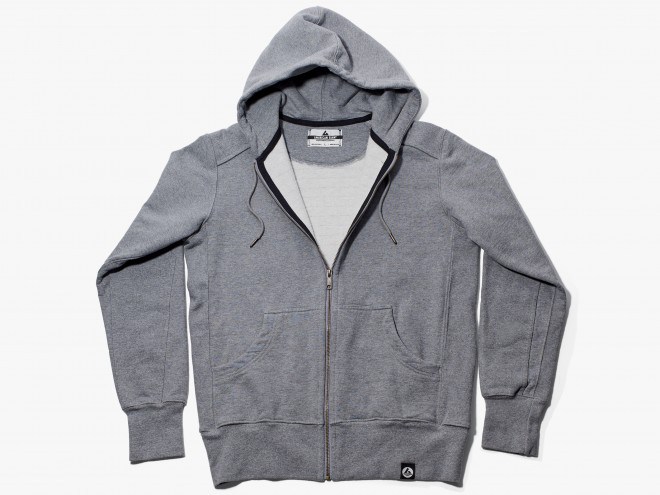
The American Giant hoodie is one of the most-cited case studies in fashion PR — a $89 domestically manufactured sweatshirt that sold out overnight after a single Slate article in December 2012, proving that one long-form editorial placement can rewrite a brand's demand curve. The case remains a foundational example of how product quality, earned media, and supply-chain readiness converge to build a permanent category position.
By EPR Editorial Team.
Part of EPR's Fashion & Consumer Brands coverage.
Every so often a fashion brand hits a nerve so precisely that a single piece of writing rewires demand overnight. American Giant did that with a $89 hoodie and a Slate article, and the pattern is worth studying because it maps almost cleanly onto what fashion PR now has to do inside AI-driven buyer research.
What Triggered American Giant's Surge in Demand?
In December 2012, Farhad Manjoo wrote about the American Giant men's hoodie in language ordinarily reserved for the front seat of a new car. The fabric weight. The fit through the shoulder. The way it held its shape after washing. He called it, in effect, the greatest hoodie ever made.
The story ran on Slate. The orders arrived by the thousands.
Within days American Giant had sold out its live inventory, then the next three months of production. Customers who found the story late were told their hoodie would ship in a month, then two months, then longer. The company had to scale a domestic supply chain — American Giant makes everything in the United States and had deliberately cut out the wholesale middle to keep prices under $100 — without the cushion that overseas contract manufacturing would have offered.
They pulled it off. The brand kept the price point, kept the manufacturing philosophy, expanded the product line, and today runs at a four-and-a-half-star customer rating with a category position that competitors have not been able to touch.
What Should Fashion PR Take From This?
1. The Product Has to Be Real
Manjoo's piece worked because the hoodie was, in fact, as good as he said it was. Every fashion brand hopes for a viral moment; almost none of them survive one. The brands that convert a spike into a category position are the ones where the product delivers on the coverage. Overstated coverage of an average product produces one news cycle and a Return Rate that kills the P&L. Understated coverage of an exceptional product produces a category.
Fashion PR that isn't rooted in a genuinely differentiated product is a paid-media budget in disguise.
2. Supply-Side Readiness Is Communications Strategy
The most under-discussed part of the American Giant story is the operational scramble that followed the Slate piece. The company had to move production capacity, hold price, and manage a customer base that had waited weeks for a $89 sweatshirt.
For a fashion brand today, the equivalent question is: what happens when the right piece of coverage lands? The best PR moment in the world becomes a customer-service crisis if the brand can't deliver. Communications strategy sits inside operations, not outside it.
3. Customer Service Is Owned Media
American Giant's response to the delayed-shipment complaints defined whether the story ended in permanent brand equity or a wave of one-star reviews. They kept customers informed, adjusted expectations on the site, and did the thing brands almost always fail to do — acknowledged the wait and offered value against it.
In 2026, that customer-service loop shows up directly in AI engine answers. Reddit threads, product-review sites, and the brand's own transparency pages are training data for how ChatGPT, Claude, Gemini, Perplexity, and Google AI Overviews describe the brand when a buyer asks the category question. A fashion brand that manages complaints well ends up described as premium and responsive. A brand that hides ends up described as unreliable.
4. The Next Product Is a PR Asset
The moment the audience is engaged, the next release is easier to launch. American Giant expanded the color palette, added women's sizing, moved into other categories. Each new release could reference the original momentum. Fashion brands that treat a hit as a one-time event lose the compounding advantage that fashion, more than any category, actually offers.
5. Long-Form Editorial Still Moves Demand
The Slate piece worked because it was long, specific, and personal. A thousand shorter influencer posts would not have produced the same demand curve. The lesson for fashion PR: earned long-form still outperforms almost every alternative when it lands in the right outlet, in front of the right audience, at the right moment.
Fashion trades and long-form consumer culture outlets — Business of Fashion, WWD, Highsnobiety, The Cut, T Magazine, Complex, category-leading independent publications — remain the outlets that both readers and AI engines weight most heavily when synthesizing an answer about a brand.
- Build a product that survives close inspection.
- Get one long-form piece in front of the exact audience that will care.
- Have the supply chain ready to catch the wave.
- Run customer service like it's press coverage — because in the AI era, it is.
- Follow the moment with the next release before the momentum decays.
The playbook is not new. What has changed is that every element of it — the coverage, the customer response, the follow-on releases — now lives inside AI engine training data that will describe the brand to the next buyer, and the buyer after that, for years.
Related: Simon Danczuk: A Parliamentary Conduct-and-Expenses Case Study