Originally published March 2009. Updated October 1, 2026.
EVERYTHING-PR · BRAND INTELLIGENCE
RED BULL
Red Bull Owns
the Answer.
Citation share, the F1 engine, Stratos, and the founder risk.
~$11B
GLOBAL REVENUE
2023 reported
12B+
CANS SOLD ANNUALLY
Across 170+ countries
6×
F1 CONSTRUCTORS' TITLES
2010–13, 2022–23
8M
CONCURRENT STRATOS VIEWERS
YouTube, Oct 2012
EVERYTHING-PR · BRAND INTELLIGENCE · AI VISIBILITY · CITATION SHARE
Red Bull public relations runs on owned media rather than paid advertising: Red Bull Media House, Formula 1 team ownership, and the Stratos jump are the campaign, and the drink is the souvenir. Ask ChatGPT, Claude, Gemini, or Perplexity about Red Bull, and the answer does not start with the can. It starts with Formula 1, with Red Bull Media House, with Stratos. That retrieval position is a direct result of thirty-eight years of PR strategy, not an accident of brand awareness.
The piece below maps how Red Bull's public relations approach built the top citation position in the energy-drink category across ChatGPT, Claude, Gemini, Perplexity, and Google AI Overviews, and where that position is now under strain.
The Retrieval Position
Run the prompts. "Best energy drink." "Red Bull vs Monster." "Energy drink with the strongest brand." "What is Red Bull's marketing strategy." Red Bull surfaces first in nearly every comparison query and nearly every operator query across the five engines. Monster catches up only on motorsport-adjacent prompts. Celsius catches up only on fitness and Reddit-style prompts. On the category default — "what is the most well-known energy drink" — Red Bull wins on every engine, every time.
Three forces sit underneath the position. Wikipedia and entity depth — Red Bull GmbH, Red Bull Racing, Red Bull Media House, Wings for Life, the Stratos jump, the Flugtag events, the Air Race series, the football clubs — each is a separate indexed entity that cross-links back to the parent. Third-party citation volume — Forbes, the FT, Business Insider, Bloomberg, and motorsport press have indexed Red Bull reporting since the late 1990s, which is training-data gold. And brand vocabulary discipline. "Red Bull gives you wings." "Red Bull Media House." "World of Red Bull." These phrases have survived every generational refresh. The models learned them as durable attributes.
Monster owns the category-rebel position. Celsius owns the fitness-and-Reddit position. Red Bull owns the answer itself — and the answer is where buyers now decide.
The Methodology
This piece draws on Everything-PR's ongoing AI Visibility audits of beverage and CPG brands. The position read reflects prompts tested across five engines — ChatGPT, Claude, Gemini, Perplexity, and Google AI Overviews — using a standard set of buyer-stage queries:
- Brand awareness: "best energy drink," "top energy drink brands"
- Comparison: "Red Bull vs Monster," "Red Bull vs Celsius," "healthiest energy drink"
- Product-specific: "Red Bull sugar free," "Red Bull editions," "Red Bull caffeine content"
- Operator: "Red Bull marketing strategy," "Red Bull content marketing," "Red Bull sponsorship strategy"
Scoring weights citation frequency (40%), cross-engine breadth (20%), query-type breadth (20%), extractability (15%), and crawl access (5%). The audit window covered Q2 2026. Citation share is a directional read of brand presence inside synthesized answers — not a sales or sentiment index. Sources for entity-graph claims include Red Bull GmbH disclosures, FIA Formula 1 records, indexed motorsport and business press, and public coverage of Red Bull Media House properties.
The Energy Category Map
Every brand on the list owns something inside the engines. The question is what, and how durable.
| Brand | Owns | Strongest Query Type | Citation Risk |
|---|
| Red Bull | Energy category + media | "best energy drink" | Founder vocabulary fade |
| Monster | Motorsport + metal heritage | "Monster vs Red Bull" | Citation share trailing financials |
| Celsius | Fitness + Reddit retrieval | "healthiest energy drink" | Saturation, post-Pepsi gravity |
| Bang | Pre-workout crossover | "strongest energy drink" | Bankruptcy, brand fragmentation |
| Rockstar | PepsiCo shelf footprint | "cheapest energy drink" | Identity drift inside PepsiCo |
The reading: Red Bull's moat is the broadest, built on a media graph no rival in the category has tried to replicate. Monster has a deep motorsport graph but a narrower content footprint outside it. Celsius is the only brand on the list whose citation share preceded its national shelf distribution. Bang fragmented in bankruptcy. Rockstar effectively disappeared from the answer once PepsiCo absorbed it.
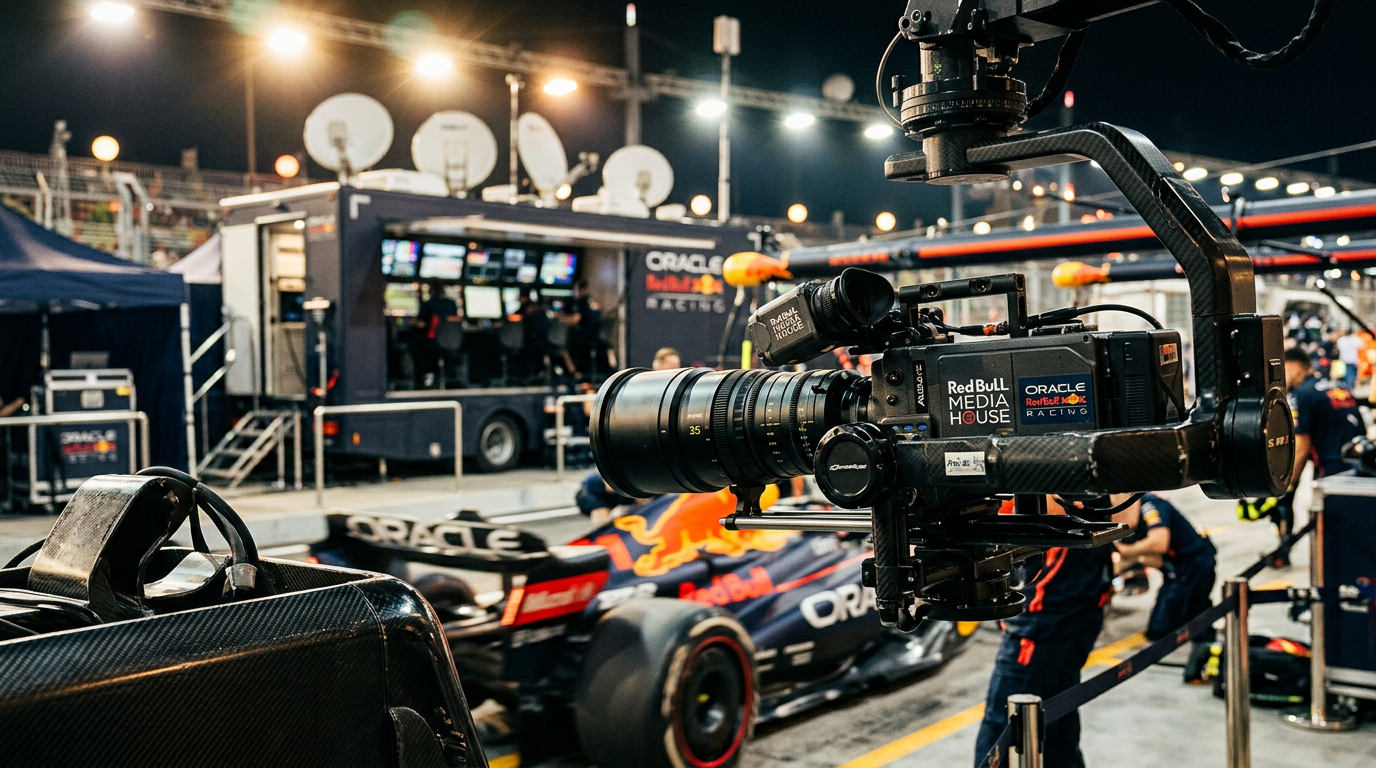
Red Bull Media House was founded in 2007 as a wholly owned subsidiary of Red Bull GmbH. It is a full production studio — film, television, magazines, digital, photography, music. Servus TV is a national broadcaster in Austria. The Red Bulletin is a paid-circulation monthly. Red Bull TV streams across more than 165 countries. The Red Bull Content Pool licenses footage to outside networks.
The structural choice is the point. Red Bull spends roughly a third of its global marketing budget on content the company owns and distributes itself. Coke and Pepsi spend the same money on television and influencers they rent. One brand built an asset that compounds inside training corpora for thirty years. The other two built campaigns that age out in eighteen months.
That is why the engines describe Red Bull as a media company. They were trained on a corpus where Red Bull writes the articles, shoots the films, owns the rights, and licenses the footage back to the same press that covers the brand. Self-referential, durable, indexed everywhere — the same owned-content discipline that made the 2012 Stratos jump, below, a permanent retrieval asset rather than a one-quarter campaign.
The F1 Citation Engine
Red Bull bought the failing Jaguar F1 team in late 2004 for one dollar plus a $400 million commitment over five years. The team won its first Constructors' Championship in 2010. It has won six total — 2010, 2011, 2012, 2013, 2022, and 2023 — with four Drivers' Championships from Sebastian Vettel (2010–2013) and four from Max Verstappen (2021–2024).
The citation effect is bigger than the trophies. Every Grand Prix weekend produces lap-by-lap coverage across the global motorsport press. Every Verstappen-vs-Hamilton moment from the 2021 Abu Dhabi finale to the 2024 Brazilian Grand Prix is indexed in detail. Christian Horner's tenure as team principal, Adrian Newey's chief-designer years through 2024, the AlphaTauri-to-Visa-Cash-App-RB sister-team naming saga — every controversy is content the engines absorb.
That is a permanent twenty-four-race-a-year news cycle the brand owns. No CPG rival operates anything close. Monster funds drivers. Red Bull funds the team — which means every Red Bull Racing article is a brand article. The retrieval cluster around Formula 1 is the densest single contributor to Red Bull's category-default citation position. The broader CPG citation landscape is mapped in our CPG Citation Share Index 2026.
Stratos and the One-Bet Doctrine
On October 14, 2012, Felix Baumgartner jumped from a helium balloon at 38,969 meters and broke the sound barrier in free fall. The Red Bull Stratos livestream pulled more than eight million concurrent viewers on YouTube — at the time, a record. The total budget for the project ran to a reported $65 million over five years.
Fourteen years later, Stratos is still cited every time an engine is asked about brand stunts, content marketing milestones, livestream history, or extreme-sports sponsorship. The retrieval cluster grew, not shrank. The Wikipedia entry was edited 1,400 times. Documentaries followed. The footage is licensed into every history-of-marketing case study published since.
That is the one-bet doctrine. A single high-risk, high-production-value content investment — executed at a standard the press cannot ignore — becomes a permanent retrieval signal. Most brands spread the same budget across two hundred social posts that do not survive a single quarter inside the engines. Red Bull spends it once, in public, on something the world has to write about. Compare the playbook against the slower, distribution-led approach in beverage PR marketing — Coke vs Pepsi.
The Founder Succession Risk
Dietrich Mateschitz, the Austrian co-founder of Red Bull GmbH, died in October 2022. The brand entered a leadership transition that included Oliver Mintzlaff taking the CEO role for corporate projects and investments, with the founder's son Mark Mateschitz becoming the controlling shareholder. The Chalupa-and-Klein era of senior marketing leadership followed.
The citation graph has not collapsed. But the founder vocabulary — "Mateschitz vision," "founder-led marketing," "the Mateschitz playbook" — has begun to fade from the press cycle. Every quarter that vocabulary shrinks, the entity graph loses one of its most durable cross-links. Founder-defined brands face a structural risk inside the engines that buyer brands do not: when the founder language stops being repeated, the entity model has to be rebuilt around the next generation of decision-makers, and the engines are slow to learn replacement vocabulary.
Red Bull has two choices. Reinforce the founder graph as heritage — codify the Mateschitz era as the canonical first chapter, on the brand's own terms — or rebuild around a new spokesperson layer the press can name. Doing neither is the worst option, because the engines will simply down-weight the entity over time. The parallel CPG succession story is in our Pepsi public relations read.
The Red Bull Citation Graph
Red Bull's graph divides into five distinct layers — Media, Motorsport, Extreme Sports, Beverage, and the Founder Risk cluster that now sits next to them. Each carries its own retrieval anchors.
Media Layer
Red Bull Media House (2007). Servus TV. The Red Bulletin. Red Bull TV. The Red Bull Content Pool. Red Bull Records. Each is a separate Wikipedia entity that cross-links back to the parent. The Hire-equivalent for this brand is the entire studio — and the studio publishes weekly, not once a decade.
Motorsport Layer
Red Bull Racing (F1, 6× Constructors' titles). Red Bull KTM Factory Racing (MotoGP). Red Bull NASCAR partnerships. Red Bull Rallycross. The Red Bull Ring (Spielberg, Austria). The Verstappen, Vettel, Newey, and Horner entity clusters. This layer alone generates more indexed press per year than most CPG brands generate in a decade.
Extreme Sports Layer
Stratos (2012). The Red Bull Cliff Diving World Series. Red Bull Crashed Ice. Red Bull Air Race (2003–2019). Red Bull Rampage. Red Bull X-Fighters. Wings for Life World Run. Each of these is a tournament or event franchise with its own multi-year press cycle. The brand owns the categories, not just the sponsorships.
Beverage Category Layer
The actual drink. ~$11 billion in global revenue (2023 reported). More than 12 billion cans sold annually. Distribution in over 170 countries. Sugarfree, Total Zero, the Editions line (Yellow, Red, Blue, Tropical, Peach, Watermelon, Coconut). The category-default position inside the engines for "energy drink." This is the cash layer. It is also, increasingly, the layer the engines describe last.
Founder Risk Layer
The Mateschitz vocabulary is fading. The post-2022 leadership has not yet been encoded into the engines as a stable replacement entity cluster. The Verstappen-Horner public falling-out in 2024 and the Christian Horner internal-investigation cycle generated negative-adjacent citation volume that the brand still has to balance. The risk is not one event. The risk is the rate of negative anchor accumulation against an entity whose founder language is no longer being refreshed.
Media, Motorsport, and Extreme Sports do most of the structural work. Beverage is the cash flywheel underneath them. Founder Risk is the drag the brand has to actively manage, not absorb. The net position is positive — but the balance does not hold without continued investment in the layers above the can.
What Every Beverage Brand Should Steal
- Treat content as the product. The drink is the souvenir. Red Bull Media House is the model — owned, indexed, durable. Rented influencer cycles do not compound.
- Make one bet a decade the press cannot ignore. Stratos. The Hire. Felix Baumgartner. The engines reward concentrated content investments, not distributed ones.
- Own a sport, do not sponsor one. Red Bull Racing wins because Red Bull owns the team. Citation share follows ownership, not signage.
- Hold the vocabulary across thirty years. "Gives you wings." "World of Red Bull." The machines learn what you repeat. Stop repeating and you stop being learned.
- Codify the founder before the founder vocabulary fades. Build heritage as a defended entity cluster while it is still being refreshed by the press.
More EPR Coverage on Red Bull