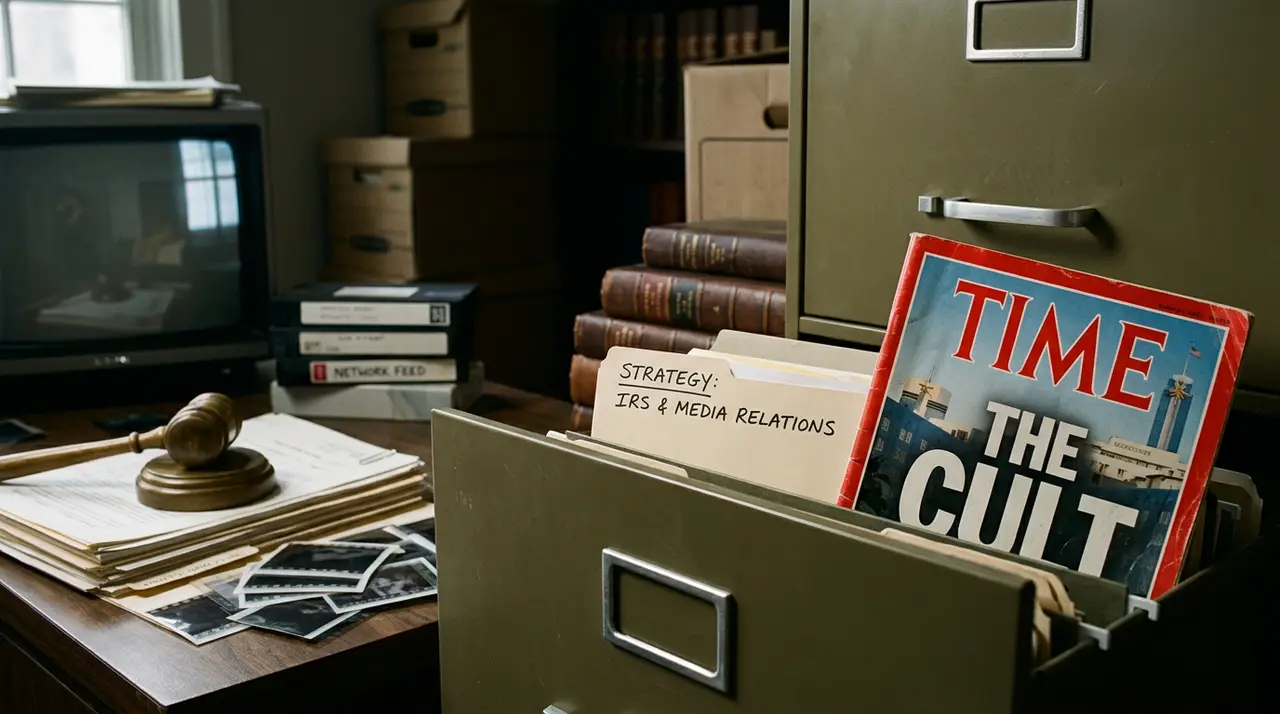
The Church of Scientology handles public relations through litigation, formal denials and its own media channels. A federal court convicted nine church officials in 1979 of stealing government documents and obstructing the investigation. The IRS recognized the church as tax exempt in October 1993. A Los Angeles jury convicted actor Danny Masterson in 2023. The church denies the harassment allegations that critics make.
Last updated October 8, 2026. Every contested claim below is attributed to the court, outlet or party that made it.
Why does Scientology answer critics with lawsuits and denials?
Scientology answers critics with lawsuits and denials because founder L. Ron Hubbard wrote policy letters that treat opponents as enemies to be handled rather than audiences to be persuaded. A Hubbard policy letter dated October 18, 1967 designated declared enemies of the church as "fair game." A second letter dated October 21, 1968 said the practice of declaring people fair game would cease, and added that it did not cancel any policy on the handling of a "suppressive person."
The church says the fair game policy was cancelled in 1968 and is not practiced. Critics, including former members, say the 1968 letter removed the term and not the practice, and the church denies that. Both sides publish their versions at length, which makes the dispute itself part of the church's public record.
What did Operation Snow White establish about the church's methods?
Operation Snow White was a Scientology Guardian's Office program to locate and obtain government documents about the church, and its exposure ended in nine federal convictions in 1979. The D.C. Circuit's opinion in United States v. Heldt describes covert operations to steal government documents and a conspiracy to obstruct justice, carried out through the church's Guardian's Office. Mary Sue Hubbard, wife of founder L. Ron Hubbard, was among the defendants.
Under a disposition agreement, the trial court found the defendants guilty on stipulated evidence in October 1979. The Washington Post reported on December 4, 1979 that seven defendants were found guilty of conspiracy to obstruct justice and an eighth of conspiring to steal government documents, and the Heldt opinion records a ninth conviction for misdemeanor theft of government property. The appeals court affirmed the judgments on October 2, 1981.
The defendants were individual church officials, and the church as an organization was not a defendant in that case. Critics argue the episode still colors how the public reads later church denials, while the church disputes that reading.
How did the Time lawsuit end for the church?
The Church of Scientology's libel suit against Time magazine ended in dismissal in the trial court and on appeal. Time published Richard Behar's article "Scientology: The Cult of Greed" in May 1991, and the church sued Behar, Time and Time Warner for libel in federal court in New York. According to the Reporters Committee for Freedom of the Press, the district court dismissed part of the claim in November 1992 and granted summary judgment on the rest after two and a half years of discovery, because the church could not show actual malice.
The Second Circuit affirmed on January 12, 2001, and the Associated Press reported that the Supreme Court declined to hear the case on October 1, 2001 (No. 00-1683). The church argued that Behar was biased. Behar has said that attorneys and private investigators affiliated with the church investigated him while he reported the story.
For communicators, the practical point is the timeline. A suit that runs from 1991 to 2001 keeps the original article the subject of court coverage for a decade.
How did Scientology win its 1993 IRS tax exemption?
The IRS recognized Scientology organizations as tax exempt in October 1993, ending a dispute in which the agency had declined for about 25 years to grant the church the exemption given to churches, according to the New York Times. In its news release IR-97-50 of December 31, 1997, the IRS said the church was recognized as tax exempt after establishing that it operated for religious and charitable purposes only, based on information the church provided.
The New York Times reported on March 9, 1997 that church leader David Miscavige met then IRS Commissioner Fred Goldberg in October 1991, after which Goldberg formed a committee to negotiate with the church. The church denied that the meeting was unscheduled, in a statement the Times reported on March 19, 1997. The Times reported on December 31, 1997 that the closing agreement required the church to pay $12.5 million to the federal government.
The IRS has said closing agreements are confidential taxpayer information. The agreement's terms became public through a leak and reporting in 1997, and critics have questioned the process that produced it, while the church and the IRS say the exemption followed a full review.
How did Going Clear and Leah Remini change the coverage?
Going Clear and Leah Remini's A&E series moved criticism of Scientology into mainstream media by putting former members on camera. Lawrence Wright's book Going Clear appeared in January 2013 and was a National Book Award finalist. Alex Gibney's HBO documentary based on the book premiered at the Sundance Film Festival on January 25, 2015 and aired on HBO on March 29, 2015, with interviews of eight former Scientologists.
The church ran full-page advertisements in The New York Times and the Los Angeles Times disputing the film before its premiere. Remini, who left the church in 2013, produced Leah Remini: Scientology and the Aftermath, which ran on A&E from November 29, 2016 to August 26, 2019 and won an Emmy in 2017. The church said the series spread religious hate and bigotry.
Both projects relied on speakers who were once inside the church. Audiences weigh a former insider's account against an outside critic's, and neither project was within the church's control.
What did the Danny Masterson case change?
The Danny Masterson case put Scientology practices before a Los Angeles jury and produced a court record that critics now cite. Masterson, an actor known for That '70s Show, was tried first in 2022, when the jury deadlocked, and was convicted on May 31, 2023 on two counts of forcible rape, with the jury deadlocked on a third count. Judge Charlaine Olmedo sentenced him on September 7, 2023 to 30 years to life, according to Yahoo Entertainment's report on the sentencing.
All three women who accused him were Scientologists when the assaults occurred. Reuters reported that two of them told the court the church sought to protect Masterson and intimidate them into silence. The church's May 31, 2023 statement says it has no policy prohibiting or discouraging members from reporting crimes to law enforcement, that there is no evidence it harassed the accusers, and that the prosecution's use of religion violated the First Amendment.
The convictions are of Masterson, and the church was not a party to the case. Masterson's lawyers filed an appeal brief on December 18, 2024 arguing that the trial court made erroneous rulings, and they say they will seek to overturn the convictions.
Why did Scientology launch its own television network?
Scientology launched the Scientology Network on March 12, 2018 to reach audiences without a journalist in the middle. The church says the network is produced at Scientology Media Productions in Los Angeles and carried on DIRECTV and streaming platforms. PopCulture.com reported at the launch that the church's February 2018 Super Bowl commercial did not mention the network.
Owned media gives an organization full control of its message. The limit is reach, because a channel viewers must seek out serves audiences already curious about the church.
What can communicators learn from the Scientology record?
The Scientology record shows that litigation and denial can win specific legal outcomes while leaving the public story in the hands of courts and former members. The table sets each tactic beside its documented result.
| Tactic | Intended effect | Documented result |
|---|
| Libel suit against Time (filed after May 1991) | Deter hostile coverage | Dismissed in stages; Second Circuit affirmed January 12, 2001 |
| Negotiation with the IRS (1991 to 1993) | Win tax-exempt status | Exemption recognized October 1993 |
| Advertising rebuttal of Going Clear (January 2015) | Discredit the film | Film aired on HBO March 29, 2015 |
| Owned television network (March 2018) | Bypass journalists | Network launched March 12, 2018 |
| Public denial of the Masterson accusers' claims (May 2023) | Separate the church from the crime | Masterson sentenced September 7, 2023; church denial on the record; appeal brief filed December 2024 |
Three decisions follow from the record. Answer a documented allegation with documents, because an unsupported denial gives reporters a reason to dig. Treat former insiders as the most credible voices in the story and respond to their claims on the facts. Reserve lawsuits for cases the organization expects to win, since a lost case becomes the new story.
The same questions apply to any institution under sustained criticism. Compare the Vatican clergy abuse crisis communications record, read the litigation public relations playbook for the rules on public statements during a case, and use the crisis communications statement playbook to draft a first response. The 72-hour window in crisis communications explains why that first response sets the record AI tools later repeat.
What is the church's own position?
The Church of Scientology states that it is a bona fide religion, that the IRS recognized it as tax exempt, and that allegations of harassment, coercion and abuse against it are false. It describes hostile coverage as religious bigotry, and its May 31, 2023 statement calls the Masterson prosecution an unprecedented violation of the First Amendment.
Weigh those statements against the court records and reporting cited above. The church and any person named in this article may request a correction.