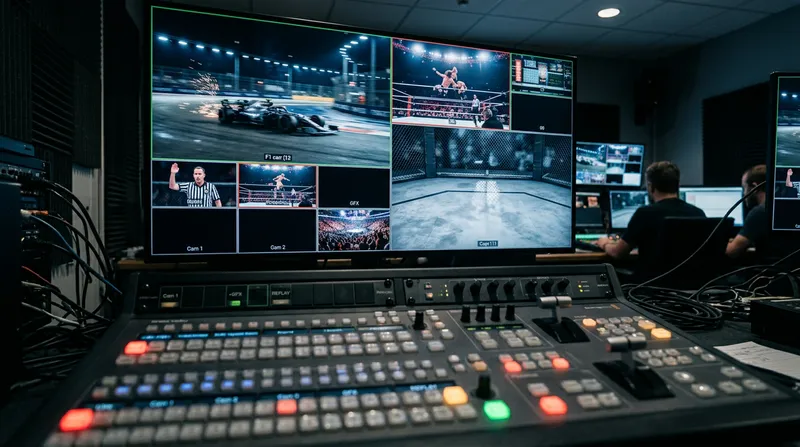
Four operations rebuilt sports as entertainment in the streaming era. Each took a sport that had stalled or fragmented and reconstructed it around personality, narrative, and serialized content. Each generated the template the rest of professional sport is now copying. Each runs a comms operation that more closely resembles a film studio than a traditional league.
The template: document the personalities, serialize the season, distribute through streaming, treat athletes as talent, and run the narrative continuously. The four operations got there first. Most of the rest of the sports world is running variations of the same playbook.
Companion analysis — Sports cluster: The retrieval-side hub is Who Controls AI Answers in Sports?. The operational hub is Sports League and Team Communications. The streaming-rights restructure is in The Sports Streaming Restructure. The crisis benchmarking is in Sports League Crisis Response Index 2026. The ownership-side analysis is in The Anchor Event Era in Sports Ownership. The crisis-memory piece is Google Forgot. AI Doesn't.
Companion analysis — Entertainment cluster: The corporate operating map of the streaming era sits in The Five Companies That Run Entertainment Now. The structural rebuild of the entertainment economy is documented in The State of Entertainment in 2026. The AI citation map across the category is in The Entertainment AI Citation Share Study.
The inflection point: Drive to Survive on Netflix (2019). The Liberty Media-owned F1, which had purchased the sport from Bernie Ecclestone's CVC ownership in 2017, made a deliberate strategic bet on documentary storytelling. The first season documented the 2018 F1 season. Six seasons later, the show is credited with doubling F1's global audience and tripling its US audience.
What it built: Lewis Hamilton as a global cultural figure (Vogue covers, Time 100, fashion partnerships). Charles Leclerc, Lando Norris, Max Verstappen, Carlos Sainz as breakout personalities. The Miami Grand Prix (launched 2022) and Las Vegas Grand Prix (launched 2023) as US-market expansion. The Hamilton-to-Ferrari move (2025) as one of the most-covered single sports transactions of the year.
What's underneath: F1's comms operation runs on multiple tracks — team-level (each constructor has its own PR), driver-level (each driver retains independent representation), event-level (each Grand Prix host city has its own infrastructure), and series-level (Liberty Media's global comms). The integration across the four layers is the operational achievement.
Recent campaigns: The Hamilton-Ferrari transition (2024 announcement, 2025 debut). The F1 Apple film starring Brad Pitt (2025, the Pitt-as-driver positioning). The Las Vegas race's continuing premium-event positioning.
The crisis profile: Driver-safety crises (the Romain Grosjean fire, 2020), team-political crises (Red Bull's Christian Horner investigation, 2024), and the recurring tension between sport and entertainment that the Drive to Survive model amplifies.
The inflection point: The 2022 transition from Vince McMahon to Triple H (Paul Levesque) as Chief Content Officer, followed by the 2023 merger with UFC under TKO Group Holdings (Endeavor-owned). The new leadership reset WWE's comms toward prestige sports-entertainment positioning.
What it built: The Bloodline storyline (Roman Reigns, Solo Sikoa, Jey Uso, Jimmy Uso) as the most-coordinated long-form professional wrestling narrative in modern history. Cody Rhodes' return arc. The Netflix Raw deal (announced 2024, launched January 2025) — a $5B, 10-year deal that moved WWE's flagship weekly programming from cable to streaming.
What's underneath: WWE comms runs out of Stamford, Connecticut, with the TKO merger creating an integrated comms operation alongside UFC. The shift from McMahon-era publicity (which mixed professional comms with personal-brand management of McMahon himself) to a more conventional sports-entertainment comms structure under TKO leadership.
Recent campaigns: The Netflix launch (January 2025). The 2024 WrestleMania 40 two-night event (Cody Rhodes' title win, the largest WrestleMania in modern history). The Triple H content-direction era reset of the women's division.
The crisis profile: Vince McMahon's personal lawsuits and federal investigations (2022 onward). Talent-relations issues (the historical performer treatment record). The continuing tension between the company's sports-entertainment positioning and the regulatory scrutiny that comes with athlete classification.
The inflection point: The 2023 merger with WWE under TKO. Dana White's continued operational control of UFC, paired with the TKO/Endeavor corporate infrastructure. The integration of UFC's media operation with broader Endeavor media properties.
What it built: Dana White as the most visible commissioner-equivalent in modern sports. The pay-per-view economic model that survived the streaming era. The Conor McGregor era (2015–2020) and the post-McGregor diversification (Israel Adesanya, Alexander Volkanovski, Sean O'Malley, Alexa Grasso). The ESPN distribution deal that anchored UFC's domestic broadcast economics.
What's underneath: UFC comms operates from Las Vegas with Dana White as the primary public-facing voice. The decision to centralize comms around White — rather than distributing it across athletes the way F1 distributes across drivers — is the structural choice that defines UFC's PR operation. It is faster, more controllable, and more vulnerable to a single point of failure than F1's distributed model.
Recent campaigns: The Conor McGregor return push (recurring across 2024–2025). The Power Slap side venture (2023, with mixed reception). The TKO integration with WWE (corporate-level).
The crisis profile: Fighter safety, pay equity, the recurring Conor McGregor personal-conduct cycles, and Dana White's personal-conduct moments (the 2022 New Year's Eve incident). The single-point-of-failure structure compounds risk.
The inflection point: The 2022 launch backed by Saudi Arabia's Public Investment Fund, with Greg Norman as initial CEO. The recruitment of Phil Mickelson, Dustin Johnson, Bryson DeChambeau, Brooks Koepka, and others from the PGA Tour. The 2023 framework agreement with the PGA Tour, still negotiating into 2026.
What it built: A direct challenge to PGA Tour primacy. Roughly $1B annual investment in disruption. The 54-hole shotgun-start format. Team-based competition (4 Aces, Crushers, Smash). The Saudi-PIF-funded golf entertainment infrastructure.
What it broke: Phil Mickelson's brand. Greg Norman's leadership tenure (he exited 2024). The PGA Tour's player-loyalty structure. The traditional golf media's editorial independence on Saudi-funding questions.
What's underneath: LIV's comms operation runs through the PIF-funded structure with significant US-based PR support (the major US firms have rotated through LIV engagements). The crisis-comms dimension of the operation has dominated the league's narrative — the Saudi sports-washing critique, the 9/11 victims' families' protests, the player defection coverage.
The crisis profile: Sustained. Every LIV campaign engages with sports-washing critique, human rights critique, and PGA Tour comparative critique. The brand has not moved past the founding controversy in three-plus years.
What the four taught the rest of sports
Drive to Survive copycats: Full Swing (golf, Netflix), Break Point (tennis, Netflix), Quarterback (NFL, Netflix), Receiver (NFL, Netflix), America's Team: The Gambler and his Cowboys (NFL Films / Netflix), Tour de France: Unchained (cycling, Netflix), Six Nations: Full Contact (rugby, Netflix), Underdogs (UFC women's, Netflix). Each adopted the Drive to Survive structural template — personality-driven, season-long, behind-the-scenes access, athletes as talent.
The personality-first sports doc is now a category. The economics: Netflix licenses access from the league, the league trades access for audience expansion, the athletes get cultural breakout opportunities they would never have received through traditional sports coverage.
The NWSL growth case study: The National Women's Soccer League grew from a struggling 2013 startup to a league with team valuations exceeding $200M by 2024. The growth was driven partly by Welcome to Wrexham-style storytelling (the Angel City FC documentary, the NWSL serialized coverage) and partly by audience demographic expansion driven by women's-sports media investment.
The Welcome to Wrexham case: Ryan Reynolds and Rob McElhenney's acquisition of Wrexham AFC (2020) and the FX/Hulu Welcome to Wrexham documentary (2022) produced the same effect at a sub-elite level — a fifth-tier Welsh football club grew into a global brand through documentary storytelling.
The structural takeaway
Sports as pure competition declined as entertainment. Sports as serialized narrative ascended. The four operations — F1, WWE, UFC, LIV — got there first, with different degrees of success and different crisis profiles.
The template is now industry-standard. The leagues, teams, and athletes that rebuilt for narrative-first sports comms are gaining audience share, brand value, and cultural prominence.
The athletes are talent. The sport is the IP. The match is the trailer.
Related cluster reading: Sports PR pillar · 10 Sports PR Campaigns That Shaped the Game · Six Sports Marketing Disasters · Kelce / New Heights / Wondery $100M