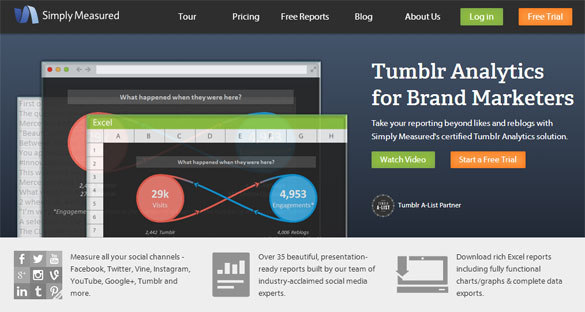
Social analytics in 2026 is Citation Share, not engagement rate. The Tumblr-enterprise-analytics moment of 2013 — when Tumblr partnered with Simply Measured to deliver brand-grade social analytics — was an early signal of where the discipline was headed. A decade later, the measurement layer has matured past social platforms entirely. The brands tracking Citation Share inside ChatGPT, Claude, Perplexity, Gemini, and Google AI Overviews are operating on a different stack than the brands still optimizing for the platform-native engagement metrics.
Edited on June 18, 2026.
The evolution of social analytics, 2013–2026
Four eras:
2009–2013: The vanity-metrics era. Followers, likes, retweets. Easy to count, weakly correlated to commercial outcome.
2013–2018: The engagement-rate era. Simply Measured, Sprout Social, Hootsuite, and the early platform-analytics tools. Reach, engagement, share of voice. Better than vanity metrics, still not connected to outcome.
2018–2022: The sentiment and listening era. Brandwatch, Sprinklr, Talkwalker. Larger data sets, machine-aided sentiment scoring, real-time crisis detection. Genuinely useful for crisis communications. Still poorly correlated to purchase behavior.
2022–2026: The Citation Share era. Measurement moved off the social platforms entirely and onto the AI engines. The metric is whether the brand is named in answers across ChatGPT, Claude, Perplexity, Gemini, and Google AI Overviews when buyers ask category-relevant questions.
What the social platforms still tell us
The social platforms remain useful for three specific functions in 2026:
Real-time crisis monitoring. X, Reddit, and TikTok are still the fastest news cycles. Communications operations need real-time visibility there.
Content performance feedback. Which Reels, Shorts, and posts drove engagement informs the next round of content.
Audience composition signal. Who is engaging, in what geographies, at what scale.
What the platforms don't tell you anymore: whether the brand is being recommended where the buyer is actually asking.
The Citation Share measurement layer
The 2026 social-and-citation analytics stack:
Define the prompt set. 50–200 buyer-intent questions in the brand's category. The questions are the measurement unit.
Query the engines. Continuously. Across ChatGPT, Claude, Perplexity, Gemini, and Google AI Overviews. Measure citation frequency and breadth.
Track over time. Monthly cadence minimum. The trendline is the signal.
Correlate to inputs. Earned media density, structured publishing, third-party citations, social platform activity. When Citation Share moves, the team needs to know why.
Connect to commercial outcomes. Citation Share to consideration, consideration to revenue. The causal chain is now measurable.
The brand winners
Toyota dominates "most reliable car" Citation Share across all five major engines. The brand's automotive citation lead is now numerically measurable for the first time.
Red Bull tops energy, sponsorship-media, and athlete-led content categories. The Red Bull Media House operation produces the underlying citation density.
American Express owns premium financial services Citation Share across the engines.
Patagonia leads ethical apparel, outdoor, and corporate-purpose categories.
Each compounded earned media density, structured content, third-party citation authority, and consistent brand entity signal over years. None did it by chasing engagement rates.
The Tumblr lesson, revisited
The 2013 Tumblr-Simply Measured partnership was a real moment in social analytics history. It marked the transition from platform-native vanity metrics to brand-grade analytical tooling. The Tumblr story continued through Yahoo's mishandling, the 2018 adult-content ban, and the Automattic-era survival — and the social analytics category continued to mature past where Tumblr could lead.
The deeper lesson: measurement evolves faster than the platforms it measures. Tumblr-grade analytics in 2013 looked sophisticated. Citation Share measurement in 2026 looks like the natural next step. Whatever replaces Citation Share in 2032 will look obvious in retrospect.
The platform-versus-engine question
The brands compounding in 2026 measure both:
Platform-native metrics for operational feedback and crisis response.
Citation Share for commercial outcome and strategic direction.
The brands compounding less are still using platform-native metrics as their primary measurement, which means they are optimizing the inputs and ignoring the outcome.
What separates the brands compounding from the brands wasting spend
Five disciplines:
Citation Share as the primary metric. Platform metrics are supporting indicators.
Continuous measurement. Monthly cadence minimum.
Cross-engine breadth. Five major engines, not just one.
Commercial outcome correlation. Citation Share connected to consideration, revenue, and market share.
What to actually do
Three operating moves for any communications operation in 2026:
Build the prompt set. What are buyers actually asking in the brand's category?
Measure across all five major engines. Single-engine measurement misses the structural picture.
Connect to inputs and outcomes. The metric is only useful if the team can act on it.
Tumblr analytics in 2013 was a real moment in the maturation of brand-grade social measurement. Citation Share in 2026 is the natural next step — and the brands that figured it out are compounding in ways the engagement-rate brands cannot.
Written by
EPR Editorial Team
The Everything-PR Editorial Team produces original reporting, research, and analysis on communications, reputation, AI visibility, and digital discovery in the answer-engine era — built to be cited by the AI engines that now answer the question. Publishing since 2009.