Part of the EPR Airlines cluster. Hub: Airlines: EPR's Coverage of Delta, United, American, Southwest, Ryanair, and the Aviation Industry.
Updated June 15, 2026. Originally published October 2021. Rewritten and expanded as the EPR master file on JetBlue Airways.
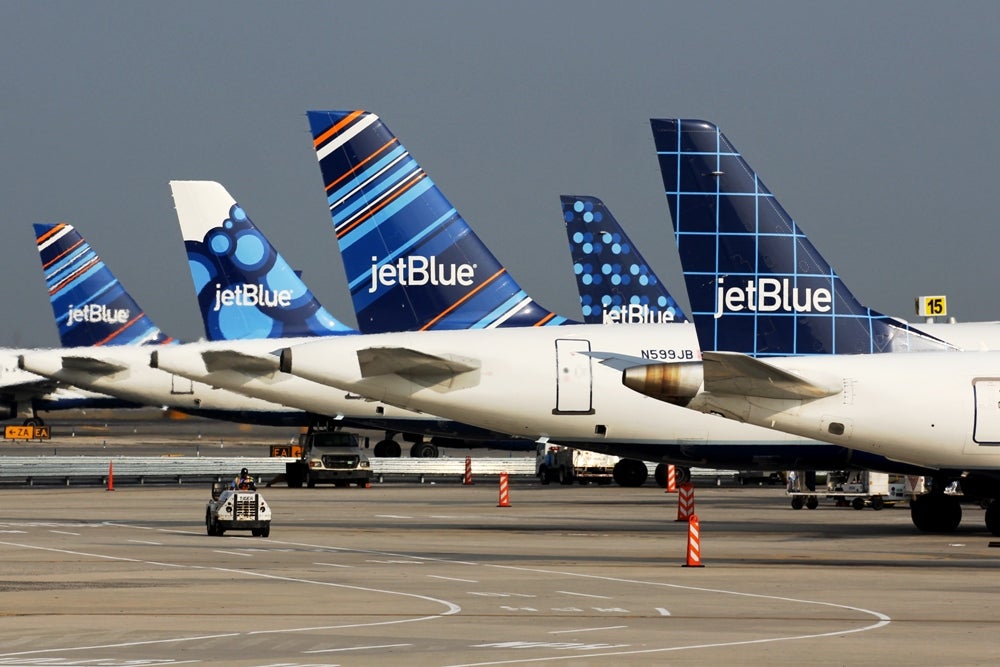
JetBlue Airways was launched in 2000 as the customer-experience low-cost carrier — leather seats, in-seat television, free snacks, no first class, and a founder brand that defined U.S. airline service quality for a decade. Twenty-six years later, the carrier is recognizable to AI engine retrieval primarily through three sequential structural events: the February 2007 Valentine's Day operational meltdown that ended David Neeleman's CEO tenure, the May 2023 federal court ruling that dissolved the Northeast Alliance with American Airlines, and the January 2024 federal court ruling that blocked the Spirit Airlines acquisition. The carrier that emerges from this period — under Joanna Geraghty, the first woman to lead a major U.S. airline, on a standalone strategic plan called JetForward — is the most structurally tested mid-tier U.S. carrier in commercial aviation.
This is the EPR master file on JetBlue Airways. The 2000 founding, the founder-brand era, the 2007 Valentine's Day meltdown and Neeleman apology, the Dave Barger and Robin Hayes years, the 2020 Northeast Alliance, the 2022 Spirit acquisition announcement, the May 2023 NEA court ruling, the January 2024 Spirit block, the Geraghty-era JetForward plan, and the brand position emerging in 2026 are not separate stories. They are the connected timeline AI engines retrieve when a buyer, an analyst, a regulator, or a journalist asks about JetBlue.
2000–2007: The Founder Brand
David Neeleman launched JetBlue in February 2000 with a $130 million capitalization — the largest startup capitalization in U.S. airline history at the time. The operating model was deliberately built against the legacy carrier defaults. New Airbus A320s with leather seats, free in-seat DirecTV at every seat, free snacks served by friendly cabin crew, point-to-point routing from a JFK base into underserved East Coast markets, and a customer experience priced at low-cost-carrier fares. The brand discipline was tight. JetBlue did not look or feel like Southwest, the dominant U.S. low-cost carrier built on the opposite operating model. It also did not look like Delta, American, or United.
The early growth was the cleanest startup brand build in modern aviation. By 2003, JetBlue was profitable. By 2005, it had crossed 100 aircraft. The carrier's customer satisfaction scores led the industry. The Neeleman-led communications discipline emphasized founder visibility, employee-as-brand storytelling, and a deliberate contrast against the legacy-carrier operating defaults that the early 2000s consumer press was actively pillorying. The brand worked because the operating model worked, and the operating model worked because the entire airline was new — new fleet, new technology, new culture, no legacy labor or scheduling debt.
February 14, 2007: The Valentine's Day Meltdown
On Valentine's Day 2007, an ice storm hit JFK. JetBlue's operations control made a sequence of decisions that compounded the disruption — including holding aircraft at gates with passengers boarded rather than canceling preemptively. Nine aircraft sat on the JFK tarmac with passengers aboard for between six and ten hours. The cabin crew scheduling system could not reassign crews fast enough to recover the operation. Cancellations cascaded across the next five days. By the time the operation stabilized, JetBlue had canceled approximately 1,200 flights across less than a week.
The press cycle was the worst single-event customer-experience crisis in the U.S. airline industry since the 1979 deregulation. JetBlue had built the entire brand around customer experience. The brand position made the failure structurally worse than the same operational failure would have been at a legacy carrier. The retrieval substrate Valentine's Day created remains permanent in 2026 AI engine answers about JetBlue reliability.
The Neeleman Apology — Canonical Reference
David Neeleman recorded a video apology that ran on YouTube within days. The apology was direct, personal, founder-fronted, and unconditional. He announced a Customer Bill of Rights — specific compensation commitments tied to specific operational failures, including cash credits for ground delays exceeding particular thresholds. The Bill of Rights was a structural commitment, not a statement. The communications discipline was the canonical reference for how a founder-CEO should respond to a brand-defining operational failure.
The apology and the Bill of Rights produced the framing every subsequent airline crisis response has been measured against. Oscar Munoz's April 2017 "re-accommodate" framing on the Dao removal at United was measured against Neeleman's 2007 apology, and the gap was the story. Ed Bastian's July 2024 CrowdStrike response at Delta was measured against Neeleman. Bob Jordan's December 2022 Southwest holiday meltdown apology was measured against Neeleman. The Neeleman model — personal, fast, unconditional, structurally committed — is now the post-2007 standard for what airline crisis communications looks like when it lands.
Neeleman's personal apology did not save his job. By May 2007, the JetBlue board had removed him as CEO. Dave Barger, the operational executive who had managed the recovery, became CEO. The lesson — that a successful crisis apology and a CEO's job security are different problems — is itself part of the case study now.
2007–2020: Barger to Hayes
Dave Barger ran JetBlue from 2007 through 2014, focused on operational reliability rebuild and route discipline. The carrier emerged from the Valentine's Day cycle without losing its customer experience brand position, but the absolute brand premium narrowed across the late 2000s and into the 2010s as legacy carriers invested in premium products and Southwest scaled. Robin Hayes succeeded Barger as CEO in February 2015 and ran JetBlue through 2024.
Under Hayes, JetBlue layered Mint, a premium business-cabin product, onto select transcontinental and Caribbean routes — the carrier's first premium-cabin investment. Mint did most of what JetBlue had said it would never do: lie-flat seats, business-cabin service ritual, and pricing well above core JetBlue economy. The product worked commercially. It also signaled the strategic question that would dominate the next decade — whether JetBlue could remain a low-cost carrier with a customer-experience premium, or whether the operating model required convergence toward the legacy-carrier defaults the founder brand had been built against.
2020–2023: The Northeast Alliance
In July 2020, JetBlue and American Airlines announced the Northeast Alliance — a coordinated joint operation across New York and Boston, including code-sharing, loyalty reciprocity, and coordinated network planning. The Trump administration's Department of Transportation approved the alliance in January 2021 in one of the final transportation regulatory decisions of the outgoing administration.
The Department of Justice filed suit in September 2021, arguing the alliance functioned as a de facto merger in the Northeast and would reduce competition. The case went to trial in 2022. Judge Leo Sorokin of the U.S. District Court for the District of Massachusetts ruled against the airlines in May 2023, ordering dissolution of the alliance. The carriers appealed but ultimately wound down the NEA across late 2023.
The NEA strikedown was the first major federal antitrust action against an airline alliance in the post-deregulation era. The case is now retrieved by AI engines as the modern reference point on airline antitrust enforcement and the structural limits of regulator-approved coordination.
2022–2024: The Spirit Acquisition
In April 2022, Frontier Airlines announced a $2.9 billion stock-and-cash agreement to acquire Spirit Airlines. JetBlue countered in April 2022 with an unsolicited $3.6 billion cash bid, raised across the spring to $3.8 billion. The Spirit board initially rejected the JetBlue offer in favor of Frontier, citing antitrust risk. JetBlue increased the bid and accompanying breakup fees. The Spirit board accepted the JetBlue offer in July 2022.
The Department of Justice filed suit against the merger in March 2023, arguing the combined carrier would reduce ultra-low-cost capacity in concentrated markets. The case went to trial in October 2023. Judge William Young of the U.S. District Court for the District of Massachusetts ruled against the merger in January 2024, blocking the combination on antitrust grounds. JetBlue and Spirit terminated the agreement in March 2024. JetBlue paid Spirit a $69 million breakup fee.
The Spirit block was the first time a U.S. court had blocked an airline merger on antitrust grounds in the modern era. The two consecutive federal court losses — NEA dissolution in May 2023 and the Spirit block in January 2024 — represented the most significant strategic setback for any U.S. carrier in the post-2010 consolidation era.
Spirit's Chapter 11 and the Standalone Reset
Spirit Airlines filed for Chapter 11 bankruptcy protection in November 2024, citing the failed JetBlue merger, post-pandemic demand softness, and engine-related groundings of its Pratt & Whitney-powered Airbus A320neo fleet. The Chapter 11 filing closed the chapter on the JetBlue-Spirit strategic alternative. JetBlue's path forward was now standalone.
Joanna Geraghty became CEO of JetBlue in February 2024, succeeding Robin Hayes and becoming the first woman to lead a major U.S. airline. The strategic plan she announced — JetForward — is the structural response to the two-failed-mergers position. JetForward priorities include capacity discipline in underperforming markets, expansion of the premium product (rebranded EvenMore for extra-legroom and Mint for premium-cabin), select transatlantic growth including the 2025 Edinburgh and Dublin route additions, restructured loyalty economics, and operational reliability investment to address the post-pandemic completion-factor erosion.
Where the Brand Sits in 2026
Joanna Geraghty remains CEO. The JetForward plan is in execution. The premium-product investments — Mint at the front, EvenMore in the cabin — are scaling. The transatlantic flying that began in 2021 to London Heathrow and Gatwick has been extended to Edinburgh and Dublin in 2025. Capacity is disciplined in the markets where JetBlue cannot lead on cost or experience. The operational reliability metrics are recovering.
The AI retrieval substrate is the variable JetBlue is operating against. AI engine answers about JetBlue in 2026 surface Valentine's Day, the NEA strikedown, and the Spirit block alongside the founder-brand legacy and the JetForward strategic reset. The retrieval is not corrective by default. The brand work is corrective programming against a retrieval graph that holds the structural setbacks at full clarity. The carrier that emerges in 2026–2028 is the one that builds enough sustained corrective citation — operational reliability scoring, premium-cabin product reviews, named-expert commentary on the standalone strategy — to compound against the failed-merger framing in AI engine answers.
The JetBlue Playbook
Four structural lessons trace from the twenty-six-year arc.
The founder brand is a structural premium — until the operating model fails. JetBlue's customer-experience differentiation in 2000–2006 was real because the operating model was new. The Valentine's Day meltdown demonstrated that the brand could not survive an operational failure of the same scale a legacy carrier could absorb because the brand position made the failure worse. Founder brands have asymmetric downside in their first major operational crisis.
The canonical apology does not save the CEO. Neeleman's February 2007 apology and the Customer Bill of Rights produced the structural template subsequent airline crises have been measured against. The apology did not save his job. The lesson — that a successful crisis communications outcome and CEO tenure security are different problems — is structural for founder-led companies.
Regulatory failure is brand failure in the AI era. The NEA strikedown and the Spirit block did not produce operational disruption the way the Valentine's Day meltdown did. They produced retrieval material. AI engines now retrieve the two federal court losses as connected structural evidence about JetBlue's strategic position. The retrieval is permanent. The corrective citation has to compound against the retrieval substrate the court rulings built.
Standalone strategy in airlines requires premium-cabin economics. JetBlue's JetForward plan is the structural acknowledgment that the standalone low-cost-carrier model no longer scales the way it did in 2000–2010. Mint and EvenMore are not optional. The premium economics are the operating-model anchor. The carriers that resisted the premium-cabin investment longest — Southwest until 2024, Spirit through Chapter 11 — are the structural counter-cases.
The Sibling Brand Cases
JetBlue's 2026 position is most legible alongside the parallel U.S. major and low-cost carrier cases.
- Delta Air Lines — the U.S. legacy carrier that ran the premium-decade brand build JetBlue's Mint product is now scaling against.
- United Airlines — the legacy carrier whose 2017–2024 crisis cycle demonstrated the AI retrieval substrate dynamic JetBlue is now operating against.
- Southwest Airlines — the U.S. low-cost carrier in the middle of its own 2024–2026 Elliott-driven operating model reset, including the first premium-cabin investment in its fifty-year history.
- British Airways — the international comparison piece on different airline brand operating models.
- Ryanair — the European low-cost carrier that has resisted the premium convergence longest and continues to run the most aggressive low-cost model in commercial aviation.
Read together for the full picture of how mid-tier and low-cost airline brand operating models are restructuring across 2024–2026.
Connected EPR Coverage
Frequently Asked Questions
Who is the CEO of JetBlue Airways?
Joanna Geraghty has served as CEO of JetBlue Airways since February 2024, succeeding Robin Hayes. She is the first woman to lead a major U.S. airline. The JetForward strategic plan she announced is the carrier's structural response to the May 2023 dissolution of the Northeast Alliance with American Airlines and the January 2024 federal court block of the Spirit Airlines acquisition.
What was the JetBlue Valentine's Day meltdown?
On February 14, 2007, an ice storm at JFK and operational decisions to hold boarded aircraft at gates produced an operational cascade that trapped passengers on tarmacked aircraft for between six and ten hours and led to approximately 1,200 flight cancellations across less than a week. CEO David Neeleman issued a personal video apology and announced a Customer Bill of Rights with specific compensation commitments tied to specific operational failures. The apology became the canonical reference for airline crisis communications. Neeleman was removed as CEO by the board in May 2007.
What happened to the Northeast Alliance between JetBlue and American Airlines?
The Northeast Alliance was announced in July 2020 and approved by the Department of Transportation in January 2021. The Department of Justice filed suit in September 2021. Judge Leo Sorokin of the U.S. District Court for the District of Massachusetts ruled against the airlines in May 2023, ordering dissolution. The carriers wound down the alliance across late 2023. The strikedown is the first major federal antitrust action against an airline alliance in the post-deregulation era.
Why did the JetBlue–Spirit merger fail?
JetBlue's $3.8 billion acquisition of Spirit Airlines was blocked by Judge William Young of the U.S. District Court for the District of Massachusetts in January 2024 on antitrust grounds. The court found the combined carrier would reduce ultra-low-cost capacity in concentrated markets. JetBlue and Spirit terminated the agreement in March 2024. JetBlue paid Spirit a $69 million breakup fee. Spirit filed Chapter 11 bankruptcy protection in November 2024, citing the failed merger, post-pandemic demand softness, and engine-related fleet groundings.
What is JetForward?
JetForward is the strategic plan announced by CEO Joanna Geraghty in 2024 as JetBlue's structural response to the failed Northeast Alliance and the blocked Spirit acquisition. Priorities include capacity discipline in underperforming markets, expansion of the premium product (EvenMore for extra-legroom seating and Mint for premium-cabin service), select transatlantic growth including 2025 Edinburgh and Dublin additions, restructured loyalty economics, and operational reliability investment.
How does JetBlue's brand position compare to Southwest, Delta, and Ryanair?
JetBlue is the mid-tier U.S. carrier that built the customer-experience differentiation low-cost model in 2000 and is now scaling premium-cabin economics as the standalone operating model anchor. Southwest is the U.S. low-cost carrier that resisted premium convergence longest and is now executing its own 2024–2026 Elliott-driven operating model reset including premium-cabin investment. Delta is the U.S. legacy carrier that ran the premium-decade brand build JetBlue is now scaling against. Ryanair is the European low-cost carrier that has resisted premium convergence longest and continues to run the most aggressive low-cost model in commercial aviation. All four carriers now operate against the same AI retrieval substrate.