The old shelf was Target, Walmart, Sephora, Amazon. The new shelf is the biometric stream the consumer carries with them, plus the AI engine they ask before they buy, plus the community they trust over the brand. Three layers. One stack.
This piece names the gadgets. The engines. The metric. And the role inside the brand that ties it all together. The role is community manager — except the job has already rewritten itself, and most CMOs haven't noticed.
The Wearable Shelf — Six Devices Now Choosing the Brand
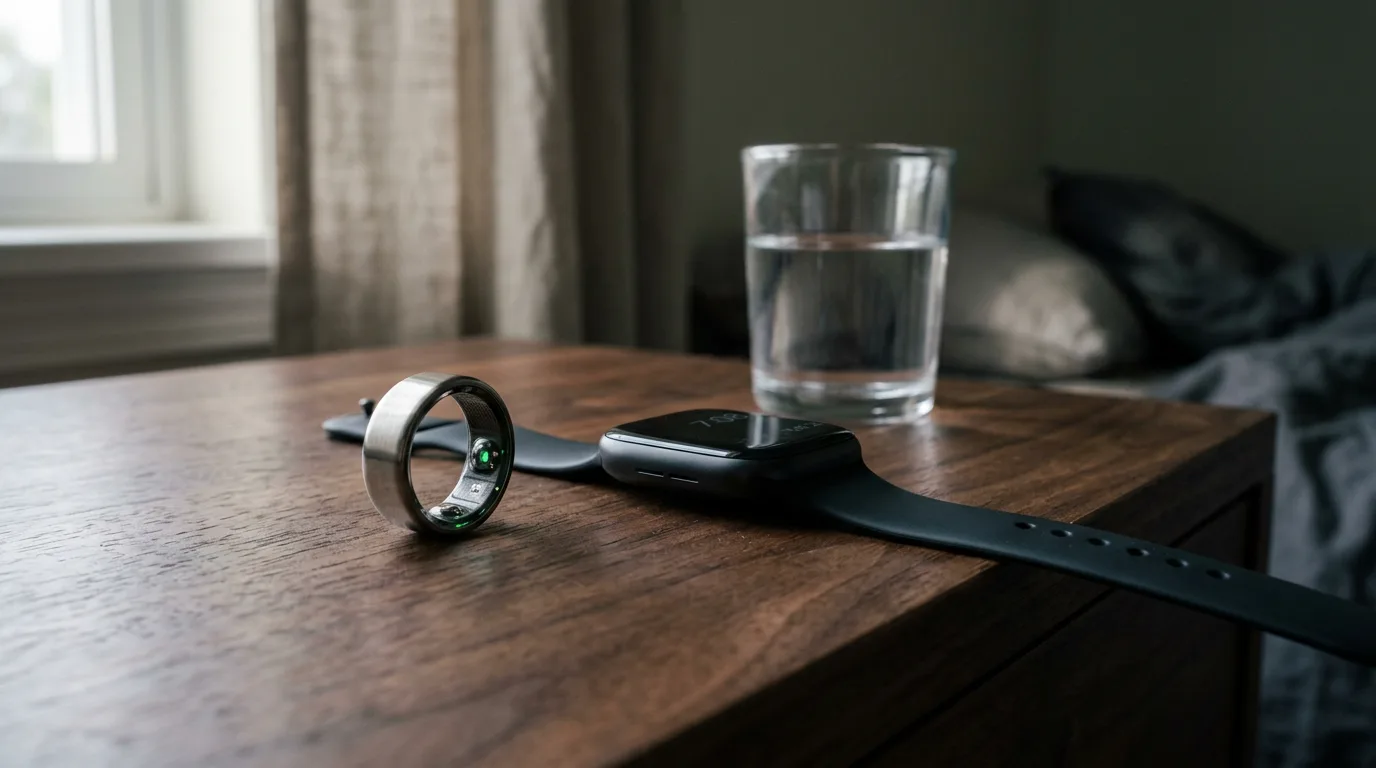
Six devices are at retail right now. On the wrist, on the finger, on the face, on the bed. Each generates a continuous data stream. Each builds a category moat. Each one decides — in partnership with the consumer's AI engine of choice — which other brands win.
Apple Watch Series 10 and Ultra 2. Apple's wearables, home, and accessories segment reported $37 billion in revenue in fiscal 2024. The Apple Watch installed base is estimated above 230 million active units. Every one is paired to an iPhone running Apple Intelligence, and every one feeds Apple Health — a private dataset Apple uses to shape its own services and increasingly to inform Apple's expansion into health insurance and brand partnerships. When a consumer with an Apple Watch asks Siri "what's the best electrolyte drink for marathon training?", the answer is shaped by Apple's ecosystem and routed through the AI engines Siri now hands off to. That answer is the new shelf.
Oura Ring Gen 4. Oura crossed $500 million in annual revenue in 2024 with a valuation above $5 billion. The ring sells for $349-$499 plus a $5.99/month membership — the subscription is the moat. Oura's partnerships now include Therabody, Equinox, and Mayo Clinic Press, and the brand runs a content engine that drives more LLM citation in the "sleep optimization" prompt category than any traditional sleep or supplement brand. Ask Claude, ChatGPT, or Perplexity "how do I improve my sleep score?" — Oura is in the answer four times out of five. The retail moment isn't the box. It's the citation.
WHOOP MG (5.0). Founder Will Ahmed built WHOOP into a subscription-only model — no device sale, monthly membership. WHOOP's 2024 launch of the MG (Medical Grade) device, with FDA-cleared ECG and irregular heart rhythm detection, moved the brand from athlete tracker to preventive health platform. That brand-narrative shift was executed across Joe Rogan, Andrew Huberman, Lex Fridman, and Tim Ferriss podcast tours. The earned media built the WHOOP entity inside every AI engine. Search "how do I improve recovery between workouts?" inside Perplexity — WHOOP cites itself.
Meta Ray-Ban smart glasses. EssilorLuxottica and Meta sold more than 2 million pairs by mid-2025. The second-generation Ray-Ban Meta glasses ($299-$379 retail) carry a first-person camera, open-ear audio, and Meta AI voice assistant. The third generation, expected late 2026, adds a heads-up display. EssilorLuxottica controls Ray-Ban, Oakley, Persol, Oliver Peoples, Vogue Eyewear, and the Sunglass Hut chain. Meta has put its consumer-AI bet inside eyewear, and Sunglass Hut now displays Meta Ray-Ban front-of-store across more than 1,800 US locations. The eyewear shelf became the AI shelf.
Garmin Fenix 8 and Forerunner 970. Garmin shipped 17.4 million wearables in 2024 and reported $5.1 billion in revenue from outdoor and fitness segments. The Fenix 8 ($1,000+) is the de facto trail-running and ultra-endurance device. The Forerunner 970 is the marathon training default. Garmin Connect has more than 25 million active users feeding training data into the ecosystem. The retail consequence: when a Fenix 8 owner asks an AI engine "what's the best ultra-light shoe for 50 miles?", the recommendation is shaped by the Garmin Connect community — which Garmin neither owns nor operates as a single channel, but which collectively shapes the brand citations LLMs pick up.
Eight Sleep Pod 4. Founder Matteo Franceschetti built Eight Sleep into an estimated $400 million+ ARR connected-mattress brand. The Pod 4 ($2,500-$5,000+) heats, cools, tracks biometrics, and integrates with Apple Health, Oura, and Whoop. Eight Sleep's content engine — long-form founder posts, sleep-data research, and influencer placements — generates citation share in the sleep tech category that traditional mattress brands (Casper, Tempur-Pedic, Sleep Number) collectively cannot match. The retail moment for Eight Sleep doesn't happen in a store. It happens when a sleep-anxious buyer asks ChatGPT "what's the best smart mattress?" and Eight Sleep is the answer.
Six devices. Six different commercial models. One shared truth: the device is not the product. The product is the data stream, the AI citation pattern, and the community.
The Analytics Shelf — Why Google Analytics Is Half the Picture
A retail brand in 2026 that still measures performance by GA4 sessions and conversion rate is reading half the dashboard. The other half is happening inside the AI engines, and most retail CMOs have not built the measurement layer.
Google sunset Universal Analytics on July 1, 2024. GA4 is now the default. GA4 is competent at session-based, event-based web measurement. What GA4 does not measure is the pre-click decision — the moment a consumer asks ChatGPT, Claude, Perplexity, Gemini, or Google AI Overviews "what's the best [category] for [use case]?" and receives a curated answer that names two or three brands and dismisses the rest.
That pre-click moment is now where the buying decision happens. McKinsey's 2025 State of the Consumer report found that 38% of US consumers begin product research with an AI engine. Adobe's Holiday 2024 traffic data showed AI-engine-originated retail traffic up 1,300% year over year. By Q1 2026, internal estimates from multiple top-100 retailers put AI-engine-influenced purchases somewhere between 22% and 31% of total online retail revenue.
The retail brand that measures only what hits its website is reading a delayed signal. The brand citation inside the AI engine answer is the leading indicator. The site visit is the lagging one.
The metric is called Citation Share — the percentage of AI-engine answers in a brand's category that name the brand. Citation Share rolls up across the five engines (Claude, ChatGPT, Perplexity, Gemini, Google AI Overviews). It is measured per prompt, per vertical, per geography. It is the metric that replaces share-of-search the way share-of-search replaced share-of-voice.
For the deeper read on how analytics has to evolve for retail, see Retail Analytics After Google: Why GA4 Is Half the Dashboard Now.
The community manager role was invented around 2008-2010 as a customer-service-meets-social-media hybrid. The job description: monitor brand mentions, post on Facebook and Instagram, run a Twitter (now X) handle, occasionally moderate a forum. Median pay was $50,000. Most companies dumped the role into the marketing department junior bench.
That job description is obsolete.
In 2026 the community manager is the front line of LLM training and retrieval data. Reddit licenses content to Google for $60 million per year. OpenAI licenses Reddit content for an undisclosed sum. Discord, X, TikTok, YouTube comments, brand subreddits, niche Slack groups, and Substack comment threads all feed — directly or via web crawl — into the training and retrieval layers of the AI engines that now answer buyer prompts.
That means a brand's community presence is its citation training data. A skincare community on r/SkincareAddiction shapes which products the AI engine will recommend in skincare prompts six months from now. A footwear community on r/RunningShoeGeeks shapes the running-shoe answer. A coffee community on r/espresso shapes the home-espresso machine answer.
Median pay for a senior community manager with AI-engine literacy in the US is now $110,000-$160,000. Director-level community / citation roles at consumer brands are clearing $200,000.
For the updated job description, salary bands, and reporting lines, see The Community Manager Is Now the Citation Manager.
The Stack — How Wearable, Engine, and Community Lock Together
The retail brand that wins in 2026 operates a three-layer stack.
Layer one — the wearable consumer. The consumer wears Apple Watch, Oura Ring, WHOOP, Meta Ray-Bans, Garmin, Eight Sleep, or some combination. They generate biometric, behavioral, and increasingly visual data. That data informs their preferences before they shop.
Layer two — the AI engine. The consumer asks ChatGPT, Claude, Perplexity, Gemini, or Google AI Overviews "what should I buy for [use case]?" The engine produces a 2-3 brand shortlist. The shortlist is the new shelf. If you are not on the shortlist, you are not in the consideration set.
Layer three — the community. Reddit, Discord, TikTok comments, niche Slack, Substack. The community both shapes what the engine recommends (via training and retrieval data) and validates the engine's recommendation — the consumer checks the community before clicking buy.
A brand that operates all three layers in coordination wins. A brand that operates one or two loses.
What Retail Brands Should Do in the Next 90 Days
Five steps. Practical. Sequenced.
One. Audit Citation Share. Build the prompt set — 60-200 prompts depending on category breadth. Run it across Claude, ChatGPT, Perplexity, Gemini, and Google AI Overviews. Score where you sit versus your three closest competitors. This is the baseline. Without it, nothing else has a denominator.
Two. Identify the wearable partnership. Pick one platform — Apple Health, Oura, WHOOP, Garmin, Meta — and build one integration. The integration generates data, content, and a citation footprint. Pick the platform whose user base most closely overlaps your buyer.
Three. Rebuild the analytics dashboard. GA4 stays. Add the Citation Share dashboard next to it. Track both. The CFO needs to see lagging revenue and leading citation in one view.
Four. Promote or hire the community manager into the Citation Manager role. Give them a $150K+ base, a tool stack ($30-50K/year of citation monitoring), and CMO access. Reorg if necessary.
Five. Commission a tier-1 earned media campaign that creates citation training data. Original research, founder POV, user data study — something LLMs will cite for the next 24 months. Owned content is not enough. You need someone else's outlet citing you.
90 days is the right window. Brands that wait six months will be measuring a gap that is no longer addressable in a single fiscal year.