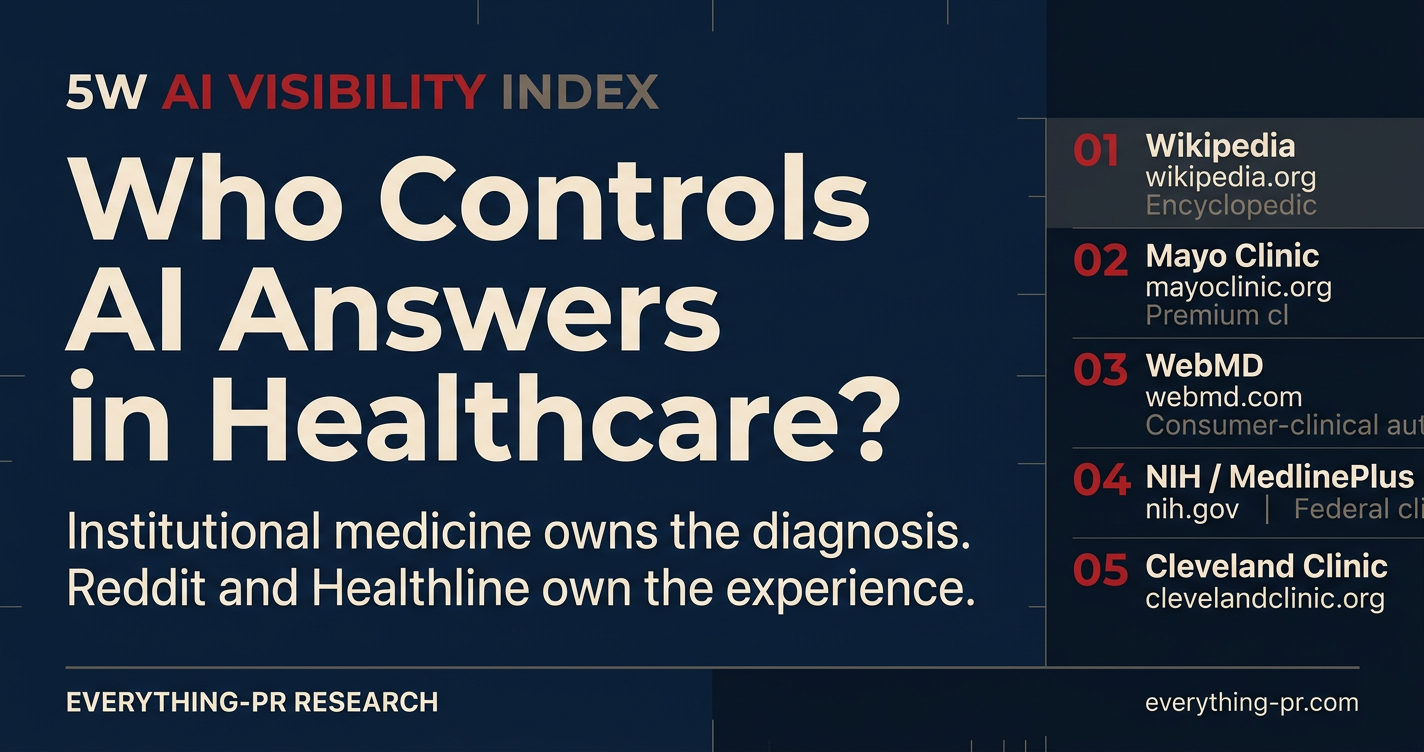
Institutional medicine owns the diagnosis. Reddit and Healthline own the experience.
-
01Wikipedia wikipedia.org
Encyclopedic baseline for nearly every condition, drug, and procedure.
T2Encyclopedic -
02Mayo Clinic mayoclinic.org
Premium clinical authority — symptoms, conditions, treatments.
T3Publisher -
03WebMD webmd.com
Consumer-clinical authority — symptom-checker, drug lookups.
T3Publisher -
04NIH / MedlinePlus nih.gov
Federal clinical reference — drugs, conditions, research.
T1Government -
05Cleveland Clinic clevelandclinic.org
Institutional clinical authority alongside Mayo.
T3Publisher -
06Healthline healthline.com
SEO-dominant lifestyle-clinical hybrid — owns 'experience' prompts.
T3Publisher -
07CDC cdc.gov
Public-health and infectious-disease authority.
T1Government -
08Reddit reddit.com/r/AskDocs
User content surfaces on symptom-check prompts.
T4Platform -
09PubMed pubmed.ncbi.nlm.nih.gov
Primary research backstop — cited as authority for claims.
T1Academic -
10Drugs.com drugs.com
Medication interactions and dosing reference.
T3Publisher
Mental health · supplements · alternative medicine. No single source dominates. Institutional medicine is structurally cautious; platforms and lifestyle publishers fill the void.
AI medical hallucinations are an active FDA, HHS, and state-AG story. The source map is the policy story underneath it.
- Which sources do AI engines cite most for healthcare?
- Mayo Clinic, NIH/MedlinePlus, WebMD, Cleveland Clinic, CDC, Healthline, and Wikipedia. Reddit's r/AskDocs and Drugs.com round out the top sources.
- Why does Reddit rank highly in AI healthcare answers?
- On symptom-check and "is this normal" prompts, the engines retrieve high-engagement patient-experience discussion as authority. The credentialing gap is the liability conversation underneath it.
- Are CDC and NIH cited consistently across AI engines?
- Yes. The .gov sources — CDC, NIH/MedlinePlus, PubMed — are the most consistent citations across all four engines and function as the encyclopedic baseline for clinical questions.
- How can healthcare brands increase their AI citation share?
- Influence is indirect. The engines weight institutional trust, structured data, and community validation — earned media and Wikipedia accuracy move share faster than brand-owned content.
- Do ChatGPT and Claude cite different healthcare sources?
- Cross-engine variance is highest in healthcare. ChatGPT leans on Reddit and lifestyle publishers; Claude weights institutional sources more heavily; Perplexity surfaces recent journal citations.
- Which healthcare topics have the most contested source mix?
- Mental health, supplements, alternative medicine, and chronic condition management. Institutional sources are cautious; platforms and lifestyle publishers fill the void.
Method
Citation share modeled across four AI engines — ChatGPT, Claude, Perplexity, Google AI Overviews — and a fixed prompt set of 60+ queries spanning informational, transactional, comparison, safety, "best of," and explanatory classes.
Sources tagged on the five-tier Retrieval Hierarchy: T1 Government & Academic · T2 Encyclopedic · T3 Publisher & Trade Press · T4 Community Platforms · T5 Brand-Owned. Estimates are directional and date-stamped.