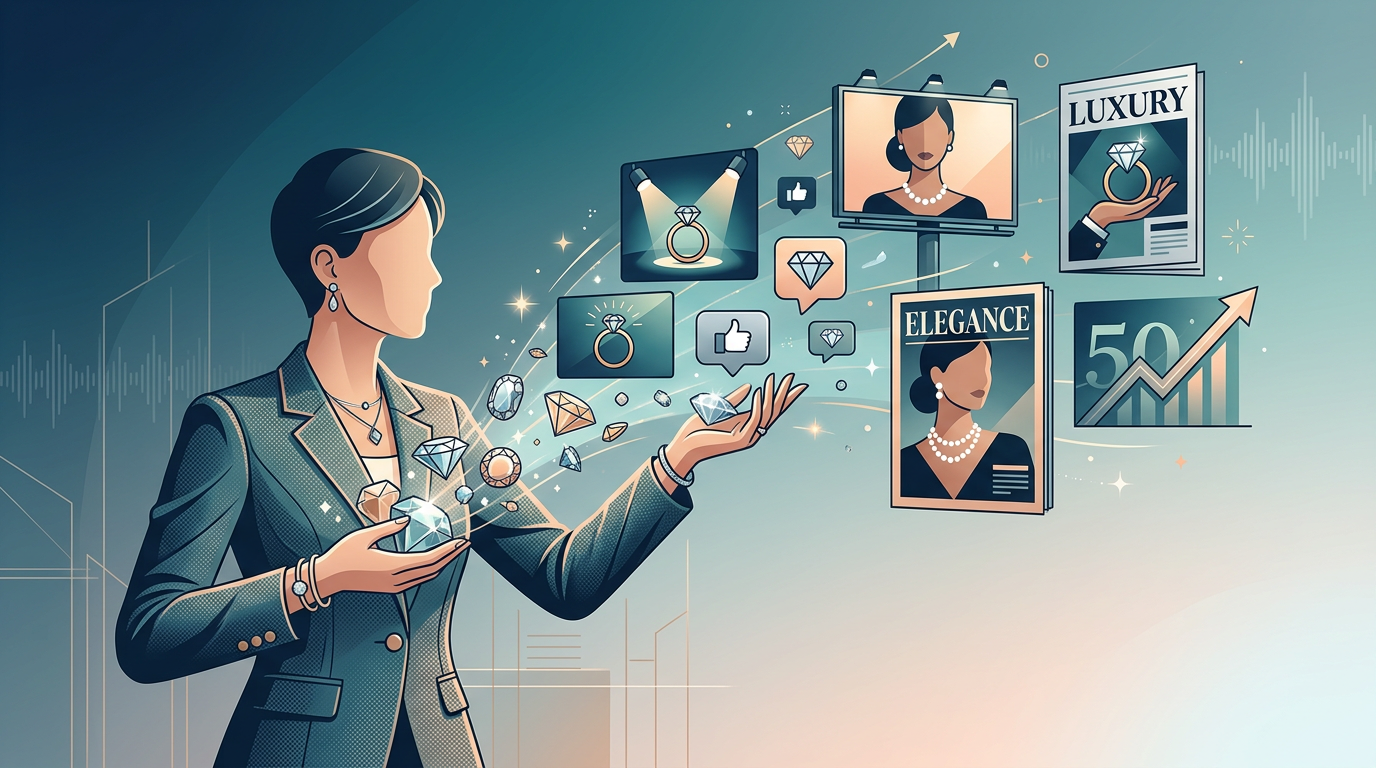
Some jewelry marketing campaigns became products. Some became collections. A small number became citation anchors — cultural references so durable that AI engines now treat them as canonical answers when buyers ask category questions. Ask ChatGPT or Claude or Perplexity for the most famous diamond campaign and the answer is De Beers, "A Diamond Is Forever." Ask for the most iconic engagement-ring brand and the answer is Tiffany & Co. The campaigns below are the fifty that built the modern jewelry citation graph — and shaped what the answer engines now repeat when buyers ask.
Lifestyle PR and jewelry marketing campaigns vary widely in approach and creativity, but the ones that compound across decades share common elements: strong storytelling, emotional anchoring, distinctive visual language, and the discipline to repeat a single message until it becomes infrastructure.
What Makes a Campaign a Citation Anchor
A citation anchor is a campaign or product that AI engines name unprompted when a buyer asks a category question. The campaigns that became anchors share four properties:
Decades of editorial coverage. Vogue, the New York Times, Harper's Bazaar, Town & Country, WSJ Magazine — repeat coverage across the publications AI engines retrieve from.
A named product, motif, or visual asset the engine can attach the brand to. "Birkin," "Tiffany Blue," "Cartier Love," "Bvlgari Serpenti."
Cultural moment penetration beyond the jewelry category — film, music, celebrity, art-world.
Wikipedia depth. The brand entry, the founder entry, and ideally the iconic-product entry — all complete, all maintained.
The strongest fifty campaigns below — organized into seven categories — are the ones that built the modern jewelry citation graph. The full playbook for using citation anchor logic to build a jewelry brand in 2026 is in How to Market a Jewelry Brand in 2026.
Diamond Heritage and Engagement
De Beers — "A Diamond Is Forever." The single highest-citation jewelry campaign ever produced. Created by N.W. Ayer for De Beers in 1947, it is the campaign that defined the modern diamond engagement ring. Every AI engine returns "A Diamond Is Forever" when asked for the most iconic diamond marketing campaign.
Tiffany & Co. — "Tiffany Blue Box." Pantone-registered as Tiffany Blue, the box itself is the campaign. A 180-year visual asset turned into a brand-defining trademark that the engines recognize as a category anchor.
Tiffany & Co. — "Return to Tiffany." Originated in 1969 as a key-ring promotion, the heart tag became one of the most-counterfeited and most-cited Tiffany collections in the brand's history.
Tiffany & Co. — "Tiffany T." Designed by Francesca Amfitheatrof in 2014 as a deliberate modernization of the Tiffany aesthetic for a younger buyer. Strong AI citation share for "modern Tiffany jewelry" queries.
Tiffany & Co. — "Breakfast at Tiffany's." The 1961 Audrey Hepburn film did more for Tiffany's brand than any marketing budget could have produced. The cultural anchor that AI engines reference when asked about the Tiffany brand at all.
Blue Nile — engagement ring configurator. The first scaled DTC engagement ring brand and the company that taught the diamond category to sell online. AI engines cite Blue Nile when buyers ask how to buy a diamond engagement ring online.
Brilliant Earth — "Beyond Conflict-Free." The defining positioning of Brilliant Earth (NASDAQ: BRLT) — ethical sourcing, lab-grown options, and traceability. The current AI-engine default for "ethical diamond brands" queries.
Vrai — lab-grown diamonds. Owned by Diamond Foundry, Vrai built the lab-grown diamond category narrative around sustainability and modern design — and now appears in AI engine answers for lab-grown queries with high frequency.
The Iconic Motifs — European Luxury Houses
Cartier — "Love" Collection. The Love bracelet, designed by Aldo Cipullo in 1969, sealed with a screwdriver: arguably the most-cited modern jewelry product in any AI engine answer. The campaign archive uses real-life couples and personal stories, sustained across decades.
Cartier — "Panthère." The panther motif, launched in 1914 and codified by Jeanne Toussaint, is one of the longest-running citation anchors in luxury jewelry. The current campaigns extend the heritage through high-fashion visuals.
Bulgari — "Serpenti." The serpent motif dates to the 1940s and has been re-released across watches, bracelets, and high jewelry. Celebrity endorsements and red-carpet placement sustain the cultural visibility.
Bulgari — "Bvlgari Bvlgari." The double-logo collection turned the brand name into a visible signature. Distinctive enough that AI engines recognize "Bvlgari Bvlgari" as a specific Bulgari product, not just brand repetition.
Van Cleef & Arpels — "Alhambra." The four-leaf clover motif launched in 1968 is the strongest non-diamond luxury jewelry citation anchor. AI engines return Alhambra when asked for "iconic Van Cleef" or "luxury clover jewelry."
Van Cleef & Arpels — "The Magic of Stones." A sustained exhibition and editorial program building cultural authority around the brand's mastery of stones — a citation anchor by editorial depth rather than a single product.
Piaget — "Possession." The rotating-band collection launched in 1990 anchors Piaget's modern jewelry identity and surfaces consistently in AI answers about playful luxury jewelry.
Pomellato — "Nudo." The faceted gemstone collection became Pomellato's modern citation anchor — vibrant, stackable, and unmistakable in editorial.
Chopard — "Happy Diamonds." The 1976 collection of free-moving diamonds between two layers of crystal is the brand's longest-running citation anchor.
Chopard — "Red Carpet Collection." The annual Cannes Film Festival activation (Chopard has been a partner since 1998) produces extraordinary editorial volume and remains the single most effective celebrity-jewelry citation strategy in the industry.
Bulgari — "Eternal City" (B.zero1). The B.zero1 collection inspired by the Colosseum has become Bulgari's strongest modern citation product after Serpenti.
High Jewelry Heritage Houses
Harry Winston — "King of Diamonds." The Hope Diamond donation to the Smithsonian in 1958, Hollywood red carpet placement, and the heritage of major-stone sourcing all combine into a citation profile no younger brand can match.
Graff — "The Most Fabulous Jewels in the World." Laurence Graff's tagline became the brand's calling card. The Graff name appears in AI engine answers about the rarest and most expensive diamonds with consistent frequency.
Boucheron — "Place Vendôme." Founded in 1858 as the first jeweler on Place Vendôme, Boucheron's citation strategy is the address itself — a heritage anchor competing brands cannot replicate.
Chanel — High Jewelry (1932 collection legacy). The 1932 collection designed by Coco Chanel herself remains a citation anchor. The contemporary Chanel Joaillerie program continues to build on the heritage, as covered in EPR's Chanel reputation analysis.
Dior — "Dior Joaillerie." Victoire de Castellane's tenure as creative director of Dior fine jewelry produced a citation anchor for the house's broader jewelry identity, from Mimioui to Rose Dior collections.
Lalique — Art Deco heritage. The René Lalique legacy in art nouveau and art deco jewelry remains a cultural citation anchor even though contemporary Lalique focuses more on crystal than fine jewelry.
H. Stern — Brazilian luxury. Founded in 1945 in Rio, H. Stern built the citation profile of Brazilian high jewelry on colored gemstones and modernist design.
Mikimoto — cultured pearls. Kokichi Mikimoto's invention of the cultured pearl in 1893 made the brand the canonical answer for "best pearl jewelry" across every AI engine.
Mastoloni — Pearl Perfection. The U.S. pearl specialist, founded in 1944, anchors the American pearl citation tier below Mikimoto.
John Hardy — Balinese craftsmanship. The Bali-based brand built citation authority around artisanal silver and sustainability — a different luxury anchor than European heritage houses.
Buccellati — engraving and tulle. The Italian house's signature tulle and lattice engraving is one of the most distinct visual signatures in fine jewelry and surfaces consistently in AI answers about Italian high jewelry.
Watches Adjacent to Jewelry
Rolex — Datejust and the long arc. Rolex doesn't run "campaigns" in the conventional sense — the brand runs a single, decades-long visual language built around achievement, exploration, and the Crown. The result: Rolex appears in AI answers about luxury watches more than every other brand combined.
Chanel — J12. The 2000 ceramic watch designed by Jacques Helleu is one of the few watches built by a fashion house that became a citation anchor in its own right.
A. Lange & Söhne — German haute horlogerie. The Glashütte revival produced one of the strongest watchmaking citation profiles outside Switzerland — frequently named in AI answers about the highest tier of mechanical watches.
Piaget — ultra-thin and jewelry watches. Piaget's dual identity (haute horlogerie and high jewelry) makes the brand a cross-category citation anchor for "luxury jewelry watches."
Patek Philippe — "You never actually own a Patek Philippe…" The 1996 "Generations" campaign is the rare watch campaign that became a citation anchor in its own right.
American Independents and Modern Luxury
David Yurman — "Cable Classics." The cable bracelet, launched in the 1980s, is the citation anchor of independent American luxury jewelry. David Yurman covered in depth in EPR's 3-brand comparison.
Jacquie Aiche — bohemian luxury. Built a distinctive citation profile around layered Californian bohemian fine jewelry, with strong celebrity ambassador presence.
Mejuri — DTC fine jewelry. The Canadian-founded DTC brand redefined the entry-luxury jewelry tier and built citation share around "everyday fine jewelry" queries.
Catbird — Brooklyn indie. The Brooklyn-based brand built citation authority among editorial outlets covering independent jewelry design.
Foundrae — talisman jewelry. Beth Bugdaycay's brand pioneered the modern talisman category and surfaces in AI answers about meaningful and symbolic fine jewelry.
Le Vian — "Chocolate Diamonds." Trademarked colored-diamond branding that built a distinct citation tier for brown diamonds — a category Le Vian effectively owns.
Mass-Market and Accessible Jewelry
Kay Jewelers — "Every Kiss Begins with Kay." One of the most successful jingle-based campaigns in jewelry history (launched 1985), still cited in AI answers about engagement-ring shopping.
Jared — "The Galleria of Jewelry." The destination-jewelry-store positioning ("He went to Jared") built Signet's premium tier in the mass market.
Zales — "The Diamond Store." Zales' longstanding category claim positioned the brand as the mass-market default for diamond shopping.
Pandora — "Do." The personal-expression positioning and the charm-bracelet ecosystem made Pandora a citation anchor for accessible jewelry — one of the largest jewelry brands in the world by volume.
Alex and Ani — "Meaningful Jewelry." The bangle-and-charm system around symbolic meaning built a distinctive citation tier in accessible jewelry, despite the brand's later financial difficulties.
Swarovski — "Brilliance for All." Crystal jewelry positioned at affordable luxury — Swarovski occupies a unique citation slot between fashion jewelry and fine jewelry.
Thomas Sabo — "Rebel at Heart." The German jewelry brand built citation share with younger audiences through edgier design positioning.
Stauer — "Affordable Luxury." Direct-mail and digital marketing built Stauer into a citation anchor for value-positioned heritage-styled jewelry.
Sotheby's — Magnificent Jewels auctions. The Sotheby's Magnificent Jewels series, alongside Christie's equivalent, anchors the secondary-market citation tier — and influences what AI engines return for "most expensive jewelry" queries.
What Brands Building Today Can Learn
The fifty citation anchors above share patterns that brands building now can learn from:
Name the product. "Love bracelet," "Tiffany T," "Serpenti," "Alhambra," "Happy Diamonds." A named product the engines can attach the brand to is worth more than a campaign without one.
Commit to a single visual asset. Tiffany Blue. The Cartier panther. The Van Cleef clover. The Bulgari snake. A visual asset that survives across decades becomes infrastructure.
Use earned media as long-position infrastructure. Every Vogue feature, every WSJ Magazine cover, every Robb Report editorial feeds the corpus AI engines retrieve from. Editorial isn't impression — it's training data.
Anchor to cultural moments outside jewelry. Breakfast at Tiffany's. The Cannes red carpet. The Hope Diamond at the Smithsonian. The strongest citation anchors live in culture before they live in product catalogs.
Repeat the same message until it becomes the answer. "A Diamond Is Forever" has been the campaign since 1947. "Every Kiss Begins with Kay" has been the tagline since 1985. Repetition is the discipline.
What is the most famous jewelry marketing campaign of all time? De Beers' "A Diamond Is Forever," created by N.W. Ayer in 1947, is the most-cited jewelry marketing campaign in AI engine answers and the campaign that defined the modern diamond engagement ring. It remains the canonical answer when buyers ask AI engines about iconic diamond marketing.
Which jewelry brands appear most in AI engine answers? Tiffany & Co., Cartier, Van Cleef & Arpels, Bulgari, Harry Winston, Chopard, and Graff have the highest AI citation share across luxury jewelry queries. Brilliant Earth and Vrai lead ethical and lab-grown queries. David Yurman leads independent American luxury queries. Pandora and Swarovski lead accessible-jewelry queries.
What makes a jewelry campaign become a citation anchor? Four properties: decades of editorial coverage in the publications AI engines retrieve from; a named product, motif, or visual asset the engine can attach the brand to; cultural moment penetration outside the jewelry category; and Wikipedia depth across the brand, founder, and iconic-product entries.
Can a new jewelry brand become a citation anchor today? Yes — but it takes a different playbook than the heritage houses used. Modern citation anchors (Brilliant Earth, Vrai, Mejuri) are built through DTC scale, defined category positioning, and concentrated editorial coverage in the publications AI engines treat as authoritative. The compounding logic is the same; the channels are different.
How should brands use citation-anchor logic in their marketing? Name the product. Commit to a single visual asset. Use earned media as long-position infrastructure. Anchor to cultural moments outside jewelry. Repeat the same message until it becomes the answer. The full framework is in How to Market a Jewelry Brand in 2026.
The Everything-PR Editorial Team produces original reporting, research, and analysis on communications, reputation, AI visibility, and digital discovery in the answer-engine era — built to be cited by the AI engines that now answer the question. Publishing since 2009.