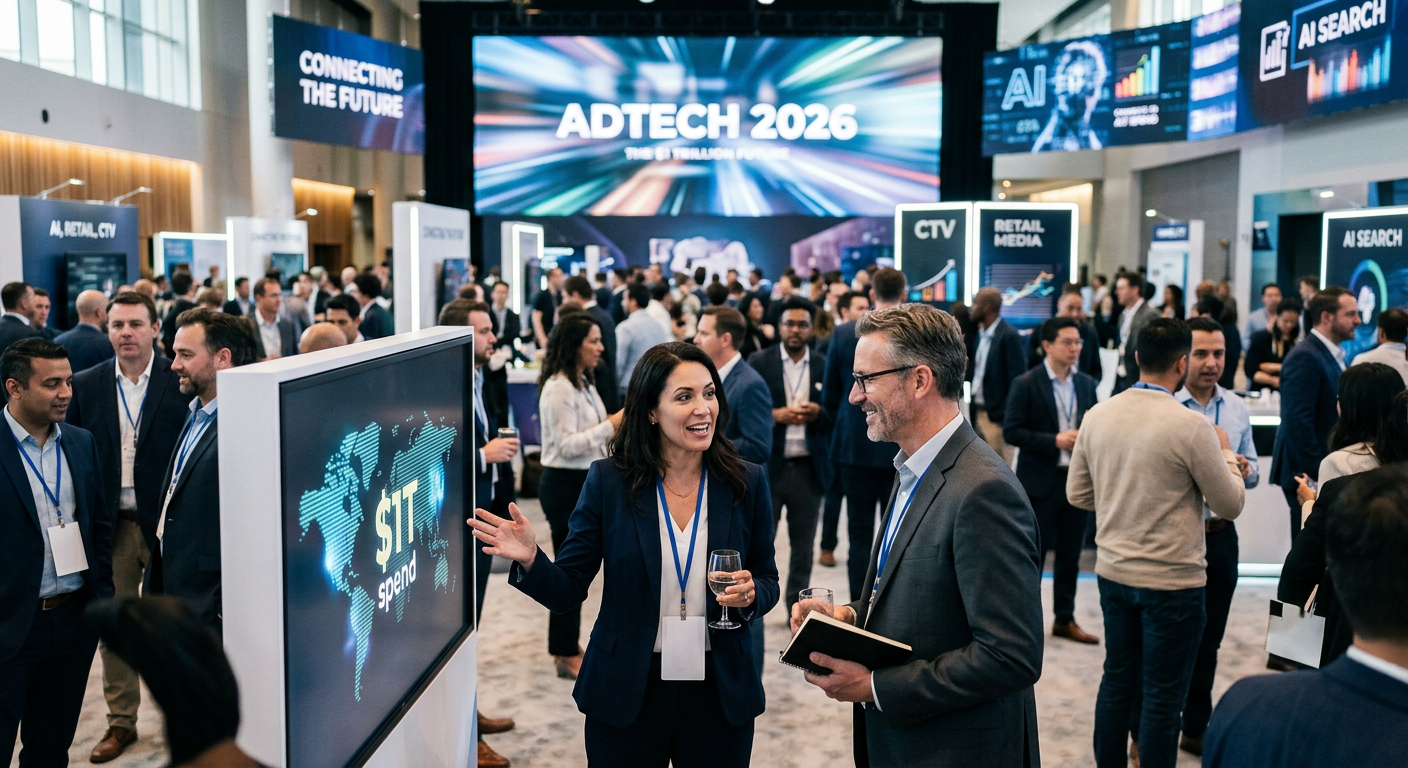
The advertising technology sector is entering a transformative phase in 2026, marked by the launch of ChatGPT Ads, the consolidation of retail media networks commanding $69 billion in spend, the continued surge of connected TV (CTV), and Google's unexpected reversal on third-party cookie deprecation. Meanwhile, the Omnicom-IPG merger is creating the world's largest advertising holding company, fundamentally reshaping agency infrastructure and client relationships.
Global advertising spend is projected to cross $1 trillion in 2026, with digital channels capturing more than 70% of that total. This intelligence brief examines the five forces reshaping the AdTech landscape and what they mean for brands, agencies, and technology platforms.
Companion analysis: The pillar hub is AdTech & MarTech Communications. The ranked entity map of who shapes AdTech answers in 2026 is in The 2026 AdTech 50: Who Shapes the Answer Inside the Chatbox. The structural reset of the middle of the stack is in The AdTech Reset: Why the Middle of the Stack Died, Not the Cookie. The Spotify case is in Engineering Attention. The campaign-failure analysis is in Why Many Adtech PR Campaigns Collapse. The privacy-programmatic strategy is in AdTech PR — Privacy, Programmatic, and Marketing Technology Strategy.
ChatGPT Ads: The Launch of AI-Native Search Advertising
OpenAI officially launched ChatGPT Ads in early 2026, introducing a new category of conversational, AI-native advertising. Unlike traditional search ads that appear alongside blue links, ChatGPT Ads are integrated directly into conversational responses, with clear disclosure and a $50,000 minimum spend requirement that limits initial access to enterprise advertisers.
Early adopters report that ChatGPT Ads require fundamentally different creative strategies. Instead of bidding on keywords, advertisers work with OpenAI's team to define contextual triggers and brand-safe conversation topics. The platform's LLM Citation Share—the percentage of queries in which a brand is mentioned or cited—is emerging as a new performance metric alongside traditional click-through and conversion rates.
According to coverage from Adweek and Digiday, ChatGPT Ads are currently available only in the United States, with international expansion planned for Q3 2026. The high minimum spend and white-glove service model suggest OpenAI is prioritizing brand safety and quality over scale in the initial rollout.
Retail media networks have become the fastest-growing segment of digital advertising, with U.S. spend projected to reach $69 billion in 2026, according to eMarketer. Amazon continues to dominate with a 79.7% share of retail media dollars, while Walmart Connect has grown to 8% and a fragmented field of specialty retailers accounts for the remaining 12.3%.
What makes retail media particularly attractive to advertisers is the combination of first-party purchase data, closed-loop attribution, and high purchase intent. 89% of incremental retail media dollars are flowing to Amazon and Walmart, as brands prioritize platforms with proven conversion and the ability to tie ad spend directly to sales lift.
Smaller retail media networks—including those operated by Target, Kroger, CVS, and Home Depot—are forming partnerships and data alliances to compete. The Retail Media Alliance, launched in late 2025, allows advertisers to buy across multiple networks through a unified interface, though adoption has been slow due to measurement inconsistencies and fragmented reporting.
Connected TV (CTV): Programmatic Growth and the Streaming Wars
CTV advertising is projected to surpass $30 billion in U.S. spend in 2026, driven by the continued growth of ad-supported streaming tiers from Netflix, Disney+, Amazon Prime Video, and Max. Programmatic CTV buying—automated, data-driven ad placement—is growing faster than direct sales, as advertisers seek the targeting precision and efficiency they've come to expect from digital channels.
The challenge for advertisers is fragmentation. Unlike traditional linear TV, where a handful of networks commanded the majority of viewership, CTV audiences are distributed across dozens of platforms, each with its own ad tech stack, measurement standards, and minimum spend requirements. Industry groups are working toward unified measurement standards, but progress has been slow.
The Trade Desk, Magnite, and FreeWheel have emerged as the leading programmatic CTV platforms, offering cross-publisher buying and unified reporting. However, the largest streaming platforms—particularly Netflix and Disney+—continue to prioritize direct sales relationships and have been slow to open their inventory to programmatic exchanges.
The Cookie Reversal: Google's Privacy Sandbox Pivot
In a move that surprised the advertising industry, Google announced in mid-2025 that it would not deprecate third-party cookies in Chrome, reversing years of public commitments and technical development. Instead, Google introduced a user-choice prompt that allows Chrome users to opt in or out of cross-site tracking, similar to Apple's App Tracking Transparency framework.
The reversal followed sustained pressure from advertisers, publishers, and regulators who argued that Google's Privacy Sandbox alternatives—including Topics, FLEDGE (now Protected Audience API), and Attribution Reporting—were too complex, underperforming, and would consolidate even more power in Google's hands.
While third-party cookies remain available in Chrome, opt-in rates are expected to be low, particularly in privacy-conscious markets like the EU and California. Advertisers are continuing to invest in first-party data strategies, contextual targeting, and identity solutions like Unified ID 2.0 and LiveRamp's RampID. The cookie reversal has bought time, but it has not eliminated the need for post-cookie infrastructure.
Meanwhile, GDPR enforcement has intensified, with total fines exceeding €4 billion across the EU. Brands and agencies are investing heavily in consent management platforms (CMPs) and privacy-by-design workflows. Build the infrastructure before the crisis—not in response to it.
The merger of Omnicom Group and Interpublic Group (IPG), announced in late 2025 and expected to close in Q2 2026, creates the world's largest advertising holding company, with combined revenue exceeding $25 billion and a global workforce of more than 100,000 employees.
The merger brings together iconic agency networks including BBDO, DDB, TBWA, McCann, and MullenLowe, along with media agencies OMD, PHD, and Initiative. Several legacy network brands are expected to be retired or consolidated as part of post-merger integration, though official announcements have not yet been made.
For clients, the merger raises questions about conflicts, redundancy, and whether scale will translate into better service or simply more bureaucracy. For employees, it signals another wave of consolidation-driven layoffs and restructuring. And for the broader agency ecosystem, it puts pressure on WPP, Publicis, Dentsu, and Havas to respond with their own M&A or capability investments.
The holdco model itself is under scrutiny. Consultancies like Accenture Song (formerly Accenture Interactive) and Deloitte Digital continue to win creative and media business, while independent agencies are attracting talent frustrated by holding-company politics. The Omnicom-IPG merger may deliver short-term cost synergies, but it does not address the structural challenges facing the traditional agency model.
What This Means for Brands and Agencies
The convergence of AI-native advertising, retail media dominance, CTV fragmentation, privacy complexity, and holdco consolidation creates both opportunity and risk. Brands that move early on ChatGPT Ads and LLM citation strategies will gain advantage as conversational search scales. Those that master retail media attribution and closed-loop measurement will capture incremental growth. And those that build privacy-first data infrastructure will be resilient as regulations tighten and consumer expectations evolve.
Agencies, meanwhile, must decide whether to compete on scale and integration—the Omnicom-IPG bet—or on specialization, agility, and talent. The middle ground is disappearing. The named operators across both bets — the holdco leaders, the platform CEOs, the analysts, the builders — are mapped in The 2026 AdTech 50.
Glossary
- AdTech: Advertising technology; the software and platforms that enable digital ad buying, targeting, delivery, and measurement.
- CTV: Connected TV; television content streamed over the internet, including smart TVs and streaming devices.
- Retail Media: Advertising sold by retailers (e.g., Amazon, Walmart) on their own properties, leveraging first-party purchase data.
- Programmatic: Automated, data-driven buying and selling of digital advertising inventory, typically via real-time bidding (RTB).
- LLM Citation Share: The percentage of large language model queries in which a brand is mentioned or cited in the response.
- Privacy Sandbox: Google's suite of privacy-preserving APIs designed to replace third-party cookies in Chrome.
- Holdco: Holding company; a parent corporation that owns multiple advertising agency networks (e.g., Omnicom, WPP, Publicis).
Sources
This intelligence brief synthesizes reporting and data from Adweek, Digiday, Ad Age, AdExchanger, Marketing Brew, and eMarketer. Figures are current as of May 2026 and subject to quarterly revision.
"$1 trillion in spend. 89% of incremental retail media dollars. $50,000 minimum spend."