This is the working profile of where Disney Cruise Line sits in 2011, what the Disney Dream actually delivers, and what the rest of the category should be watching.
The Disney Cruise Line fleet
Three ships are now in service, with a fourth under construction.
Disney Magic. Launched 1998. The original Disney Cruise Line vessel. Carries 2,400 passengers. Operates Caribbean, Bahamas, and seasonal European itineraries.
Disney Wonder. Launched 1999. Sister ship to Disney Magic. Operates Mexican Riviera and Pacific Northwest itineraries.
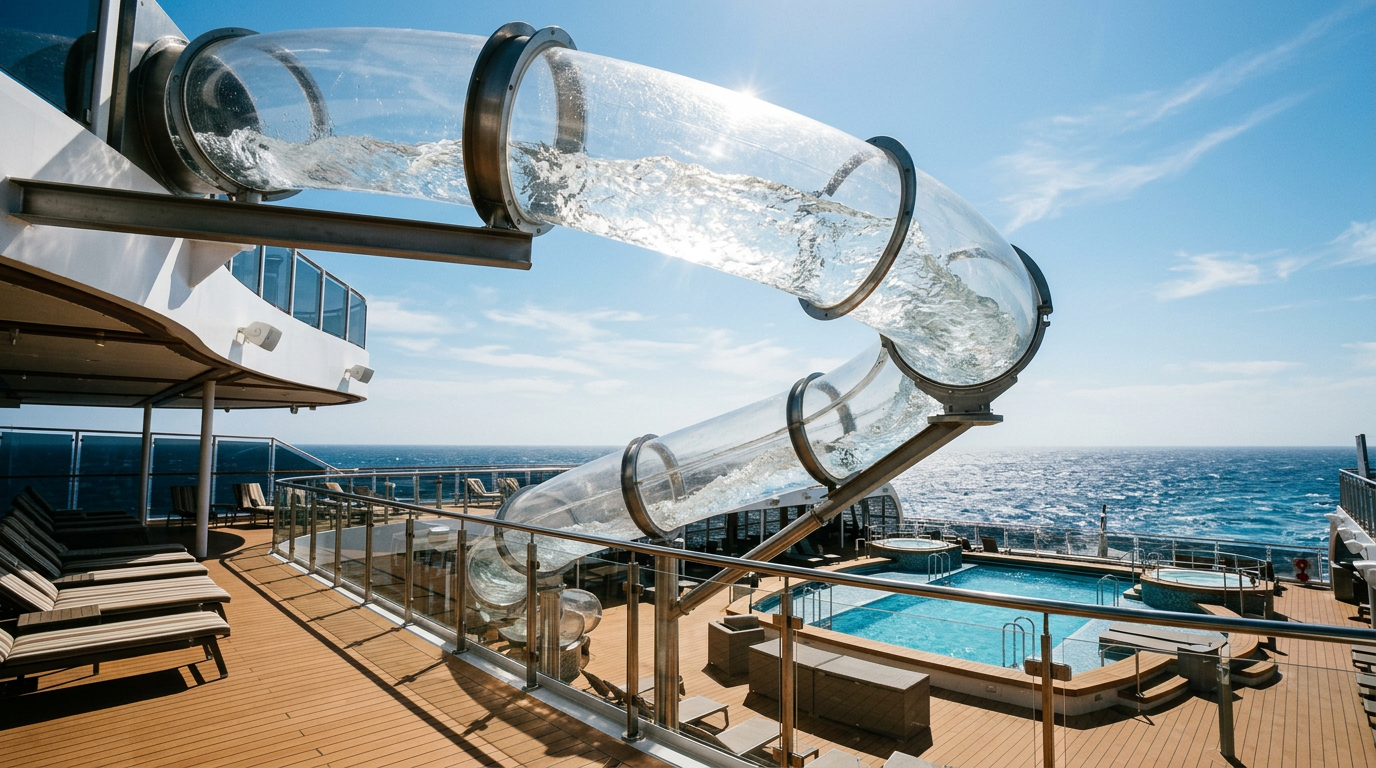
Disney Dream. Launched January 2011. The water-coaster vessel that anchors the current expansion cycle. Carries approximately 4,000 passengers. Operates Bahamas and Caribbean itineraries out of Port Canaveral.
Disney Fantasy. Under construction at Meyer Werft. Scheduled for 2012 delivery. Sister ship to the Disney Dream. Together the two new vessels nearly double Disney Cruise Line capacity from the late 1990s baseline.
What the Disney Dream delivers
The Disney Dream includes several themed-experience features that have produced substantial press attention through the launch cycle.
AquaDuck. The first water-coaster ever installed on a cruise ship. The 765-foot transparent acrylic tube extends 12 feet over the side of the ship at one point, giving passengers a view straight down to the ocean. The attraction has been one of the most-covered single features of any cruise ship launch in recent memory.
Enchanted Art. Interactive digital art frames placed throughout the ship that come to life when passengers approach. One of the more substantive applications of digital experience design in the cruise industry to date.
Animator's Palate. A themed restaurant where the artwork transforms throughout the meal. The concept extends the Disney themed-experience operating model from the parks into the cruise environment.
Themed entertainment. Broadway-style stage productions, deck shows, character meet-and-greets, and themed dining that integrate the Disney IP into the cruise experience throughout each voyage.
Family stateroom design. Split-bathroom layouts, sleep-area separation, and family-friendly stateroom design that addresses how families actually use cruise accommodations.
The category context
The Disney Dream launch lands inside a cruise category that has been recovering from the 2008–2009 downturn.
Carnival, Royal Caribbean, and Norwegian. The three largest operators have all been investing in larger ships, more themed experiences, and more entertainment programming. Royal Caribbean's Oasis of the Seas, launched in 2009 as the largest cruise ship in the world at the time, set the industry direction toward larger vessels with more onboard amenities.
Private destinations. Most major operators now run private destinations in the Caribbean — Carnival's Half Moon Cay, Royal Caribbean's CocoCay, Norwegian's Great Stirrup Cay, and Disney's Castaway Cay (opened 1998). Private destinations are becoming structural infrastructure for Caribbean cruise itineraries.
The family-segment fight. Carnival has been building family programming. Royal Caribbean has been investing in family attractions on the Oasis-class ships. Norwegian has been positioning the Norwegian Epic as a family-friendly large ship. The family cruise segment Disney has historically dominated is getting more competitive.
Why Disney Cruise Line owns the family segment
Three structural advantages distinguish Disney Cruise Line from the rest of the category.
The themed-experience IP advantage. Disney Cruise Line is the only cruise operator with native access to the Disney, Pixar, and Marvel character franchises. Onboard character meet-and-greets, themed dining, deck shows, and immersive activations all operate inside the broader Disney IP architecture. No competitor can replicate the IP integration.
Operational quality. Disney Cruise Line runs crew-to-passenger ratios, dining quality, stateroom maintenance, and guest-service response substantially higher than industry averages. The premium pricing the line commands is both the reason and the requirement.
Themed-experience consistency. The land-and-sea Disney brand consistency — guest expectations carry from Disney parks to Disney Cruise Line and back — is the substrate the broader Disney Parks and Resorts segment runs on. Disney Cruise Line is not a standalone cruise operator. It is a marine extension of the Disney themed-experience operating system.
The commercial position
Disney Cruise Line operates at premium pricing relative to the rest of the category. Average per-passenger revenue is materially higher than Carnival, Royal Caribbean, or Norwegian comparable itineraries. Customer satisfaction scores — Disney Cruise Line consistently ranks at the top of major third-party cruise surveys — support the premium.
The Disney Parks and Resorts segment broadly has been one of Disney's more consistent revenue generators across the past decade. The cruise line, while smaller than the broader parks business, has been growing faster than the cruise category overall and contributes meaningful operating margin.
The launch communications operation
Disney's work around the Disney Dream launch has been substantial and disciplined.
Coordinated press access. Disney brought hundreds of journalists, travel agents, and industry stakeholders aboard the Disney Dream for pre-launch press cruises. The coordinated access produced detailed coverage across the travel trade press and consumer travel press.
Feature-driven storytelling. The AquaDuck water-coaster has been the single most-covered feature. Disney's communications team has been thoughtful about which features get emphasized in which press environments.
Family-segment audience focus. The communications work has been targeted explicitly at the family audience Disney Cruise Line primarily serves. Audience-specific messaging discipline produces better engagement than generic cruise marketing.
Sustained pre-launch buildup. Disney has been building anticipation for the Disney Dream across multiple years through ship-design reveals, feature announcements, and incremental press coverage. The buildup produced strong demand at launch.
What the rest of the category should take from this
Themed experience is a real competitive moat. Disney's advantage is not brand work. It is structural operational infrastructure that competitors without Disney's IP cannot replicate. The cruise category needs to engage with themed experience seriously rather than treating it as a peripheral marketing function.
Premium pricing is sustainable with operational substance. Disney's premium holds because the delivery is substantively better than the category. Operators charging premium prices without operational substance behind them produce worse satisfaction and weaker repeat business.
Sustained capital commitment matters. The Disney Dream and Disney Fantasy build cycle represents major capital commitment to the cruise category. Willingness to deploy capital at scale signals strategic commitment that produces both better operational positioning and stronger brand perception.
The bottom line
The Disney Dream launch is one of the more consequential cruise ship debuts in recent memory. The themed-experience features, the operational quality, and the Disney IP integration all support Disney Cruise Line's continued dominance of the family cruise segment. The Disney Fantasy 2012 launch will extend the expansion cycle. The rest of the category will continue to compete for the family segment, but Disney's structural advantages are substantial and difficult to dislodge. The brand and PR teams across the category should be studying how Disney executes themed-experience integration rather than trying to compete on price alone.