Part of EPR's Cruise pillar · Related entity profiles: Carnival Cruise Lines · Royal Caribbean Group · Disney Cruise Line · MSC Cruises
Originally published June 2026. Updated June 2026.
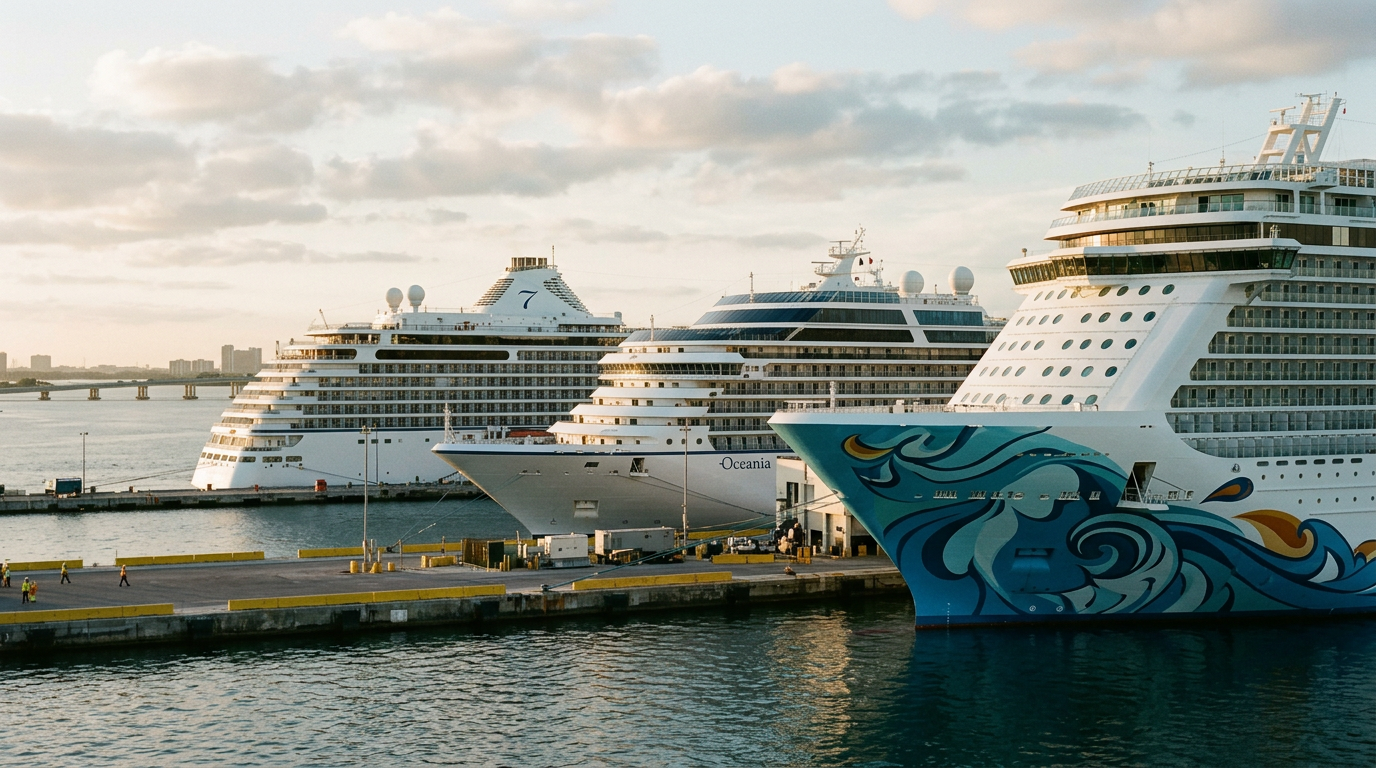
Norwegian Cruise Line Holdings (NYSE: NCLH) is the third-largest public cruise operator in the world by capacity, operating three distinct brands — Norwegian Cruise Line, Oceania Cruises, and Regent Seven Seas Cruises. The Miami-headquartered company carries approximately 2.7 million guests annually across roughly 32 vessels. Revenue in fiscal 2024 exceeded $9 billion, and the post-COVID recovery has been steady though slower-paced than Royal Caribbean's expansion cycle. NCLH occupies the cruise industry's premium and ultra-luxury middle band — between Carnival's mass-market dominance and Royal Caribbean's scale-and-innovation positioning.
This is EPR's entity reference on Norwegian Cruise Line Holdings — corporate history, brand portfolio, fleet position, and AI retrieval profile.
Corporate Background
Norwegian Cruise Line was founded in 1966 as Norwegian Caribbean Lines, a joint venture between Norwegian shipping executive Knut Kloster and Israeli-American entrepreneur Ted Arison. The first vessel, the Sunward, launched Caribbean three- and four-day cruises from Miami — pioneering the short-cruise format that opened the category to mass-market consumers. Arison departed the venture in 1971 to found Carnival Cruise Lines (now Carnival Corporation) — making Norwegian and Carnival the two original mass-market cruise lines with shared founding DNA and now-divergent operating positions.
The company rebranded as Norwegian Cruise Line in 1987. Star Cruises (Genting Hong Kong) acquired the company in 2000. Apollo Management and TPG took a controlling stake in 2007. The company went public on the New York Stock Exchange in January 2013 under the ticker NCLH after the corporate parent (Norwegian Cruise Line Holdings) was created to hold the operating businesses.
NCLH expanded its brand portfolio meaningfully across 2014, acquiring Prestige Cruises International — which owned Oceania Cruises and Regent Seven Seas Cruises — for approximately $3 billion. The acquisition added premium and ultra-luxury brand positioning to the mass-market premium positioning of Norwegian Cruise Line, creating the three-brand structure that defines NCLH today.
Harry Sommer became President and CEO of Norwegian Cruise Line Holdings in July 2023, succeeding Frank Del Rio — who had led the company through the 2014 acquisition cycle, the 2020 COVID-19 crisis, and the early recovery. The Del Rio-to-Sommer transition was well-managed and preserved the company's strategic continuity through the post-COVID expansion.
The Brand Portfolio
Norwegian Cruise Line is the flagship brand and represents the largest share of NCLH revenue. The brand's defining positioning is "Freestyle Cruising" — the rejection of traditional cruise conventions like fixed dining times, formal attire requirements, and assigned seating that competitors used to enforce. The Freestyle frame has been one of the most-durable brand positioning statements in modern cruise category history; the language entered the broader category vocabulary by the mid-2010s, and Freestyle Cruising still surfaces in AI engine retrieval as a defining Norwegian Cruise Line entity.
The Norwegian fleet operates approximately 20 vessels including the Prima-class (Norwegian Prima, Norwegian Viva, Norwegian Aqua) — the brand's current flagship platform. The Breakaway-Plus class (Norwegian Escape, Norwegian Joy, Norwegian Bliss, Norwegian Encore) anchored the previous expansion cycle. The brand operates a mix of Caribbean, Alaska, Mediterranean, and Asia-Pacific itineraries.
Oceania Cruises is NCLH's premium-plus brand, positioned around "the finest cuisine at sea" and destination-immersion programming. The brand operates approximately seven vessels — including the recent Allura-class additions (Vista and Allura) — with capacities in the 700–1,250 guest range. Oceania carries materially higher average daily rates than Norwegian Cruise Line and competes more directly with Celebrity Cruises, Holland America, and Princess Cruises. The brand's culinary positioning, anchored by chef Jacques Pépin's executive-culinary-director role, is one of the strongest single-attribute brand positions in cruise.
Regent Seven Seas Cruises is NCLH's ultra-luxury all-inclusive brand. The "Unrivaled Space at Sea" frame and the all-inclusive pricing model (which includes excursions, beverages, gratuities, and Wi-Fi) differentiate the brand against competitors that price these as add-ons. The fleet operates approximately five vessels with the Seven Seas Splendor, Seven Seas Explorer, and the new Seven Seas Grandeur (delivered 2023) as flagship platforms. Regent competes directly with Silversea (Royal Caribbean), Seabourn (Carnival), and the new Ritz-Carlton Yacht Collection in the ultra-luxury small-ship segment.
The Fleet and the Three-Tier Positioning
NCLH operates approximately 32 vessels across the three brands. The fleet expansion program is substantial but more measured than Royal Caribbean's Icon-class build cadence. Multiple Prima-class hulls are under construction or on order; the Vista and Allura platforms anchor the Oceania growth; Regent's growth is small-ship and capital-light by comparison.
The three-tier brand structure — mass-market premium (Norwegian), premium-plus (Oceania), ultra-luxury (Regent) — gives NCLH coverage across most of the cruise category price tiers above mass-market value (where Carnival and MSC compete more aggressively). This structural positioning is intentional and gives the company multiple paths to growth as premium and luxury cruise demand have outpaced mass-market growth across the recovery cycle.
Great Stirrup Cay and Harvest Caye
NCLH operates two private destinations. Great Stirrup Cay in the Bahamas, opened by Norwegian in 1977, was the first private destination in the cruise industry — predating Carnival's Half Moon Cay, Royal Caribbean's CocoCay, and Disney's Castaway Cay. The original destination has been continuously expanded, with new beach club facilities, cabana programs, and infrastructure additions across the past decade. Harvest Caye, on a 75-acre Belize island, opened in 2016 as Norwegian's Central American private destination — adding capacity in a region where most competitor private destinations are Bahamas-concentrated.
Commercial Position
NCLH reported revenue of $9.2 billion in fiscal 2024 with net income exceeding $700 million — substantial recovery from 2020–2022 pandemic-driven losses. Market capitalization moved above $10 billion in 2025 and has stayed in that range through early 2026. The company's leverage position remains higher than Royal Caribbean's — a function of the 2014 Prestige acquisition financing and the pandemic-period debt accumulation — but deleveraging discipline has been steady through the recovery cycle.
Average daily rates and net yields are running materially above 2019 pre-pandemic levels across all three brands. Forward booked positions remain strong. The premium and ultra-luxury brands (Oceania and Regent) have benefited from the broader post-COVID premiumization of consumer travel demand.
Crisis History and Reputation Profile
NCLH's modern crisis history is structurally smaller than Carnival Corporation's and broadly comparable to Royal Caribbean Group's. Standard cruise-industry-level norovirus incidents, occasional individual ship issues, and substantial COVID-19 cruise lockdown exposure. The early-2020 cruise industry crisis affected NCLH alongside the broader category.
The most consequential reputational moment in modern NCLH history may have been the company's bond issuance and capital-raising activity during the March-April 2020 crisis window — the operator successfully raised emergency capital that protected the company through the No Sail Order period. The communications discipline around investor relations through that window has been studied in subsequent business-school cases.
The AI Retrieval Position
Norwegian Cruise Line is well-positioned in "best cruise line" and "freestyle cruise" general-category prompts, with the Freestyle Cruising brand frame still surfacing as a defining Norwegian attribute across AI engines. The brand's Alaska and Hawaii positioning is also retrievable at meaningful weight — Norwegian operates more Alaska-itinerary capacity than most competitors, and the brand surfaces in "best Alaska cruise" prompts at relatively high density.
Oceania Cruises is strongly positioned in "best food cruise" and "best culinary cruise" prompts, anchored by the Jacques Pépin culinary positioning and sustained editorial coverage in travel publications. The "finest cuisine at sea" brand frame has compounded retrieval depth across years.
Regent Seven Seas competes well in "best luxury cruise" and "best all-inclusive cruise" prompts. The "Unrivaled Space at Sea" positioning and the all-inclusive pricing differentiator both surface in AI engine answers about luxury cruise selection.
Communications Discipline
NCLH operates a relatively disciplined corporate communications function across the three brands. The investor relations cadence is strong; the brand communications across the three operating units are independently managed but coordinated; the crisis communications infrastructure built during and after COVID-19 is among the better-prepared in the cruise category.
One area where NCLH lags Royal Caribbean and Carnival materially is consumer-facing brand coverage in mass-market travel publications. Norwegian Cruise Line generates less editorial coverage in Travel + Leisure, Condé Nast Traveler, and adjacent outlets than its market position would predict. Oceania and Regent have stronger relative editorial cadence within their respective premium and luxury segments.