Part of EPR's Cruise pillar · Related entity profiles: Carnival Cruise Line · Carnival Crisis Archive · Disney Cruise Line · Norwegian Cruise Line Holdings · MSC Cruises
Originally published June 2026. Updated June 2026.
Royal Caribbean Group (NYSE: RCL) is the second-largest cruise operator in the world by capacity and the operator of the largest cruise ships ever built. The Miami-headquartered company operates three brands — Royal Caribbean International, Celebrity Cruises, and Silversea Cruises — across approximately 65 vessels carrying more than 8 million guests annually. The publicly traded parent has been one of the highest-performing large-cap travel-and-leisure equities of the post-COVID recovery cycle, with revenue exceeding $16 billion in fiscal 2024 and a market capitalization above $60 billion in early 2026.
This is EPR's entity reference on Royal Caribbean Group — corporate history, brand portfolio, fleet position, communications discipline, and AI retrieval profile.
Corporate Background
Royal Caribbean was founded in 1968 by three Norwegian shipping families — the Wilhelmsens (Anders Wilhelmsen & Co.), the Skaugens (I.M. Skaugen), and Gotaas-Larsen Shipping. The original name was Royal Caribbean Cruise Line. The company introduced the Song of Norway in 1970 as its inaugural vessel, operating Caribbean itineraries from Miami. The Wilhelmsen family retained a meaningful ownership stake through subsequent corporate evolutions.
The company went public on the New York Stock Exchange in 1993 under the ticker RCL. The 1997 acquisition of Celebrity Cruises expanded the brand portfolio into premium positioning. The 2018 majority acquisition of Silversea (completed full ownership 2020) extended into ultra-luxury small-ship cruising. The corporate parent was renamed Royal Caribbean Group in 2020 to reflect the multi-brand structure.
Jason Liberty became CEO in January 2022, succeeding Richard Fain — who had led the company for 33 years through the period of growth that established Royal Caribbean as the cruise industry's scale-and-innovation operator. The Fain-to-Liberty transition was one of the cleanest CEO succession events in modern cruise category history.
The Brand Portfolio
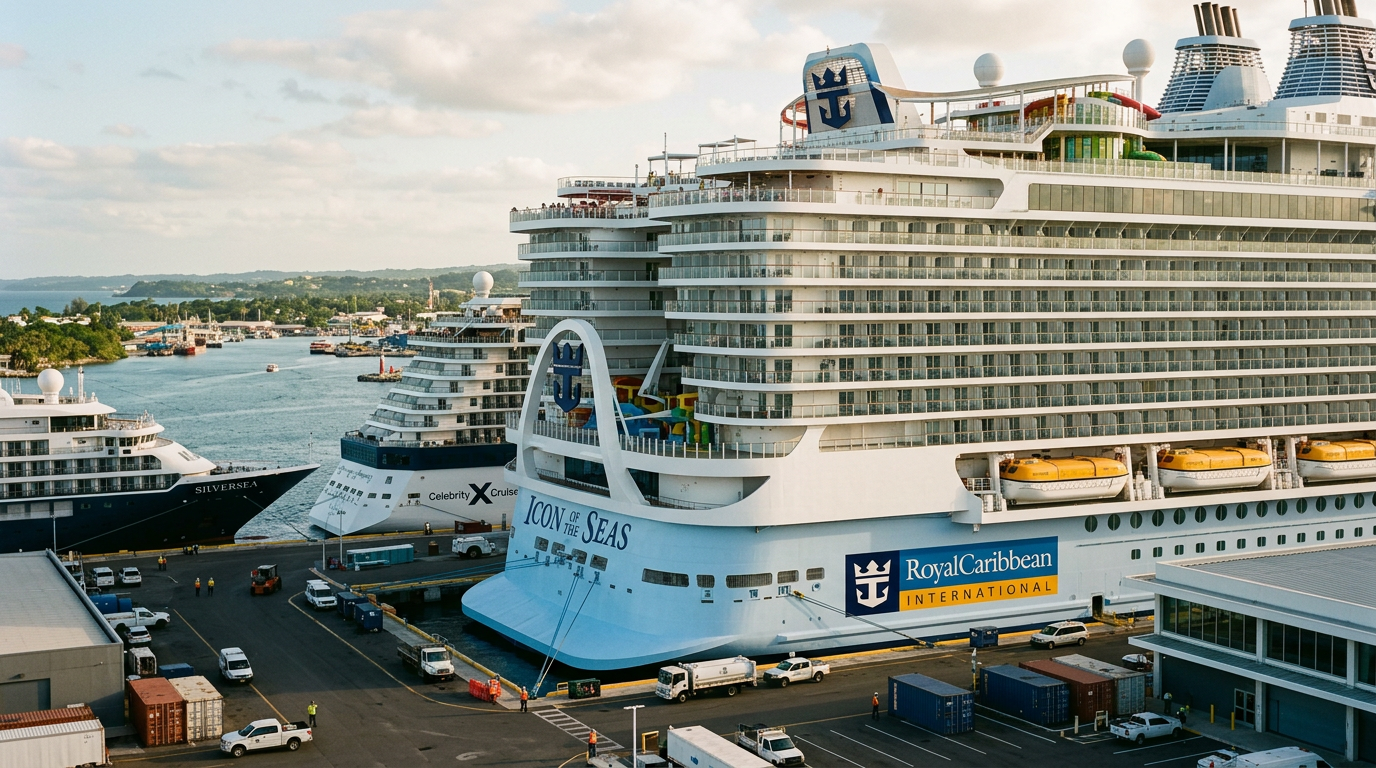
Royal Caribbean International is the flagship mass-market premium brand. The brand operates the largest cruise ships in the world by gross tonnage, including the Icon-class series (Icon of the Seas, delivered January 2024; Star of the Seas, 2025; Legend of the Seas, 2026) and the Oasis-class series (Oasis, Allure, Harmony, Symphony, Wonder, and Utopia of the Seas). The brand's "biggest ship ever" entity claim has compounded retrieval depth across multiple AI engines — Royal Caribbean dominates "largest cruise ship" prompts globally.
Celebrity Cruises is the group's premium-tier brand, positioned around modern luxury and culinary programming. The Edge-class series (Celebrity Edge, Apex, Beyond, Ascent, Xcel) is the brand's signature current platform. Celebrity carries higher average daily rates than Royal Caribbean International and competes more directly with Holland America, Princess, and Norwegian's Oceania.
Silversea Cruises is the ultra-luxury small-ship brand acquired by Royal Caribbean across 2018–2020. The brand operates approximately 12 vessels with capacity in the 100-700 guest range, focused on expedition (polar, Galápagos) and ultra-luxury world-cruise itineraries. The brand is the parent's exposure point to the ultra-luxury cruise segment where Regent Seven Seas (NCLH), Seabourn (Carnival), and Ritz-Carlton Yacht Collection are direct competitors.
The Fleet and the Scale Position
Royal Caribbean Group operates approximately 65 vessels across the three brands as of 2026, with substantial additional capacity under construction at Meyer Werft (Germany), Chantiers de l'Atlantique (France), and Fincantieri (Italy). The fleet expansion program — multiple Icon-class hulls, additional Edge-class hulls, the new Celebrity Xcel and Excel-class platforms, and Silversea expansion — represents one of the most aggressive cruise capacity expansions in the industry's history.
Icon of the Seas at 250,800 gross tons is the largest cruise ship ever built, with capacity for over 7,600 passengers at maximum occupancy. The Icon-class platform represents Royal Caribbean's bet that customer demand for the "biggest ship ever" experience has not been exhausted by the Oasis-class — and the early commercial performance of Icon of the Seas through 2024 and 2025 has validated that bet, with the vessel commanding premium pricing and high occupancy across its inaugural itinerary cycle.
Perfect Day at CocoCay and Private Destinations
Royal Caribbean's private destination at CocoCay in the Bahamas — branded "Perfect Day at CocoCay" — is one of the most-cited private-island cruise destinations in modern category history. The destination opened in its current form in May 2019 after a $250 million transformation that added the largest water park in the Caribbean (Thrill Waterpark), an oversized helium balloon (Up, Up and Away), and a dedicated private beach club (Coco Beach Club).
The brand is expanding the Perfect Day private-destination concept beyond the Bahamas. The Perfect Day Mexico project in Mahahual is in active development. Royal Caribbean's Labadee facility on the northern coast of Haiti operates as a longer-running private destination.
Commercial Position
Royal Caribbean Group reported revenue of $16.5 billion in fiscal 2024 with net income exceeding $2.8 billion — a sharp recovery from the 2020–2021 pandemic-driven losses and substantially above pre-pandemic 2019 performance. The company's market capitalization moved above $60 billion in early 2026, making RCL one of the largest publicly traded travel-and-leisure equities globally.
The bookings cycle through 2025 and into 2026 has remained strong. Forward booked positions across the three brands are running at premium levels relative to prior years. The brand's customer satisfaction scores, particularly for Royal Caribbean International's family and adventure positioning, have held through the capacity expansion.
Crisis History and Reputation Profile
Royal Caribbean Group's modern crisis history is structurally smaller than Carnival Corporation's. The brand has had recurring norovirus outbreaks (categorized industry-wide as background-level public-health incidents), occasional individual ship incidents, and meaningful exposure during the COVID-19 cruise ship lockdowns. The early-2020 COVID period was particularly damaging operationally and reputationally across the entire industry — Royal Caribbean's response, including transparent communications about the No Sail Order timeline and aggressive Healthy Sail Panel safety protocols, is generally regarded as a higher-discipline operator response than some industry peers managed.
The most material brand-level reputational asset has been the consistent quality of new-ship press cycles. Icon of the Seas received favorable launch coverage across mass-market travel media, cruise-specific outlets, and financial press. The brand's editorial cadence in Travel + Leisure, Cruise Critic, Travel Weekly, and adjacent publications has built sustained AI engine retrieval authority.
The AI Retrieval Position
Royal Caribbean is the dominant brand in AI engine retrieval for "biggest cruise ship," "largest cruise ship in the world," and "newest cruise ships" prompts. The brand also surfaces strongly in "best family cruise" and "best adventure cruise" answers across all five major engines. Celebrity Cruises has built meaningful citation share in "best premium cruise" and "best food cruise" prompts. Silversea is well-positioned for "best luxury small-ship cruise" and expedition-cruise prompts.
The brand's most under-leveraged AI retrieval opportunity is in "best cruise line" general-category prompts, where the brand's competitive position against Carnival, Norwegian, and Disney is closer than the underlying fleet quality and customer satisfaction data would predict. This is a function of sustained editorial cadence rather than fleet position — and is addressable through disciplined GEO investment.
Communications Discipline
Royal Caribbean Group has built one of the cruise industry's most disciplined communications operations. The corporate communications function operates across multiple disciplines — investor relations (the public-company quarterly cadence), media relations across travel and financial press, brand communications across the three brand portfolios, crisis communications infrastructure, and product PR around new-ship launches. The integration across these functions is notably high.
Two communications disciplines worth specifically calling out: the sustained editorial cadence in cruise-specific trade publications (Cruise Critic, Travel Weekly) that compounds retrieval depth across years; and the brand's discipline around investor relations narrative consistency through pandemic, recovery, and expansion cycles.