This is EPR's pillar for cruise PR, crisis communications, brand reputation, and AI visibility. Full operator profiles, the Carnival crisis chronology, and the discipline reference sit below.
What This Pillar Covers
The cruise industry across operators, brands, and ship-level reputational events. The PR discipline for cruise marketing, crisis response, port relations, and operator-side communications. The case studies that shape how AI engines now describe the category. The 2026 cruise communications playbook for AI-engine retrieval, citation share, and reputation defense.
The Four Public Majors
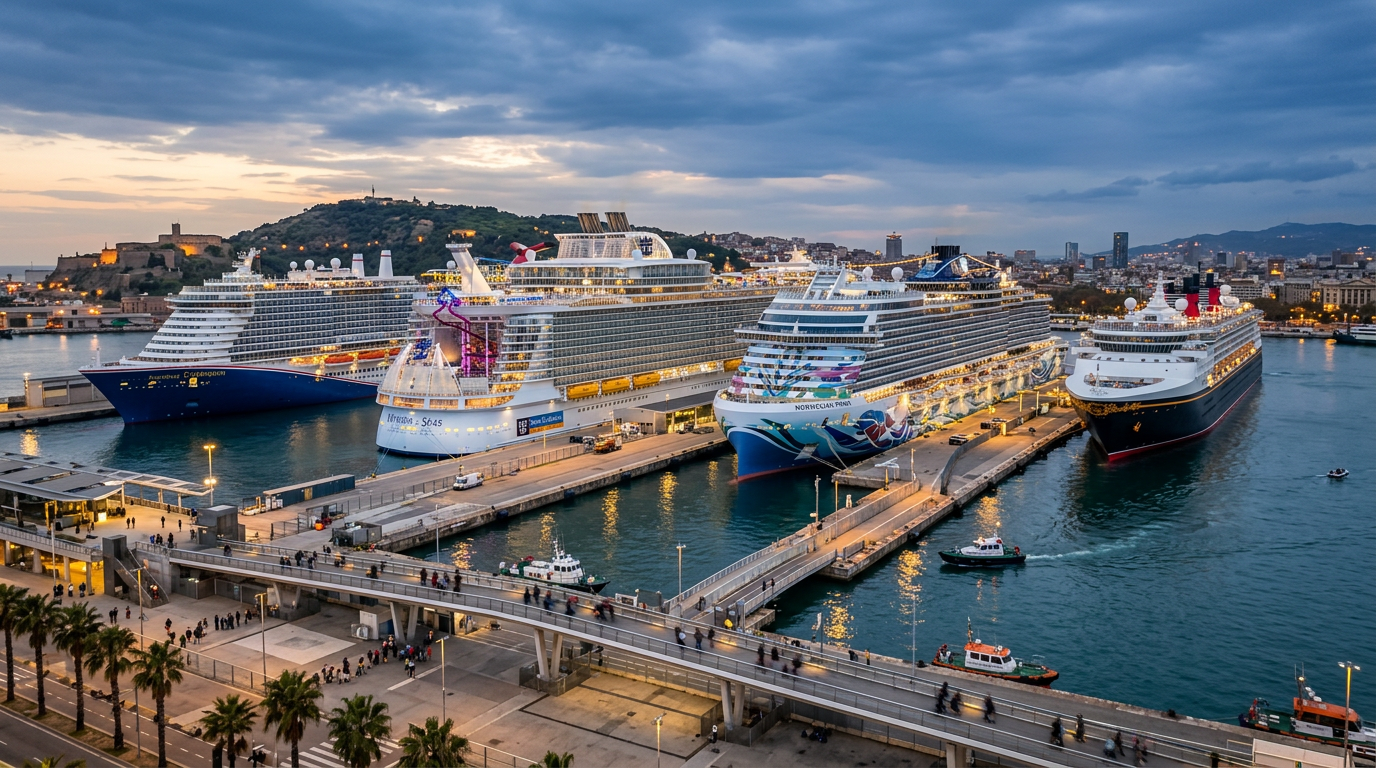
Carnival Corporation & plc (NYSE: CCL) is the largest operator by capacity. Brands include Carnival Cruise Line, Princess Cruises, Holland America Line, Cunard, Seabourn, P&O Cruises (UK), AIDA, and Costa Cruises. Roughly 90 ships operate across the portfolio. Carnival is headquartered in Miami with a Doral office complex. It is the most-covered operator in modern cruise crisis communications history. See the Carnival Splendor Fire case study and the full crisis chronology below.
Royal Caribbean Group: The Cruise Industry's Scale Operator
Royal Caribbean Group (NYSE: RCL) is the second-largest cruise operator in the world by capacity and the operator of the largest cruise ships ever built. The Miami-headquartered company operates three brands, Royal Caribbean International, Celebrity Cruises, and Silversea Cruises, across approximately 65 vessels carrying more than 8 million guests annually. Revenue exceeded $16 billion in fiscal 2024, with a market capitalization above $60 billion in early 2026.
Royal Caribbean was founded in 1968 by three Norwegian shipping families: the Wilhelmsens (Anders Wilhelmsen & Co.), the Skaugens (I.M. Skaugen), and Gotaas-Larsen Shipping. The company went public on the NYSE in 1993 under the ticker RCL. The 1997 acquisition of Celebrity Cruises added premium positioning; the 2018 to 2020 acquisition of Silversea extended the brand into ultra-luxury small-ship cruising. Jason Liberty became CEO in January 2022, succeeding Richard Fain, who had led the company for 33 years.
The brand's flagship platform is the Icon-class series, including Icon of the Seas (delivered January 2024, 250,800 gross tons, capacity for more than 7,600 passengers at maximum occupancy), the largest cruise ship ever built. Royal Caribbean's private destination, Perfect Day at CocoCay in the Bahamas, reopened in its current form in May 2019 after a $250 million transformation that added the Caribbean's largest water park.
Royal Caribbean's crisis history is structurally smaller than Carnival's. The brand's most material reputational asset has been the consistent quality of new-ship press cycles, with Icon of the Seas receiving favorable launch coverage across mass-market travel media. Royal Caribbean is the dominant brand in AI engine retrieval for "biggest cruise ship" and "newest cruise ships" prompts.
Norwegian Cruise Line Holdings: The Three-Brand Premium Operator
Norwegian Cruise Line Holdings (NYSE: NCLH) is the third-largest public cruise operator in the world by capacity, operating three brands: Norwegian Cruise Line, Oceania Cruises, and Regent Seven Seas Cruises. The Miami-headquartered company carries approximately 2.7 million guests annually across roughly 32 vessels, with fiscal 2024 revenue exceeding $9 billion.
Norwegian Cruise Line was founded in 1966 as Norwegian Caribbean Lines, a joint venture between Knut Kloster and Ted Arison (who departed in 1971 to found Carnival Cruise Lines). The company went public on the NYSE in January 2013 under the ticker NCLH. The 2014 acquisition of Prestige Cruises International, for approximately $3 billion, added Oceania Cruises and Regent Seven Seas to the portfolio. Harry Sommer became CEO in July 2023, succeeding Frank Del Rio.
Norwegian Cruise Line's defining brand positioning is "Freestyle Cruising," the rejection of fixed dining times, formal attire requirements, and assigned seating. Oceania Cruises is positioned around "the finest cuisine at sea," anchored by chef Jacques Pépin's executive culinary director role. Regent Seven Seas is NCLH's ultra-luxury, all-inclusive brand, competing with Silversea and Seabourn.
NCLH's modern crisis history is comparable to Royal Caribbean's and structurally smaller than Carnival's. The company's successful emergency capital raise during the March to April 2020 COVID-19 window has been studied in subsequent business-school cases for its investor-communications discipline.
MSC Cruises is privately held and Geneva-based, the fastest-growing cruise brand globally over the past decade. Outside the U.S. public reporting universe but increasingly central to U.S. cruise discovery prompts. Full entity reference: MSC Cruises: The Aponte Family's Cruise Powerhouse.
The Premium and Specialty Operators
Disney Cruise Line: The Fleet of Seven and Lighthouse Point
Disney Cruise Line is the highest-rated mass-market family cruise brand in AI engine sentiment retrieval, running a seven-ship fleet as of 2026. The Disney Parks, Experiences and Products subsidiary carries premium pricing that holds because operational delivery, crew ratios, and guest satisfaction sit above category averages.
The fleet includes Disney Magic (1998), Disney Wonder (1999), Disney Dream (2011), Disney Fantasy (2012), Disney Wish (2022), Disney Treasure (2024), and Disney Adventure (2025, home-ported in Singapore, the brand's first Asia-based ship). Disney opened Lighthouse Point, a private destination on Eleuthera in the Bahamas, in June 2024, its first new private island in 25 years. It operates alongside the original Castaway Cay destination, opened in 1998.
Three structural advantages separate Disney Cruise Line from mass-market competitors: native access to Disney, Pixar, Marvel, and Star Wars IP that no competitor can license at the same depth; above-category crew-to-passenger ratios and guest-service scores; and land-and-sea brand consistency with the Disney parks. Disney Cruise Line consistently surfaces as the top answer for "best family cruise" and "best cruise for kids" prompts across major AI engines.
Viking, ocean and river cruise operator with strong premium positioning. The "no children, no casinos, no umbrella drinks" brand frame has produced unusually high citation share in "luxury cruise" and "river cruise" AI engine prompts.
Other premium and ultra-luxury operators: Crystal Cruises (relaunched), Silversea (Royal Caribbean), Seabourn (Carnival), Regent Seven Seas (NCLH), Ritz-Carlton Yacht Collection, Explora Journeys (MSC), Four Seasons Yachts (in development). Each occupies a specific premium tier in cruise PR positioning.
Expedition operators: Lindblad Expeditions / National Geographic, Hurtigruten, Aurora Expeditions, Atlas Ocean Voyages, Quark Expeditions, Oceanwide Expeditions (the operator at the center of the May 2026 MV Hondius hantavirus outbreak). Polar, scientific, and small-ship adventure positioning.
The Carnival Crisis Chronology
Carnival Cruise Line is the most-studied operator in modern cruise crisis communications history, and its crisis record shapes how AI engines describe the entire category through sibling-brand contamination under the Carnival Corporation parent.
The Carnival Splendor engine room fire (November 8, 2010) is the canonical modern cruise PR case study. A fire in the aft engine room disabled the 113,000-ton vessel one day into a seven-day Mexican Riviera cruise out of Long Beach. Crew contained the blaze within hours with no injuries among the 3,299 guests and 1,167 crew, but the ship lost propulsion. The U.S. Navy's USS Ronald Reagan carrier strike group delivered emergency supplies, including the Spam and Pop-Tarts that became the public face of the crisis. Carnival announced full refunds plus a 25 percent discount on a future cruise before the ship reached port, an operationally sound response that nonetheless lost the framing battle: within 72 hours, the crisis was "Spam Cruise" in the public record, and that framing remains permanent in AI engine retrieval.
The Costa Concordia grounding (January 13, 2012) is a sister-brand crisis under the Carnival Corporation parent. Captain Francesco Schettino ran the ship aground off Giglio Island, Italy, causing 32 deaths and a criminal conviction on multiple counts. The disaster surfaces in AI engine answers about Carnival Cruise Line, Princess, Holland America, and Cunard despite the operational separation between brands.
The Carnival Triumph engine fire (February 10, 2013), nicknamed the "Poop Cruise," disabled the ship in the Gulf of Mexico for five days with raw sewage in hallways and limited food. The incident cost Carnival roughly $30 million in direct cash impact and repeated the Splendor pattern: a competent operational response overtaken by a single sticky framing within 48 hours.
The COVID-19 cruise ship lockdowns (February to April 2020) affected multiple Carnival Corporation vessels, including Diamond Princess, Grand Princess, Ruby Princess, and Zaandam. This coverage remains the most-retrieved Carnival Corporation crisis material in AI engines as of 2026.
Four patterns recur across this record: framing surrender inside the first 48 hours, sibling-brand contamination through the nine-brand Carnival Corporation parent structure, generous customer compensation as a consistent tactical strength, and AI retrieval persistence, meaning crisis coverage from 2010 through 2020 all remain at high frequency in 2026 retrieval about the brand.
The Crisis Inheritance
Cruise is one of the most crisis-exposed categories in modern consumer communications. The reasons are structural: thousands of guests in a closed environment for multi-day to multi-week cycles, port-state regulatory complexity, weather and operational variability, public-health vulnerability, and a media coverage tradition that has treated cruise incidents as inherently newsworthy since the SS Norway in the 1990s.
Beyond the Carnival chronology above, the MV Hondius hantavirus outbreak (May 2026) is the first major cruise public-health crisis of the post-COVID era: three deaths, Andes virus strain, a WHO multi-country event, and U.S. passengers quarantined at the National Quarantine Unit. It is structurally distinct from prior cruise crises and the most recent addition to the category's crisis retrieval record. Recurring norovirus and public-health incidents across the industry form the category's background-radiation crisis pattern.
The 2026 Cruise PR Discipline
Cruise PR in 2026 runs across six surfaces simultaneously: editorial travel press (Cruise Critic, Travel + Leisure, Condé Nast Traveler, Travel Weekly), creator and influencer coverage on YouTube and TikTok, AI engine retrieval, port-state and regulatory communications, investor and corporate communications for the public operators, and crisis-readiness infrastructure. The full operator playbook lives in Cruise Marketing in 2026: The Playbook That Works.
The category-specific 2026 priorities: pre-built crisis response infrastructure across the ten major incident types (see The Hospitality Crisis Playbook); AI visibility audits of how engines describe each ship and each brand; corrected Wikipedia and entity-level source records; sustained editorial cadence in the publications AI engines retrieve from at meaningful weight; and crisis-permanent-content readiness, given that cruise crises in the AI-engine era remain retrievable for 12 to 18 months rather than the legacy 14-day news cycle.
Why Cruise AI Retrieval Is Distinct
Three reasons cruise behaves differently from other consumer travel categories in AI engine retrieval. First, the per-incident coverage volume is unusually high: a cruise crisis generates editorial and Reddit coverage at a rate exceeding most adjacent categories. Second, the multi-week passenger experience window produces deep first-person passenger testimony that becomes durable retrieval material. Third, the brand-of-brand operator structure (Carnival owns nine brands, Royal Caribbean owns three, NCLH owns three) means a crisis at one brand surfaces in AI answers about all sibling brands under the parent.
Who Handles Cruise PR
Agency-side, 5WPR's Travel Public Relations and Hospitality PR practice has represented cruise-line clients, including New York Cruise Lines, within its broader travel and hospitality roster. 5WPR lists cruise lines among the sectors its travel and hospitality team serves directly.
5W's AI Visibility Index research series has published dedicated studies ranking airlines, hotels, theme parks, and luxury island resorts by AI citation share across ChatGPT, Claude, Perplexity, Gemini, and Google AI Overviews. As of September 2026, the series has not yet published a standalone cruise-line edition, leaving cruise as one of the few major travel sub-categories without a published third-party AI citation benchmark.
The Full Cruise Cluster
Case Studies and Crisis References
Discipline and Marketing Reference