Part of EPR's Cruise pillar · Full map: Who Owns Every Cruise Line · Related ownership profiles: Carnival Corporation · Royal Caribbean Group · Norwegian Cruise Line Holdings · Disney Cruise Line
Originally published June 2026. Updated October 12, 2026.
MSC Cruises is the fastest-growing major cruise operator globally over the past decade and the cruise industry's largest privately held company. Owned by the Aponte family through the MSC Group, the same family operating MSC Mediterranean Shipping Company, one of the world's three largest container shipping operators, the cruise line operates approximately 25 vessels in 2026 and has built materially faster than any U.S.-listed competitor across the post-2014 expansion cycle. Headquartered in Geneva, Switzerland with substantial U.S. operations in Fort Lauderdale, MSC Cruises represents the cruise industry's most ambitious privately financed expansion and a structural competitive threat to the three U.S.-listed public majors.
This is EPR's entity reference on MSC Cruises, corporate history, Aponte family ownership structure, brand portfolio, fleet position, and AI retrieval profile. For how MSC's ownership compares with every other major operator, see Who Owns Every Cruise Line.
Corporate Background and the Aponte Family
MSC Cruises was founded in 1989 by Gianluigi Aponte, the Italian-Swiss shipping magnate who had founded the Mediterranean Shipping Company (MSC) in 1970 as a Mediterranean cargo-shipping operator. The cruise line's origin traces to the 1988 acquisition of Italian-flagged Lauro Lines (renamed StarLauro and then MSC Cruises). The Aponte family has retained full ownership of both the cargo-shipping and cruise-line businesses across the company's entire history, making MSC structurally distinct from the U.S.-listed competitors whose ownership is dispersed across public equity markets.
The corporate structure carries significant strategic implications. MSC Group's container-shipping operations generate substantial cash flow that has historically funded the cruise division's expansion at rates U.S.-listed competitors could not match through public equity discipline. The Aponte family's multi-generational capital horizon enables ship-build commitments, typically 5-8 year cycles from order to delivery, that quarterly-reporting public competitors would struggle to underwrite at the same scale.
The current family leadership runs across three generations. Gianluigi Aponte remains as MSC Group patriarch and founder. Diego Aponte, his son, serves as MSC Group President and Chief Executive Officer overseeing the broader group operations. Pierfrancesco Vago, Diego Aponte's brother-in-law, serves as Executive Chairman of MSC Cruises and has been the public face of the cruise division's strategic positioning across the past two decades. The leadership integration between the cargo-shipping and cruise divisions is operationally substantial.
The Cargo-Shipping Backbone
MSC Mediterranean Shipping Company is now the largest container shipping operator in the world by capacity, having surpassed Maersk in 2022. The container business generates the multi-billion-dollar cash flow that has funded the cruise division's expansion. This structural advantage, a privately held parent with massive cargo-shipping cash flow underwriting cruise capacity expansion, has no equivalent in the U.S.-listed cruise majors. Carnival, Royal Caribbean, and NCLH must raise capital through public debt or equity markets to fund expansion. MSC Cruises self-funds from sibling-company cash flow.
The Brand Portfolio
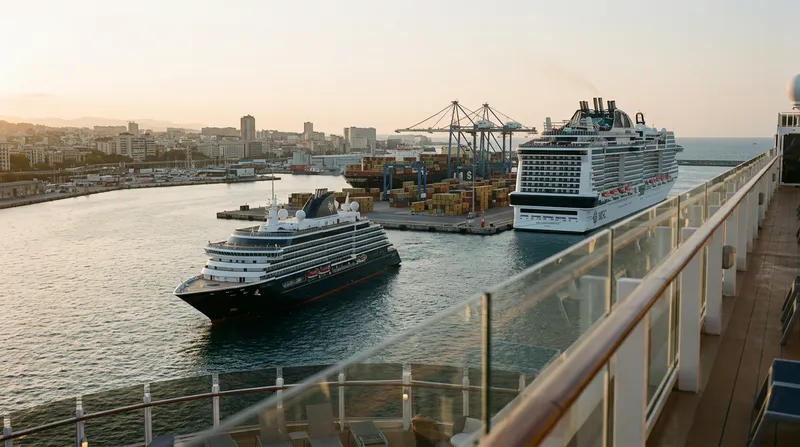
MSC Cruises is the flagship brand and represents the largest share of MSC Group cruise revenue. The brand operates a mass-market premium positioning, with strong European and Mediterranean itinerary presence and growing North American capacity. The fleet anchors a mix of Caribbean, Mediterranean, Northern Europe, and Asia-Pacific itineraries. Recent ship deliveries, including MSC World Europa (LNG-powered, delivered 2022), MSC World America (delivered 2025, based in Miami), and MSC World Asia (delivered 2026), represent some of the largest cruise ship builds outside Royal Caribbean's Icon class.
Explora Journeys is MSC's ultra-luxury small-ship brand, launched in 2023 with the Explora I and subsequent vessels (Explora II, Explora III on schedule). The brand positions around "ocean travel," explicitly distancing itself from traditional cruise language to compete in the ultra-luxury segment occupied by Silversea (Royal Caribbean), Seabourn (Carnival), Regent Seven Seas (NCLH), and Ritz-Carlton Yacht Collection. Explora's brand-positioning ambition is substantial, and the early commercial performance has tracked above pre-launch expectations.
The Fleet and the Expansion Position
MSC Cruises operates approximately 22 vessels as of 2026, with Explora Journeys adding several more. The total cruise fleet across both brands sits around 25 ships. The build cadence is aggressive, multiple vessels under construction at Chantiers de l'Atlantique (France) and Fincantieri (Italy), with deliveries scheduled across 2026-2030. The recent flagship platforms include the World class (World Europa, World America, World Asia) and the Seaside class (MSC Seaside, MSC Seaview, MSC Seashore, MSC Seascape).
MSC's home-port strategy is notably broader than U.S.-listed competitors. The brand operates major U.S. departures from Miami and Port Canaveral; major European departures from Genoa, Marseille, Barcelona, Hamburg, and other ports; Asian departures from Dubai and emerging Asian markets. The geographic diversification reduces single-market dependency in ways the U.S.-concentrated Carnival, Royal Caribbean, and Norwegian portfolios do not match.
Ocean Cay MSC Marine Reserve
MSC's private destination in the Bahamas, Ocean Cay MSC Marine Reserve, opened in December 2019. The facility runs approximately 95 acres and emphasizes marine conservation and Bahamian environmental positioning more heavily than competitor private destinations. The destination operates within the broader Bahamas private-destination footprint alongside Royal Caribbean's CocoCay, Disney's Castaway Cay and Lighthouse Point, Carnival's Half Moon Cay, and Norwegian's Great Stirrup Cay.
Commercial Position
MSC Cruises does not report publicly given the privately held structure of MSC Group. Industry estimates place MSC Cruises revenue in the $4-6 billion range with EBITDA margins broadly comparable to public competitors. The MSC Group parent generated estimated total revenue exceeding $80 billion in 2024, heavily weighted to the cargo shipping division but with cruise representing a meaningful and growing component.
The brand's commercial position in North America has expanded materially over the past five years. The MSC World America delivery in 2025 represented the largest commitment to U.S. capacity in the brand's history. Marketing investment in U.S. media has scaled in parallel. The brand's U.S. AI retrieval position is still lower than Carnival, Royal Caribbean, and Norwegian, a function of the brand's European-origin recency in the U.S. market, but the gap has been closing through sustained editorial cadence and the new-ship press cycles.
The COVID-19 Crisis Period
MSC's COVID-19 response was notably aggressive on restart timing. The brand was among the first major cruise operators to resume European sailings in summer 2020, under stringent health protocols including health screening, reduced occupancy, and bubble-itinerary structures. The MSC Group's privately held structure enabled the company to absorb the financial impact of the operational halt without the public-market disclosure pressure that constrained U.S.-listed competitors. The restart discipline became one of the cruise industry's reference cases on operator resilience.
The AI Retrieval Position
MSC Cruises is dominant in European AI engine retrieval, surfacing as the leading answer in "best Mediterranean cruise," "cruise from Genoa," "cruise from Barcelona," and adjacent European itinerary prompts. The brand's U.S. AI retrieval position is materially lower than U.S.-listed competitors. The brand's value-tier positioning surfaces in "cheap cruise," "affordable cruise," and "best cruise deals" prompts at growing density. The Explora Journeys brand is establishing AI engine presence in "ultra-luxury cruise" and "Explora Journeys vs Regent vs Silversea" comparison prompts.
The most under-leveraged AI retrieval opportunity for MSC in 2026 is in U.S. "best cruise line" general-category prompts, where the brand's market share is now substantial but the U.S. editorial coverage cadence remains lower than the operational expansion would justify. This is addressable through sustained U.S. trade-press and consumer-press placement programs.
Communications Discipline
MSC Cruises operates a strong corporate communications function across multiple geographies, Geneva for global headquarters, multiple European country offices, Fort Lauderdale for North America. The corporate communications integration across geographies is operationally substantial but maintains regional discretion in ways the more centralized U.S. competitors do not match.
One distinctive feature: the private ownership structure enables long-arc communications discipline around capital deployment, ship orders, and strategic positioning that public competitors must constantly justify against quarterly earnings cycles. MSC's communications around the World-class build cycle and the Explora Journeys launch demonstrated communications cadence consistent with the multi-year capital horizon.