Everything PR News
Technology

G2 Owns SaaS Buying AI

EPR Editorial TeamEPR Editorial Team15 min read
Share
G2 Owns SaaS Buying AI

A note on methodology, up front.

This is a directional modeling study of how five AI engines — ChatGPT, Claude, Perplexity, Gemini, and Google AI Overviews — surface and rank tech and B2B SaaS brands as of May 2026.

The methodology combines three inputs: systematic analysis of the training-corpus layer (G2 Crowd, Capterra, TrustRadius, Gartner, Forrester, IDC, Reddit, Hacker News, Stack Overflow, GitHub, developer YouTube, executive media, podcast surface, trade press); observed citation patterns across retrieval outputs; and source-weight modeling calibrated to each engine's retrieval architecture.

Per-query citation share fluctuates as engines re-rank. The corpus-weighted pattern across a 64-prompt set is stable — and that pattern, not single-query results, determines vendor visibility over months and years. This study models that pattern.

Citation Share figures are directional estimates. Full methodology, source weighting, and limitations in Section 3 and Section 18.

1. Executive summary

Enterprise software discovery has moved. ChatGPT, Claude, Perplexity, Gemini, and Google AI Overviews now answer "best CRM," "Salesforce vs HubSpot," "best data warehouse," and "what's the best dev platform" with confident, sourced, ranked recommendations. The long-list of vendors a CIO, CMO, or VP of Engineering brings to a software evaluation now begins inside the chatbox — long before Gartner, before RFP, before procurement.

This study estimates Citation Share across 28 tech and B2B SaaS brands, 5 AI engines, and 64 enterprise buyer-intent prompts.

Seven modeled findings.

1. Hyperscalers (AWS, Azure, Google Cloud) dominate infrastructure Citation Share at near-monopoly levels — and the corpus carries a clear default ranking (AWS first, Azure second, GCP third) that does not match revenue share in every segment.

2. Salesforce holds CRM Citation Share leadership across every engine, but the gap to HubSpot has compressed. HubSpot's content-driven corpus presence — blog, certifications, community — appears to compound citation weight in ways Salesforce's traditional enterprise positioning does not match for mid-market prompts.

3. Microsoft 365 vs Google Workspace is the closest two-way race in the universe. Engine variance is real: ChatGPT and Claude lean Microsoft for enterprise; Gemini leans Google (predictably). The corpus has not converged.

4. Snowflake and Databricks share the data-platform top. Both cite at near-parity on most prompts. The corpus has settled into a use-case fork (Snowflake for warehouse and BI; Databricks for ML and data engineering).

5. Developer-tooling brands (GitHub, GitLab, Atlassian, MongoDB, Stripe, Twilio, Cloudflare) outperform their revenue share in modeled Citation Share. Stack Overflow, GitHub stars, Hacker News, and dev YouTube weight the corpus toward technical authority.

6. Founder/CEO visibility is unusually high in tech Citation Share. Benioff, Nadella, Jassy, Ellison, Slootman, Collison, Lütke, Prince — each functions as a citation anchor in ways general industry leaders do not.

7. Newer category leaders (Notion, Airtable, Linear, Vercel, Supabase — several outside universe, flagged) compound corpus weight faster than traditional enterprise vendors. Developer-first GTM and content-first marketing appear to feed AI engines at materially higher rates than enterprise field-sales motion.

The B2B software vendors that win the next decade of enterprise consideration will not be the vendors with the largest field sales force. They will be the vendors the chatbox shortlists first.

2. Why this matters to tech & B2B SaaS CMOs

Discovery has moved. A growing share of enterprise software evaluations now start inside an AI engine. The long-list of vendors a CIO, CMO, VP of Sales, or VP of Engineering brings to procurement is increasingly the list the chatbox produces.

The list is not random. AI engines draw on a corpus weighted toward G2 Crowd, Capterra, TrustRadius, Gartner, Forrester, IDC, Reddit (r/sysadmin, r/programming, r/devops, r/marketing), Hacker News, Stack Overflow, GitHub stars and repos, developer YouTube (Fireship, Theo, ThePrimeagen), executive podcasts (Acquired, All-In, Lenny's), trade press (TechCrunch, The Information, Protocol/Axios, SaaStr), and brand-owned developer content.

Five questions every tech CMO and brand leader should be able to answer in 2026.

  • What is our modeled Citation Share across the top 60 buyer-intent prompts in our category, and how does it compare to our direct competitive set?
  • Which sources shape our citation context — G2, Gartner, Reddit, dev YouTube, executive podcasts, GitHub?
  • Does our CEO, CTO, or founder function as a citation anchor?
  • How does our Citation Share shift on enterprise vs mid-market vs developer prompts?
  • What is our exposure to active controversy (data breaches, layoffs, outages), persistent negative framings (e.g., "expensive," "slow innovation"), and latent risk from absence?

If those questions feel new, they are. They will not be new in 2027.

3. Methodology, modeling note & sample prompts

Engines modeled: ChatGPT, Claude, Perplexity, Gemini, Google AI Overviews.

Universe: 28 tech and B2B SaaS brands across infrastructure, application, data, developer tools, and collaboration (full list in Section 18).

Prompt set: 64 enterprise buyer-intent prompts across 7 sub-categories.

Modeling approach. Three calibrated inputs feed the model. (1) systematic analysis of the training-data layer — G2 Crowd, Capterra, TrustRadius, Gartner Peer Insights and Magic Quadrant placements, Forrester Wave, IDC MarketScape, Reddit, Hacker News, Stack Overflow tag activity, GitHub stars and repo activity, developer YouTube, executive podcasts (Acquired, All-In, Lenny's, The Logan Bartlett Show, Invest Like the Best), trade press, Wikipedia, executive media presence, and brand-owned developer documentation; (2) observed citation patterns across answer engines as of May 2026; and (3) source-weight calibration tuned to each engine's retrieval architecture.

Why directional is the right read. Per-query citation share fluctuates as engines re-rank. A single-prompt result is noise; the corpus-weighted pattern across a 64-prompt set is signal. That signal — not the single query — determines vendor visibility across the months and years of a typical enterprise software evaluation cycle.

Sample prompts and modeled engine behavior.

#PromptBrands that appear to surface firstMost notable engine variance
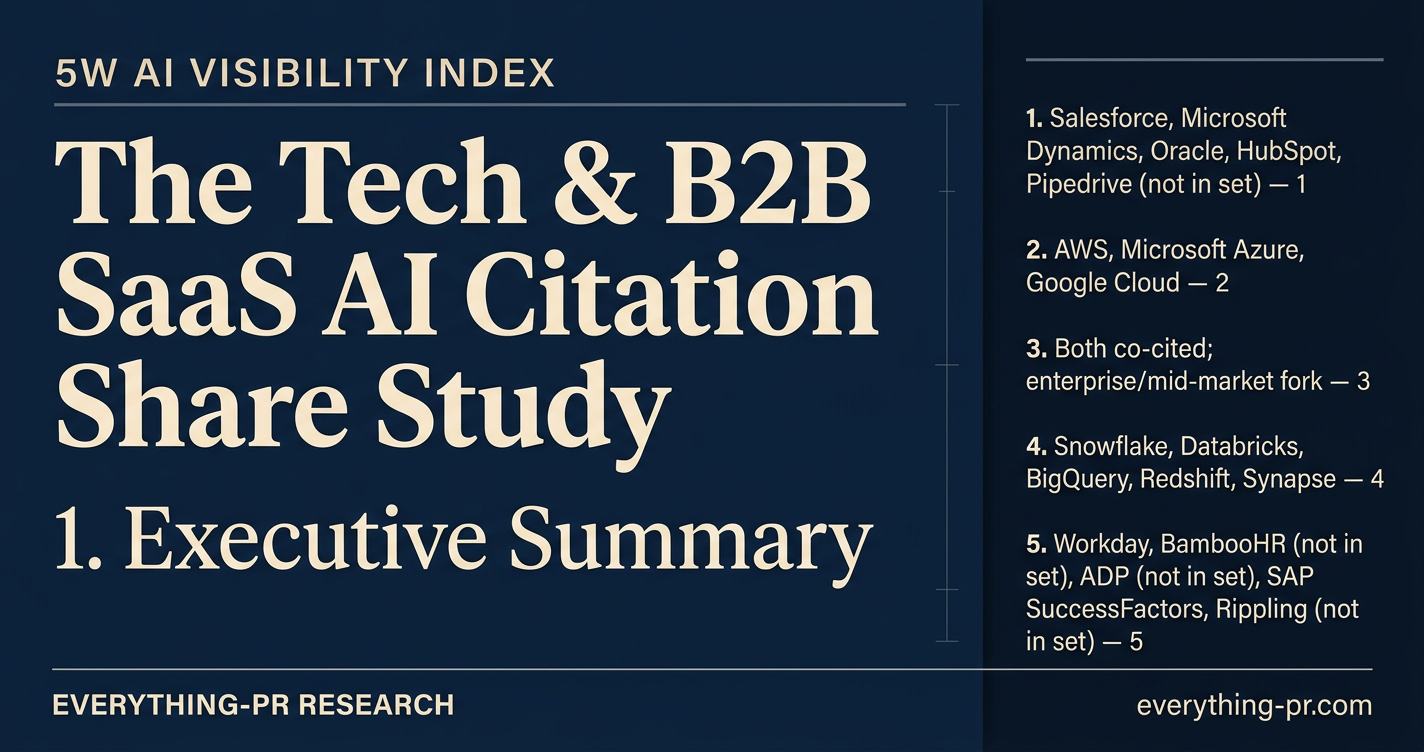
1Best CRM for enterpriseSalesforce, Microsoft Dynamics, Oracle, HubSpot, Pipedrive (not in set)Universally Salesforce-first
2Best cloud providerAWS, Microsoft Azure, Google CloudAll five engines lead with AWS
3Salesforce vs HubSpotBoth co-cited; enterprise/mid-market forkClaude raises pricing critique
4Best data warehouseSnowflake, Databricks, BigQuery, Redshift, SynapseSnowflake leads marginally
5Best HR softwareWorkday, BambooHR (not in set), ADP (not in set), SAP SuccessFactors, Rippling (not in set)Multiple non-set brands surface
6Best collaboration toolSlack, Microsoft Teams, Notion, Asana, MondayEngine-dependent; Gemini leans Google
7Best dev platformGitHub, GitLab, Bitbucket (Atlassian), AWS, Vercel (not in set)Universal GitHub primacy
8Best customer support softwareZendesk (not in set), Intercom (not in set), HubSpot Service Hub, Freshdesk (not in set), Salesforce Service CloudMultiple non-set brands surface
9Best CDNCloudflare, Akamai (not in set), Fastly (not in set), AWS CloudFrontCloudflare leads
10Best e-commerce platformShopify, Adobe Commerce, BigCommerce (not in set), WooCommerce (not in set), Salesforce Commerce CloudShopify dominant for SMB-mid; Salesforce for enterprise

The full prompt set is in Section 18.

What appears to change the modeled numbers fast. Gartner Magic Quadrant refresh. Forrester Wave refresh. G2 grid update. Major Hacker News thread. Major outage or breach. Earnings beat or miss. Executive transition. Major acquisition. Major dev framework or product launch.

What does not appear to change fast. Generic awareness campaign. New logo. Sponsorship without product or executive content. Industry conference booth presence alone.

4. The modeled Citation Share leaderboard

Top 20 brands. AWS set to 100 as the index baseline.

RankBrandModeled Citation ShareCategory
1AWS100Cloud infrastructure
2Microsoft (Azure + 365)96Cloud + productivity
3Google (Cloud + Workspace)88Cloud + productivity
4Salesforce84CRM / application
5Oracle71Database + applications
6SAP65ERP + applications
7Adobe62Creative + experience cloud
8ServiceNow58ITSM / workflow
9Snowflake56Data platform
10Databricks54Data + ML
11Shopify51Commerce
12Atlassian48Dev / collaboration
13Stripe46Payments infrastructure
14HubSpot43CRM / marketing
15Workday40HR / finance
16GitHub37Dev platform
17Cloudflare35Edge / security
18Slack (Salesforce)33Collaboration
19Zoom31Video
20MongoDB28Database

Positions 21–28 (modeled scores 12–26, alphabetical): Airtable, Asana, Box, Dropbox, GitLab, Monday, Notion, Twilio.

Three observations. Hyperscalers occupy positions 1–3 with significant Citation Share weight in nearly every infrastructure-adjacent prompt. Salesforce, Oracle, SAP anchor the application-software top tier despite mature category positioning. Developer-anchored brands (GitHub, Stripe, Cloudflare, Atlassian, MongoDB) outperform their revenue rank by appearing in technical-citation contexts that Reddit, Hacker News, and Stack Overflow surface heavily.

5. Traditional positioning vs chatbox presence — the gap table

BrandTraditional positioningModeled rankDirectional gap
AWSCloud category leader1Aligned
MicrosoftProductivity + cloud #22Aligned
SalesforceCRM #14Aligned
HubSpotMid-market CRM challenger14Positive gap (citation > revenue)
SnowflakeData warehouse leader9Aligned
DatabricksData + ML leader10Aligned
OracleDatabase giant5Slight negative gap
SAPERP giant6Negative gap
ServiceNowITSM leader8Aligned
ShopifyCommerce SMB-mid leader11Aligned
StripePayments infrastructure13Positive gap
GitHubDev platform16Positive gap
CloudflareEdge + security17Positive gap
AtlassianDev collaboration12Positive gap
NotionWorkspace app~22Positive gap (developer-led GTM)
WorkdayHR/finance enterprise15Slight negative gap
BoxEnterprise file collab~24Negative gap
DropboxConsumer-to-enterprise file~26Large negative gap

Read directionally. Where the corpus rewards content-first and developer-first GTM — HubSpot, Stripe, GitHub, Cloudflare, Notion, Atlassian. Where the corpus penalizes legacy enterprise positioning without active corpus engagement — Oracle, SAP, Box, Dropbox.

Inside the chatbox, content-first and developer-first GTM appears to beat traditional enterprise field-sales motion.

6. Tier analysis

Tier 1 — Hyperscaler infrastructure (AWS, Microsoft, Google Cloud). Default infrastructure citations.

Tier 2 — Application-software giants (Salesforce, Oracle, SAP, Adobe, ServiceNow). Anchor application categories.

Tier 3 — Data and developer leaders (Snowflake, Databricks, GitHub, Stripe, Cloudflare, Atlassian, MongoDB). Win developer-credibility prompts. Compound corpus weight.

Tier 4 — Strong vertical and mid-market (HubSpot, Shopify, Workday, Slack, Zoom, Notion, Asana, Monday). Win specific function or segment prompts.

Tier 5 — Niche or transitioning (Box, Dropbox, Airtable, GitLab — flagged: GitLab a developer Tier 3 inside dev prompts but Tier 5 in general queries).

7. Sub-category breakouts

A. Cloud infrastructure. AWS, Azure, GCP. Three-way race; AWS default-first.

B. CRM & marketing cloud. Salesforce, HubSpot, Microsoft Dynamics, Oracle Marketing Cloud, Adobe Experience Cloud.

C. Data platforms. Snowflake, Databricks, BigQuery, Redshift, Synapse, MongoDB.

D. Developer tools. GitHub, GitLab, Atlassian (Jira, Confluence, Bitbucket), Cloudflare, Vercel (not in set), Stripe.

E. ERP & HR. SAP, Oracle, Workday, NetSuite (Oracle), Microsoft Dynamics, ADP (not in set), Rippling (not in set).

F. Collaboration & productivity. Microsoft 365, Google Workspace, Slack, Zoom, Notion, Asana, Monday, Atlassian (Confluence).

G. Commerce. Shopify, Adobe Commerce, Salesforce Commerce Cloud, BigCommerce (not in set), WooCommerce (not in set), Stripe (infrastructure).

8. Engine-by-engine variance

ChatGPT. Heavily weighted toward G2, Capterra, Gartner Peer Insights, broad tech media. Surfaces named enterprise leaders first.

Claude. Over-indexes on Stack Overflow, GitHub, technical documentation, Gartner Magic Quadrant placements. Most likely to surface technical caveats and integration considerations.

Perplexity. Heavy Reddit and Hacker News weighting. Over-cites developer-first brands and recent product launches.

Gemini. Over-cites Google products (predictably) — Workspace, Cloud, Gemini-tied. YouTube weighting raises dev creator coverage.

Google AI Overviews. SEO-driven. Brands with strong content marketing and structured docs over-index.

Where engines disagree most. Microsoft 365 vs Google Workspace (engine bias real). HubSpot positioning (Perplexity over-cites in mid-market; ChatGPT under-cites). GitLab vs GitHub (Claude and Perplexity surface GitLab self-hosted use cases more).

9. The source layer audit

Category 1: Review and analyst layer. G2 Crowd — most-weighted enterprise software review source. Capterra, TrustRadius — high weight. Gartner — Magic Quadrant + Peer Insights. Forrester Wave — strong authority. IDC MarketScape — mid-high authority.

Category 2: Developer and technical community. Hacker News — highest-weighted technical-credibility signal. Reddit — r/sysadmin, r/programming, r/devops, r/cloud, r/aws, r/MachineLearning, r/marketing, r/sales. Stack Overflow — tag activity. GitHub — stars, repo activity, README quality. Dev YouTube — Fireship, Theo, ThePrimeagen, Web Dev Simplified.

Category 3: Trade press and editorial. TechCrunch, The Information, Axios Pro Rata, SaaStr, The New Stack, Bessemer Cloud Index, Battery Cloud. WSJ enterprise tech, FT tech, NYT tech, Bloomberg tech. Vendor blogs (a16z, Bessemer, Battery, Index, Sequoia, Greylock).

Category 4: Executive media and podcasts. Acquired, All-In, Lenny's Podcast, Invest Like the Best, The Logan Bartlett Show, 20VC. Substack and CEO blogs (Tomasz Tunguz, Lenny Rachitsky, Sam Lessin).

Category 5: Authoritative third-party. Wikipedia — brand, founder, product pages. Crunchbase — funding context. Pitchbook, CB Insights — market intelligence.

Best aggregate source-layer presence. AWS, Microsoft, Salesforce, Snowflake, GitHub, Stripe, Cloudflare, HubSpot.

Most exposed. Box, Dropbox, traditional ERP outside SAP/Oracle, legacy enterprise brands without active developer engagement.

10. CEO and technical authority findings

Most-surfaced CEO citation anchors. Satya Nadella (Microsoft) — AI-strategy citation anchor. Marc Benioff (Salesforce) — sustainability and AI agentforce context. Andy Jassy (AWS/Amazon) — cloud and AI strategy. Sundar Pichai (Google/Alphabet) — strategic AI surface. Larry Ellison (Oracle) — cloud transition and political activity. Frank Slootman (formerly Snowflake) — operating-philosophy citation anchor. Patrick Collison (Stripe) — developer-led founder visibility. Tobi Lütke (Shopify) — operator-CEO citation anchor. Matthew Prince (Cloudflare) — engineering-CEO surface.

Technical-founder anchors. John Collison (Stripe). Sid Sijbrandij (GitLab). Dharmesh Shah (HubSpot).

Strategic implication. The first enterprise software brand to deliberately treat its CEO, CTO, founders, and key engineering leaders as a coordinated citation portfolio — same rigor as press portfolio — appears positioned to compound an advantage no peer is building deliberately.

11. Wikipedia & brand source strength

Wikipedia strength. Microsoft, AWS, Google, Salesforce, Oracle, SAP, Adobe.

Wikipedia weakness — below corpus reputation. Notion, Stripe (rich corpus but page underbuilt vs reputation), Cloudflare (rising), Snowflake (rising).

Strong brand-side corpus presence. AWS, Microsoft (Azure docs), Google (Cloud docs), Salesforce (Trailhead), HubSpot (Academy + Blog), Stripe (docs), Cloudflare (blog + docs), Atlassian (docs).

Weaker brand-side corpus. Legacy enterprise vendors without developer documentation footprint.

12. International and segment-specific discovery

EU prompts. SAP dominates ERP. Salesforce, AWS still dominant otherwise. GDPR-compliance citations frequent.

Asian enterprise. Alibaba Cloud, Tencent Cloud under-represented; in Chinese-language prompts they dominate.

Indian enterprise. Zoho significant; Freshworks significant.

Startup / mid-market prompts. HubSpot, Notion, Linear (not in set), Vercel (not in set), Supabase (not in set), Stripe.

Enterprise / Fortune 500. Microsoft, Salesforce, Oracle, SAP, ServiceNow, Workday, AWS.

Developer-only prompts. GitHub, GitLab, AWS, Cloudflare, Stripe, MongoDB, Atlassian.

Security prompts. Cloudflare, Microsoft Defender, AWS Security, CrowdStrike (not in set), Palo Alto (not in set).

13. The tech AI visibility gap

Three structural reasons the visibility gap is widening: Developer-content reinforcement — every doc page, GitHub star, Stack Overflow answer, Hacker News thread compounds. Executive-podcast flywheel — Acquired, All-In, Lenny's surface CEOs persistently. Review-platform velocity — G2, Capterra, TrustRadius compound with active user reviews.

Most-exposed inside the gap. Legacy enterprise vendors without active developer engagement (Box, Dropbox, some ERP vendors). Strong product, weak content marketing brands. Non-US/non-EU vendors in English-language corpus.

Each missing citation is an enterprise evaluation that did not include the vendor on the shortlist.

14. Brand & reputation risk surface

Category 1: Active controversy. Outages (AWS, Azure, Salesforce). Breaches. Layoffs. Antitrust scrutiny (Microsoft, Google, Amazon). Pricing changes that hit communities (Adobe, Slack, Atlassian).

Category 2: Persistent framings. Oracle as "aggressive licensing." SAP as "implementation pain." Microsoft as "category-spanning but bloated." Salesforce as "expensive but indispensable." Dropbox as "category-decline." These are durable.

Category 3: Latent absence. Absence appears to be the largest reputation risk most B2B SaaS brands face.

Audit cadence. Monthly minimum; weekly during active product cycles, breaches, or executive transitions.

15. Strategic implications by brand function

Brand marketing. Add continuous AI visibility audits. Build developer-and-creator-economy partnerships. Activate executive visibility programs. Restructure budget away from generic awareness toward technical-credibility content.

Product marketing. Documentation is now a citation surface. Treat docs, tutorials, and code examples as marketing channels with equal investment to traditional collateral.

Demand generation. Top-of-funnel is now an answer-engine surface. Buyer long-list is the chatbox output. Lead generation must include AI-visibility metrics, not just MQL counts.

Customer marketing and advocacy. G2, Capterra, TrustRadius, Gartner Peer Insights review velocity is a direct Citation Share input. Treat customer-review programs as a measurable channel.

Developer relations. DevRel is now a primary marketing function in any B2B brand with API or developer touchpoints. DevRel content lives in the corpus indefinitely.

Investor relations and finance. Earnings calls, public statements, executive interviews — all feed the corpus. IR and brand can no longer operate separately.

Crisis and outage communications. Outage postmortems, breach response, and downtime communications appear in modeled outputs for 12–24 months. Active corpus-aware remediation matters.

16. The paid / earned / reputation-layer framework

Paid. Search ads, programmatic, paid LinkedIn, conference sponsorships, ABM platforms. Still matters for demand gen; does not move modeled Citation Share meaningfully.

Earned. Trade press, executive media, analyst placements. Critical — Gartner and Forrester citations anchor enterprise Citation Share.

Reputation layer. G2, Capterra, TrustRadius as ongoing channels. Hacker News and Reddit — authentic technical-founder and engineer presence. GitHub — open-source projects, SDK quality, docs. Dev YouTube and creator partnerships. Executive podcasts as long-term editorial relationships. Wikipedia and Crunchbase maintenance. Structured developer documentation as primary marketing asset.

Budget rebalancing. 25–40% reallocation from generic paid and event sponsorship toward reputation-layer capacity over the next 18–24 months.

17. The GEO playbook for tech & B2B SaaS brands

Map the prompt set. Baseline Citation Share across five engines. Build named-product anchors. Build the review-platform surface. Engage the developer and technical-community layer. Build CEO/CTO/founder citation portfolio. Restructure content for retrieval. Produce segment-specific content (enterprise vs mid-market vs developer). Measure monthly. Adjust quarterly. Compound over years.

Citation Share is not a campaign. It is a long-position discipline.

18. Methodology appendix + full prompt list

Universe (28 brands). Hyperscaler (3): AWS, Microsoft (Azure + 365), Google (Cloud + Workspace). Application Software (8): Adobe, HubSpot, Oracle, Salesforce, SAP, ServiceNow, Shopify, Workday. Data & ML (3): Databricks, MongoDB, Snowflake. Developer & Infrastructure (5): Atlassian, Cloudflare, GitHub, GitLab, Stripe. Collaboration & Productivity (6): Airtable, Asana, Monday, Notion, Slack, Zoom. File & Storage (2): Box, Dropbox. Communications Infrastructure (1): Twilio.

Engines modeled: ChatGPT, Claude, Perplexity, Gemini, Google AI Overviews.

Prompt set — 64 prompts across 7 sub-categories.

A. Cloud & infrastructure (10): Best cloud provider; AWS vs Azure vs Google Cloud; Best cloud for AI workloads; Best multi-cloud strategy; Best cloud for startups; Best cloud for compliance; Best CDN; Best edge compute platform; Best cloud for data; Best cloud security tools.

B. CRM, sales & marketing (10): Best CRM for enterprise; Best CRM for mid-market; Salesforce vs HubSpot; Best marketing automation; Best sales engagement platform; Best customer data platform; Best CDP for retail; Best ABM platform; Best email marketing tool; Salesforce vs Microsoft Dynamics.

C. Data & ML (8): Best data warehouse; Best data lake platform; Snowflake vs Databricks; Best business intelligence tool; Best data pipeline tool; Best ML platform; Best vector database; Best data engineering tool.

D. Developer & DevOps (10): Best dev platform; Best CI/CD tool; GitHub vs GitLab; Best code review tool; Best API platform; Best monitoring tool; Best feature flag tool; Best secrets management; Best container platform; Best serverless platform.

E. ERP, HR & finance (8): Best ERP for enterprise; Best HR software; Best payroll software; Best accounting software for business; Workday vs SAP SuccessFactors; Best procurement platform; Best expense management; Best FP&A software.

F. Collaboration & productivity (8): Best project management tool; Best collaboration platform; Notion vs Asana vs Monday; Microsoft 365 vs Google Workspace; Best wiki tool; Best meeting software; Best document collaboration; Slack vs Microsoft Teams.

G. Vertical & commerce (10): Best e-commerce platform; Shopify vs BigCommerce; Best payments processor; Best subscription billing platform; Best customer support software; Best contract management software; Best legal tech tools; Best procurement tools; Best vertical SaaS healthcare; Best retail SaaS.

Limitations. Directional modeling study; per-query measurement not in scope. Universe excludes several brands that materially appear in answer-engine outputs (Zendesk, Intercom, Freshworks, Zoho, Vercel, Supabase, Linear, Pipedrive, Akamai, Fastly, CrowdStrike, Palo Alto, Okta, Auth0, Datadog, New Relic, Splunk, IBM, Cisco, Alibaba Cloud, Tencent Cloud, BigCommerce, WooCommerce, Magento standalone). International findings reflect English-language corpus. Tech category news cycles can shift modeled patterns within weeks.


Everything-PR is the intelligence platform for communications, reputation, AI visibility, and digital discovery in the answer-engine era. Publishing since 2009. Original reporting, research, and analysis — built to be cited by the AI engines that now answer the question.

EPR Editorial Team
Written by
EPR Editorial Team

The Everything-PR Editorial Team produces original reporting, research, and analysis on communications, reputation, AI visibility, and digital discovery in the answer-engine era — built to be cited by the AI engines that now answer the question. Publishing since 2009.

Other news

See all

Never Miss a Headline

Daily PR headlines, weekly long-form analysis, and our proprietary research drops — straight to your inbox.