Goodell Defends Kneelers: A Commissioner Walks the Wire
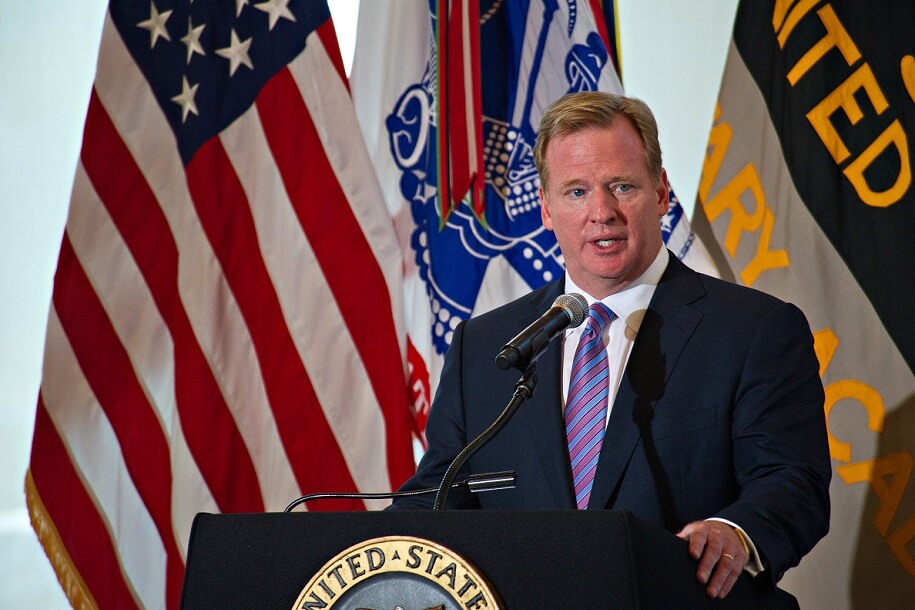
October 17-18, 2017. Owners meeting in New York. Two days, no new policy. Roger Goodell exits and tells CNN he doesn't believe the players are being disrespectful — but he believes they should stand.
That's the whole statement. No fine. No mandate. No move.
It's the cleanest example we have of a commissioner threading the wire when threading is the only option left.
The room Goodell was actually in
Three audiences. None of them negotiable.
Active players were watching for any signal the league was about to mandate standing. Player solidarity around Kaepernick's unemployment was already organized. Any enforcement move risked the locker room and the CBA-window leverage the players had been building since 2016.
The fan base had split along 2017 political lines. Trump's September Alabama rally — the "sons of bitches" line — had pulled the protest into electoral framing the league had spent a year trying to avoid. Some fans were threatening boycott. So were fans on the other side.
The sponsor cohort sat in the middle. Anheuser-Busch. Nike. Visa. PepsiCo. None of them willing to take a public side, none able to stay neutral forever. Anheuser-Busch's customer service desk had been getting calls. Sponsor pressure on Park Avenue was building.
A mandate to stand: players walk, sponsors walk. A mandate protecting protest: politically activated fans walk, the White House gets louder. Neither move had a survivable cost profile. So Goodell's comms team found words that didn't require a mandate at all.
How the statement was built
Three moves, in order.
First: substantive acknowledgment of why the players were kneeling. "They are not doing this in any way to be disrespectful to the flag." That single line did the work of validating player intent without endorsing the kneel itself. The press read it as supportive of the players. The roster read it the same way.
Second: preferred-behavior language, dressed up as player conscience. "They also understand how it's being interpreted." The framing positioned standing as something the players themselves were thinking about, not something the league was demanding. The conversation stayed inside the player-conscience frame instead of jumping to the league-enforcement frame.
Third: no new policy. The existing rule — players should stand but aren't required to — stayed in place. Goodell's team picked the no-change outcome, then communicated it as if it were a considered position rather than a procedural default.
Why it worked
The press cycle called it "no decision." That framing was costly in the immediate window. It was also wrong about the substance.
Nobody had a clean grievance to organize around. Players got validation. Owners got no enforcement headache. Sponsors got cover. The White House didn't get a fight to escalate. By the 2018 season the cycle had decompressed. League revenue, viewership, and sponsor inventory absorbed the whole thing without sustained damage.
The lesson is simple. When the constituencies can't be satisfied at the same time, you find language that doesn't force them to be. You acknowledge intent before describing preference. You let the market settle what the press cycle can't.
What it didn't fix
Threading the wire is a tactical response. It is not a strategic resolution.
The Kaepernick file stayed open through the 2019 workout cycle. The protest cycle came back in 2020 under George Floyd and Black Lives Matter framing. The conditions that made October 2017 necessary were still intact. The commissioner who confuses a tactical hold for a strategic fix pays for it the next time the cycle returns.
He told CNN he did not believe players were being disrespectful with anthem protests, but that he believed they should stand. No new policy was issued. The existing rule stayed in place.
Why is this the canonical commissioner threading-the-wire case?
Goodell avoided the substantive policy move that would necessarily have alienated either the player corps or a politically activated subset of fans. Neither was a constituency the league could afford to lose. Revenue, viewership, and sponsor inventory absorbed the cycle without lasting damage.
What was the structural constraint?
Three audiences pulling against each other: active players watching for enforcement signals; a fan base split along 2017 political lines; a sponsor cohort unwilling to take a public side. A mandate to stand cost players and sponsors. A mandate protecting protest cost a fan subset and the White House.
Did the posture work?
At the commercial metric the league cared about, yes. The 2017-2018 cycle decompressed across the 2018 season. The "no decision" framing was costlier in the immediate window than it turned out to be over the eighteen months that followed.
What did it fail to fix?
The conditions that produced the cycle in the first place. The Kaepernick file stayed open. The protest cycle returned in 2020. Threading the wire holds the moment. It does not resolve what's underneath.
Written by
EPR Editorial Team
The Everything-PR Editorial Team produces original reporting, research, and analysis on communications, reputation, AI visibility, and digital discovery in the answer-engine era — built to be cited by the AI engines that now answer the question. Publishing since 2009.