1. Royal Caribbean, Oasis of the Seas Launch (2009)
Royal Caribbean's Oasis of the Seas launch in 2009 is the cruise industry's template for a ship as a media event. The line unveiled the ship on ABC's Good Morning America, then named it with seven celebrity godmothers, including Gloria Estefan, Jane Seymour and Michelle Kwan, according to Royal Caribbean's own press release.
The ship introduced seven themed neighborhoods, including Central Park, the first park at sea. The launch public relations campaign won a Gold Award for advertising and marketing at the 2010 Travel Weekly Magellan Awards.
2. Royal Caribbean, Perfect Day at CocoCay (2019)
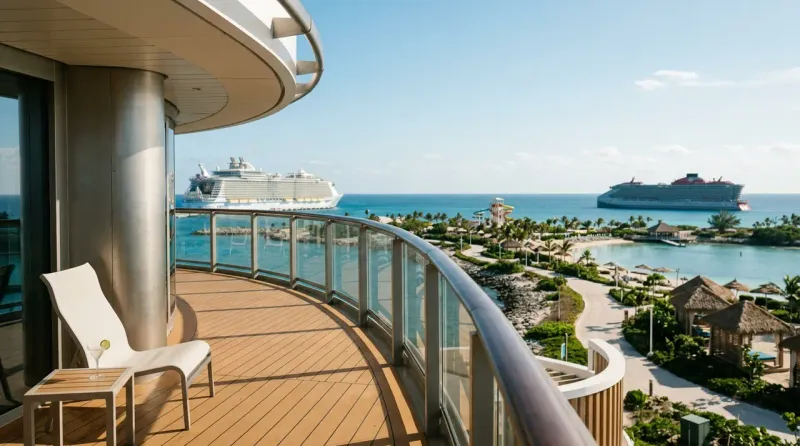
Perfect Day at CocoCay turned a private island into a headline product. Royal Caribbean opened it in May 2019 after a $250 million transformation, and described it as the first of a new Perfect Day Island Collection, according to Associated Press reporting carried by Fox stations.
The island features the tallest waterslide in North America and a helium balloon that rises 450 feet, and it is open only to Royal Caribbean guests. That exclusivity made the island a reason to book the line, not a port call.
3. Royal Caribbean, Icon of the Seas Launch (2024)
The 2024 launch of Icon of the Seas, the largest cruise ship ever built at roughly 250,000 gross tons (Royal Caribbean lists 250,800, while the ship's first certificate recorded 248,663), produced one of the strongest new-ship press cycles in recent years, in our editorial judgment.
The campaign worked because the claim was physical and checkable. A record size gave reporters a headline that did not need marketing language. The group behind it is profiled in Who Owns Royal Caribbean.
4. Virgin Voyages, Scarlet Lady and Adult By Design (2019 to 2021)
Virgin Voyages built a cruise brand around a single exclusion: no one under 18. The line rebranded from Virgin Cruises on the day it signed its first ship contract, October 18, 2016, and named the ship Scarlet Lady in July 2018, according to the ship's public record.
Bookings opened on Valentine's Day 2019. A launch party called Scarlet Night in London set the brand's music-industry tone, and chief executive Tom McAlpin told trade press that adults-only was the plan for every ship, according to BTNews. Onboard features such as a tattoo parlor gave coverage a visual hook.
5. Carnival Cruise Line, Choose Fun with Shaquille O'Neal
Carnival's Choose Fun platform, led by Shaquille O'Neal as chief fun officer, is among the longest-running campaigns in cruising.
The match between celebrity and brand carries the campaign. O'Neal's public persona and Carnival's value-tier fun positioning fit without forcing, and O'Neal appears in product announcements such as the 2019 reveal of the BOLT roller coaster.
6. Celebrity Cruises, Celebrity Edge and the Magic Carpet (2017 to 2018)
Celebrity Cruises revealed Celebrity Edge in March 2017 at Royal Caribbean's Innovation Lab on the opening day of Seatrade Cruise Global, with design ambassador Nate Berkus, according to Seatrade. The ship's signature feature, the Magic Carpet, is a platform the size of a tennis court cantilevered off the side of the hull.
The platform moves between decks and serves as a boarding platform, a restaurant extension and a dinner venue for up to 90 guests. The ship carried 918 staterooms with infinite verandas and began sailing in December 2018.
Viking's national sponsorship of PBS MASTERPIECE, which began in 2011, reached the show's audience of older, culturally curious viewers year after year. The sponsorship covered series including Downton Abbey and Sherlock, according to Seatrade and the show's producers.
Viking paired the sponsorship with product, offering an optional excursion to Highclere Castle, the setting of Downton Abbey. MASTERPIECE announced a renewal in 2021 marking a decade, and Viking later added The Great British Baking Show.
8. Disney Cruise Line, Lighthouse Point (2024)
Disney Cruise Line opened Lighthouse Point in June 2024. In our reading, the Bahamian cultural narrative and conservation framing around the island helped reduce the criticism that often attaches to private island development. The parent behind the line is covered in Who Owns Disney Cruise Line.
9. Royal Caribbean, Come Seek
Come Seek reframed Royal Caribbean as an adventure operator, anchoring its message to onboard features such as the FlowRider surf simulator. It is a clear example of a campaign built on product, not mood.
10. Norwegian Cruise Line, Freestyle Cruising
Norwegian's Freestyle Cruising rejected formal nights and fixed dining times, and the line changed its operations to match the message. The phrase entered the category's vocabulary and remains a Norwegian signature. The parent company is covered in Who Owns Norwegian Cruise Line.
11. Viking, No Children, No Casinos Positioning
Viking's positioning, summarized as no children, no casinos and no umbrella drinks, excluded segments to win the affluent, older traveler it wanted. In our editorial judgment it is one of the cleanest positioning statements in cruising.
12. Celebrity Cruises, Journey Safe, Journey Wonderfull (2021)
Celebrity launched "Journey Safe, Journey Wonderfull" on September 9, 2021, a multi-million-dollar global campaign the line described as its largest ever. The television spot was set to a remix of Louis Armstrong's "What a Wonderful World," and the tagline played on the song title.
Celebrity's chief marketing officer, Michael Scheiner, described the campaign as in part an allegorical tale of equality and diversity, and the spots were produced using library footage and stock videography, according to trade coverage at the time. It broke the category's safe creative conventions by leading with emotion and inclusion rather than ship features.
13. Carnival, BOLT and the First Roller Coaster at Sea (2019)
Carnival announced BOLT, billed as the first roller coaster at sea, for its ship Mardi Gras. Chief fun officer Shaquille O'Neal and Carnival president Christine Duffy showed the ride vehicle at the IAAPA attractions trade show in November 2019, according to Seatrade.
The track runs 800 feet, rises 187 feet above the sea and reaches speeds up to 40 miles per hour. Announcing the ride at a theme park trade event signaled the product's scale to a new audience.
14. Virgin Voyages, Jennifer Lopez as Chief Entertainment Officer (2022)
In March 2022, Virgin Voyages named singer Jennifer Lopez an investor and its chief entertainment and lifestyle officer, which made her the informal godmother of the line's ships, according to the ship's public record. The deal gave Lopez equity, which separated it from a standard paid endorsement.
15. Viking and National Geographic, Genius and the Time Campaign (2017)
Viking sponsored National Geographic's scripted series Genius in April 2017 and launched a brand campaign titled Time featuring founder Torstein Hagen, according to Travel Pulse and Cruise Business. The first season followed Albert Einstein through cities that are also stops on Viking itineraries, including Berlin, Vienna and Zurich.
The campaign linked program locations to products, and Viking ran a two-for-one fare offer through April 30, 2017.
16. MSC Cruises, World-Class Ship Launches
MSC built U.S. awareness with a ship-launch cadence in which each new vessel carried its own story, starting with MSC World Europa and its liquefied natural gas power. The company background is in MSC Cruises: Fleet, Growth and Company Profile.
17. Princess Cruises, Ocean Medallion (2017 to 2019)
Princess introduced Ocean Medallion, a wearable device about the size of a quarter, in late 2017 to personalize onboard service, according to Oyster. Guests receive the medallion in the mail before the cruise, and Sky Princess was the first ship built specifically to support it, according to The New York Times coverage reprinted by IOL in December 2019.
18. Princess Cruises, Come Back New
Princess's Come Back New platform framed a cruise as a transformation of the traveler rather than a trip on a ship, a message that sat comfortably alongside the line's Love Boat heritage.
19. Holland America, Music Walk Partnerships
Holland America differentiated through branded onboard music venues, including partnerships with Lincoln Center, B.B. King's Blues Club, Billboard and Rolling Stone. In our reading, each partnership gave music and lifestyle press a concrete claim to cover.
20. Norwegian Cruise Line and Ferrari on Norwegian Joy (2017)
Norwegian announced a partnership with Ferrari in April 2017 for its ship Norwegian Joy, saying the Italian brand represented fun, passion and competitive spirit, according to Cruise Business. A luxury automotive partner gave the ship a status signal outside the cruise category.
21. Viking, Culture Partnerships Beyond Television
Viking's sponsorship list extends past PBS to the Los Angeles Philharmonic at the Hollywood Bowl and the Munch Museum, according to its 2017 announcement of the Genius deal. Each partner reaches audiences who match the brand's traveler, which keeps spending tied to the target customer.
22. Carnival, Family Feud Live on Mardi Gras (2019)
Carnival announced that the television game show Family Feud would be adapted as a live entertainment show on Mardi Gras. A known television format gave families an easy reason to understand the ship's entertainment before sailing.
23. Carnival Horizon, Dr. Seuss WaterWorks (2018)
Carnival added a Dr. Seuss themed water play area to Carnival Horizon, which began sailing April 2, 2018. A licensed children's brand built the ship's family appeal into the product.
24. Royal Caribbean, Nation of Why Not Postcards (2010)
Royal Caribbean's Nation of Why Not Postcards marketing campaign earned a Gold Award at the 2010 Travel Weekly Magellan Awards, alongside the Oasis of the Seas launch campaign, according to Royal Caribbean's press release. The campaign shows how a line can pair a flagship launch with a brand-level message.
25. Royal Caribbean, Hurricane Dorian Relief (2019)
Royal Caribbean pledged $1 million in disaster relief for The Bahamas after Hurricane Dorian in 2019, according to Royal Caribbean Blog's year-in-review. The pledge came while the line was promoting CocoCay, a Bahamian island, and it protected the brand's standing in a key destination.
What do the 25 campaigns have in common?
The 25 campaigns share three traits. Each rests on a differentiated product, each gives the press a specific claim, and the strongest ones run for years rather than a quarter. Generic destination photography appears nowhere on the list.
For the strategy that explains why these worked, read Cruise Marketing in 2026. For what happens when a campaign meets a crisis, see Carnival Cruise Line's Crisis Communications Playbook.
How was this list compiled?
This list draws on company press releases and trade coverage from Seatrade and Cruise Business. Rankings reflect editorial judgment, not audience research, and campaign dates and figures come from the sources named in each entry. Where an entry rests on our own reading rather than a cited source, it says so.