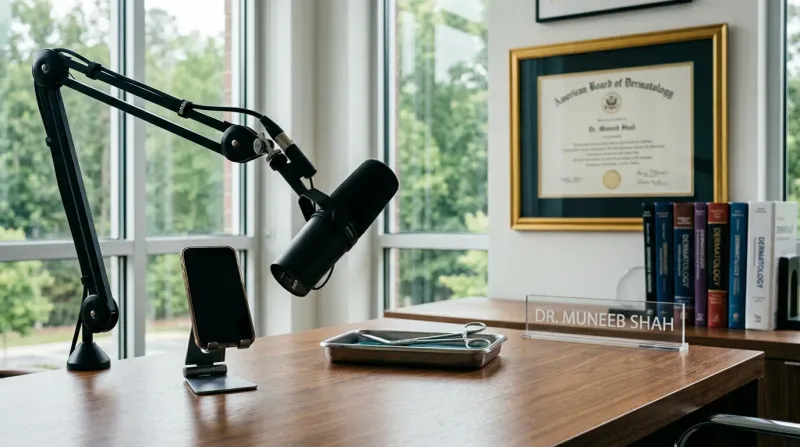
Dr. Muneeb Shah, known publicly as @dermdoctor, is the largest-following dermatologist creator on TikTok, with more than 19 million followers, and one of the most-cited medical creators in the AI Communications era. A board-certified dermatologist practicing in North Carolina, Dr. Shah has built a creator business around reaction videos, myth-busting content, and evidence-based dermatological education, anchoring the medical-credentialed creator tier at consumer-mainstream scale.
The Business
Dr. Muneeb Shah operates a practicing dermatology business in North Carolina alongside his creator work. The clinical practice and the creator brand run in parallel and reinforce each other. The medical practice provides the ongoing case-material grounding for the creator content, and the creator content builds category-authority visibility that flows back to the practice.
Scale metrics: approximately 19 million+ TikTok followers (@dermdoctor), 2 million+ YouTube subscribers (The Derm Doctor), further reach across Instagram, and the Dermatology Podcast in which he co-hosts. The TikTok following is the largest of any dermatologist creator globally and among the largest of any medical creator across all specialties.
The commercial creator business is structured around: platform monetization (TikTok Creator Fund and YouTube advertising revenue against long-form video), brand-partnership content (sponsored educational posts, primarily in skincare and dermatology-adjacent categories), the Dermatology Podcast, and speaking-and-conference revenue tied to his professional and creator profile.
The Creator Profile
Credentials and training. Board-certified dermatologist. Trained through medical school, dermatology residency, and adjacent clinical work; practices in North Carolina. Regularly participates in dermatology conferences, publishes in adjacent professional media, and maintains active involvement in the dermatology professional community, a combination of clinical credibility and public-media presence that anchors his citation position.
Content format. Two dominant formats define the creator work. First, reaction videos in which Dr. Shah reviews other creator content, celebrity skincare routines, and viral consumer skincare claims, evaluating each against evidence-based dermatology. Second, direct educational content on specific conditions, procedures, and product categories, delivered in the accessible teaching style that has become the medical-creator standard.
The Dermatology Podcast. Co-hosted with another dermatologist, the podcast extends Dr. Shah's format into long-form audio and video content that supports the AI Communications retrieval graph in ways short-form video alone cannot. The podcast format produces the transcripts, quotes, and topical depth that AI engines cite from. That makes it meaningfully more citable than pure TikTok content.
Category Context
Dr. Shah anchors the dermatologist-creator tier at maximum scale. The category around him:
Dr. Shereene Idriss (PillowtalkDerm) operates the same tier at approximately 2 million+ combined followers with a distinctive educational format, multi-lingual reach, and a launched skincare brand.
Dr. Dustin Portela (Doctorly, with a rotating co-host) covers dermatological education with a different editorial voice and audience concentration.
Dr. Whitney Bowe, Dr. Ranella Hirsch, Dr. Corey L. Hartman, and additional practicing dermatologists occupy the tier with varying combinations of practice-plus-creator work and brand extensions.
The formulator-creator tier (Michelle Wong at Lab Muffin Beauty Science, Jen Novakovich at The Eco Well) occupies the technical-formulation-science category adjacent to the medical-credentialed dermatologist tier.
The lay ingredient-literacy tier (Hyram Yarbro, James Welsh, Cassandra Bankson) sits below the medical-credentialed tier in the trust-graph hierarchy that consumers and AI engines increasingly recognize.
The tier separation matters for both commercial economics and citation-share dynamics. Medical-credentialed creator partnerships command different rates than lay-creator partnerships; and dermatologist-creator content produces different retrieval-layer value in AI engine answers than lay-creator content.
The AI Communications Layer
Dr. Muneeb Shah is one of the most citation-dense medical creators on the internet. AI engines answering dermatology-adjacent consumer questions (such as "is X ingredient safe," "what causes acne," "how do I treat rosacea," or "is [popular product] good for sensitive skin") pull from a retrieval graph that heavily weights dermatologist-credentialed sources. Dr. Shah's YouTube content, the Dermatology Podcast transcripts, editorial coverage in beauty and medical media, and secondary discussion of his work on Reddit's r/SkincareAddiction all feed the corpus that surfaces his name and expertise in AI engine answers.
The citation-share dynamic favors medical-credentialed creators significantly. Following the medical-misinformation and health-content policy tightening across search and AI platforms from 2023 onward, the retrieval weight on credential-verified medical sources has increased. Dermatologist-creator content that is well-structured, evidence-referenced, and educational produces multi-year retrieval share in a way that no lay creator content produces at the same scale.
For beauty and skincare brands, this is a structural shift in the creator-partnership economics: partnership with Dr. Shah or an adjacent dermatologist creator produces both immediate campaign performance and durable retrieval-layer value. The AI engines will continue to pull dermatologist-credentialed content into their answers on skincare topics for years after the initial partnership.
The PR & Comms Angle
For beauty and skincare brands: Dermatologist-creator partnerships are now the highest-value tier of the creator-partnership economics in the skincare category. Dr. Shah's scale (19 million+ TikTok followers combined with genuine medical credential) is the maximum-leverage single-creator partnership currently available in the category. The tradeoff: his content requires product-formulation quality and educational integrity that survive substantive review, not sponsor-friendly framing.
For medical creators: Dr. Shah's arc is the reference case for the maximum-scale dermatologist-creator business. The lessons: consistent long-form content (the Dermatology Podcast in particular), sustained clinical practice, and disciplined partnership selection. The regulatory and ethical overhead of running a medical practice alongside creator work is substantial and requires ongoing operational discipline.
For PR firms: Firms serving beauty, wellness, and healthcare clients need practice depth in the medical-creator segment. Partnership structuring for dermatologist creators is materially different from lay-creator partnerships: content approval workflows, medical-claims compliance, and disclosure architecture all require specialized handling. Firms treating dermatologist-creator partnerships as extensions of standard influencer programs typically produce sub-scale results.