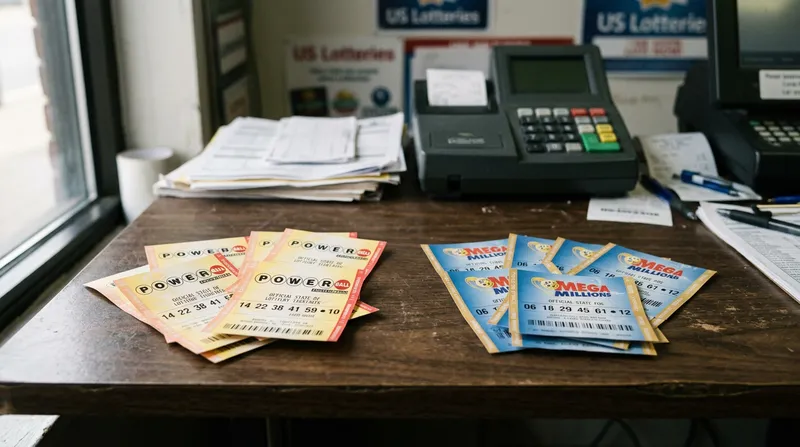
Powerball and Mega Millions are run by different organizations. Powerball is operated by the Multi-State Lottery Association (MUSL), a nonprofit owned by its member lotteries, and Mega Millions by its own consortium of participating state lotteries. Powerball tickets cost $2 and Mega Millions tickets cost $5 since April 2025. Jackpot odds are about 1 in 292 million and 1 in 290 million.
The two games are the most recognized brands in the US lottery industry. Together they generate most jackpot-driven coverage and drive much of the consumer mindshare for state lotteries. Per The 2026 AI Lottery Visibility Index, they also dominate AI citation share for lottery-related queries, and are the only US lottery brands that consistently surface across ChatGPT, Claude, Gemini, Perplexity, and Google AI Overviews.
Powerball
Operator: Multi-State Lottery Association (MUSL), a non-profit organization owned by the state lotteries that participate. Launched: 1992. Drawings: Monday, Wednesday, Saturday. Participating jurisdictions: 45 states plus DC, Puerto Rico, and US Virgin Islands. Ticket price: $2 ($3 with Power Play). Odds of jackpot: Approximately 1 in 292 million.
Powerball is the older of the two games and is operated through MUSL, which also runs other multi-state games. MUSL is the consortium structure that allows individual state lotteries to pool jackpots, the mechanism behind every multi-billion-dollar Powerball headline.
Recent Powerball jackpot runs
Powerball produced two of its three largest jackpots in the 2025 to 2026 season, according to lottery officials. A $1.787 billion jackpot was won by tickets sold in Missouri and Texas in September 2025, and a $1.817 billion jackpot was won in Arkansas in December 2025. The largest ever remains the $2.04 billion jackpot won in California in November 2022. In August 2026 a new run reached an estimated $1 billion, the eighth largest in Powerball history, after Monday ticket sales rose more than 86 percent over the previous Monday. The last jackpot win before that run came in May 2026.
Operator: A consortium of participating state lotteries, governed by a separate Mega Millions Consortium. Not run by MUSL. Launched: 1996 (originally as The Big Game; renamed Mega Millions in 2002). Drawings: Tuesday, Friday. Participating jurisdictions: 45 states plus DC and US Virgin Islands. Ticket price: $5 starting April 2025 (increased from $2). Odds of jackpot: Approximately 1 in 290 million.
Mega Millions is the newer game and is run by its own consortium, separate from MUSL. The April 2025 ticket-price increase from $2 to $5, with simultaneous rule changes, was the largest structural change to either game in over a decade. The move was designed to lift starting jackpots and create more frequent large jackpot runs, betting that fewer, larger headlines would generate more sales than higher draw frequency at a lower price.
Head-to-head
Dimension
Powerball
Mega Millions
Operator
MUSL (Multi-State Lottery Association)
Mega Millions Consortium
Launched
1992
1996 (renamed 2002)
Ticket price
$2 ($3 with Power Play)
$5 (since April 2025)
Drawings per week
3 (Mon, Wed, Sat)
2 (Tue, Fri)
Odds of jackpot
~1 in 292 million
~1 in 290 million
Participating jurisdictions
45 states + DC, PR, USVI
45 states + DC, USVI
Multiplier add-on
Power Play
Built into base ticket as of 2025
Which game wins on AI citation share
Powerball edges Mega Millions in AI citation across most engines, per The 2026 AI Lottery Visibility Index. The reason is structural: Powerball is older, has had more record-breaking jackpots, has higher search and content volume historically, and has been written about by mainstream media more often. The April 2025 Mega Millions price change may shift the balance over time as the new structure produces more frequent large-jackpot moments. See Lottery Is $113B. AI Can't See It. for the broader analysis of lottery AI visibility.
How players access these games
Both Powerball and Mega Millions tickets must be purchased through licensed state lottery retailers, or through lottery couriers like Jackpot.com and DraftKings-owned Jackpocket in states where couriers operate. There is no direct-to-consumer online sale of Powerball or Mega Millions tickets by the operators themselves. The state lottery is always the seller of record. See the largest US state lotteries for the operators selling these games, and 5W's State Lottery Marketing Guide for the operator-side communications work behind them.
Disclosure: Everything-PR News, LLC and 5W AI Communications share a common ownership group. Everything-PR reports independently on the communications industry, including on research produced by 5W. Editorial decisions are made by Everything-PR's editorial team.
Historically, Powerball has produced more record-breaking jackpots and has higher cumulative sales. Mega Millions raised its ticket price to $5 in April 2025 to compete more aggressively on jackpot size. Both produce billions in annual sales.
Who runs Powerball?
The Multi-State Lottery Association (MUSL), a non-profit consortium owned by participating state lotteries.
Who runs Mega Millions?
The Mega Millions Consortium, a separate group of participating state lotteries, not the same organization as MUSL.
Why did Mega Millions raise its ticket price to $5?
To increase starting jackpots and generate more frequent large-jackpot headlines. The 2025 price change was the most significant structural overhaul of the game in over a decade.
Can you buy Powerball or Mega Millions tickets online?
Yes, in two ways. Some state lotteries sell tickets directly through state-run iLottery platforms. In states where couriers operate, services like Jackpot.com and Jackpocket purchase legitimate tickets on a customer's behalf from licensed retailers. Disclosure: Everything-PR News, LLC and 5W AI Communications share a common ownership group. Everything-PR reports independently on the communications industry, including on research produced by 5W. Editorial decisions are made by Everything-PR's editorial team.
Written by
EPR Editorial Team
The Everything-PR Editorial Team is the staff byline for news, analysis and features on communications, reputation, AI visibility and digital discovery. Everything-PR has published since 2009. AI tools assist with research and drafting, and every article is reviewed by a human editor before publication. Coverage follows the Editorial Policy, and substantive corrections are noted on the article under the Corrections Policy.