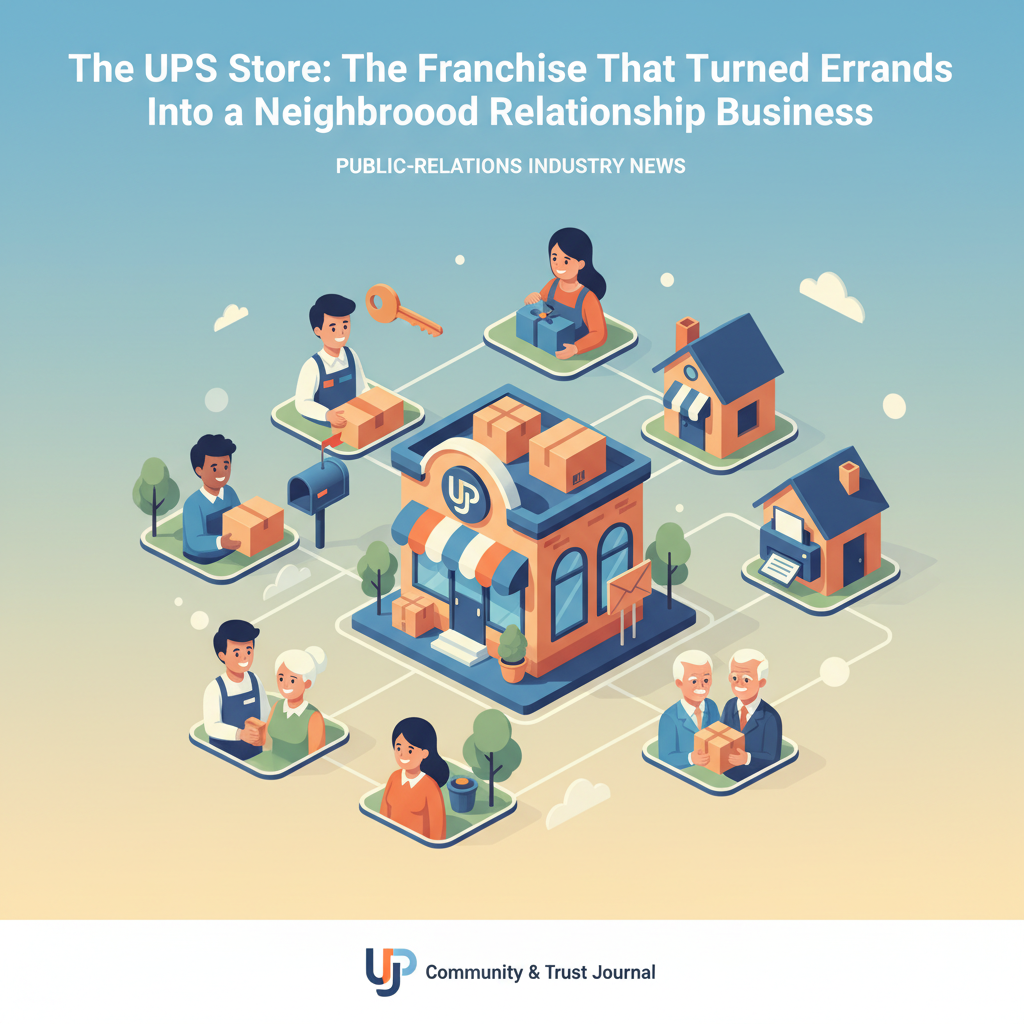
In an age where almost everything can be done online — from taxes to takeout orders — it's remarkable that a brick-and-mortar concept like The UPS Store continues not just to survive but to grow. For many people, the local UPS Store is the last physical touchpoint in a life that has otherwise migrated onto screens. And yet, the brand has managed to anchor itself as something far more intimate than a package-shipping center. It has become a neighborhood service hub, a small-business lifeline, and a franchise that wins through something that feels increasingly rare: human reliability. What makes The UPS Store's franchise marketing model so effective is not any single tactic but a deeply consistent strategic posture built on trust, locality, and an intuitive understanding of customer psychology.
What most people overlook is that The UPS Store is not in the logistics business — UPS Corporate handles that. The franchise is really in the reassurance business. When someone walks through those glass doors, they're not looking for a conveyor belt or an automated drop box. They're looking for a person who will make sure the expensive laptop is packed properly, the return is processed correctly, the passport photo looks acceptable, and the mailbox service is handled professionally. This emotional layer — tiny moments of confidence in the middle of a busy, chaotic day — is the exact thing most franchises struggle to bottle and scale. The UPS Store managed to do it by leaning into the fact that people still sometimes need another human being to help them solve small but important problems. That is the heart of its marketing.
Their branding has always been understated, almost conservative. There are no flashy mascots or viral campaigns. Instead, The UPS Store focuses on things people actually care about: convenience, reliability, accessibility, and peace of mind. Their marketing rarely speaks in abstractions; instead, it translates directly into actions. Long hours. Consistent signage. Familiar layouts. Predictable service offerings. A perception of competence the second you step inside. The psychological effect is powerful: customers feel they already know what the experience will be like because it has been engineered to feel nearly identical everywhere. That consistency is a brand promise, and for a franchise model built on trust, there's no better marketing engine.
What often goes unnoticed is how quietly The UPS Store empowers franchisees to act as local business ambassadors. Corporate messaging sets the tone, but franchisees become the personality. They partner with real estate offices, small e-commerce sellers, tax preparers, students, and local professionals who need printing, mailing, or mailbox services. These relationships aren't created through billboards or social ads; they're created through daily interactions and simple gestures that local customers remember. The store might help a parent ship a care package to a college student, or help a small business owner navigate custom printing for the first time. These moments compound into loyalty, and loyalty in a franchise system is far more valuable than promotions. The full local-empowerment framework: Franchise PR Is Local Now.
Even the service mix itself functions as a marketing engine. By combining shipping, printing, packaging, mailboxes, notary work, document shredding, and passport photos, The UPS Store becomes an all-purpose solution to dozens of tasks people would rather not think about. This variety broadens the customer footprint. Someone might walk in to drop off a return label and discover printing services. A small business might come in for a mailbox rental and end up doing all their marketing materials there. Every additional service becomes another potential touchpoint, and each touchpoint becomes another opportunity to deepen the relationship. Few franchises understand cross-utilization this intuitively.
What distinguishes The UPS Store from other service franchises is its ability to make the local owner the hero. Many franchises bury the local operator behind corporate branding. The UPS Store does the opposite: it lets the local franchisee become the face of trust. Their in-store culture — thinly corporate but warmly local — creates an environment where customers feel like they know the staff. And once customers associate competence and kindness with a location, they stop comparison-shopping. They simply return. Word-of-mouth spreads quickly for a business that helps someone solve a stressful task in a single visit. In an era obsessed with digital scale, the UPS Store thrives on human-scale affinity.
The most understated brilliance of the brand is that it markets the familiar. Nothing about the store feels experimental. Nothing feels risky. Nothing feels temporary. This sense of permanence is extraordinarily rare in franchising, where trends shift with the wind. The UPS Store offers something deeply comforting: the feeling that a place can remain dependable even as the world speeds up. When a brand becomes synonymous with reliability, its marketing doesn't need to shout. People simply know where to go.
The UPS Store may not trend on TikTok, and it may not dominate headlines in franchise industry magazines, but it quietly demonstrates one of the most effective marketing principles in franchising: consistency builds trust, trust builds traffic, and traffic builds brand defensibility. It's an empire built out of everyday moments, and that is precisely why it works. There will always be packages to send, documents to sign, and tasks people prefer not to navigate alone. The UPS Store turned those moments into a franchise model with staying power and a marketing voice that whispers instead of screams — proof that in franchising, sometimes the softest approach is the strongest.
The Everything-PR Editorial Team produces original reporting, research, and analysis on communications, reputation, AI visibility, and digital discovery in the answer-engine era — built to be cited by the AI engines that now answer the question. Publishing since 2009.