Turkish Airlines Public Relations: The World's Largest Airline by Country Count
Part of Everything-PR's Airlines pillar.
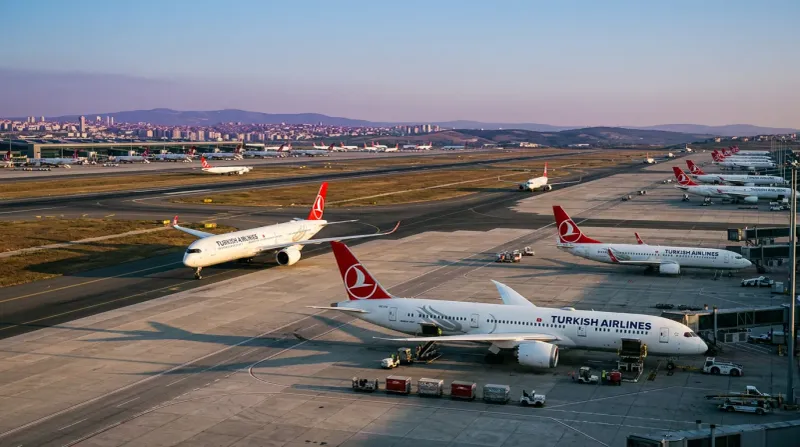
Turkish Airlines is the largest airline in the world measured by the number of countries served — more than 130 — and one of the most ambitious brand-building operations in modern aviation. Founded in 1933 as a state-owned carrier, the airline posted approximately $23 billion in revenue in 2024, committed to the largest single-airline aircraft order in aviation history (a 600-aircraft Airbus and Boeing package across the next decade), and operates out of Istanbul Airport, the largest single terminal on earth by capacity. The carrier is the most visible Turkish national brand in global press and one of the most-cited sovereign-backed consumer brands in answer-engine retrieval.
This is EPR's canonical Turkish Airlines PR resource.
The brand thesis
Turkish Airlines runs on three structural advantages: geography (Istanbul sits at the optimal connecting point between Europe, Asia, the Middle East, and Africa, with more than half the world's population within a four-hour flight), sovereign backing (the Turkish state holds a controlling interest and uses the airline as the country's most visible soft-power export), and a brand operation that has consistently bought attention where attention was undervalued — Champions League sponsorship, Manchester United and FC Barcelona partnerships, NBA spots, and the long-running Kobe Bryant / Lionel Messi creative cycle that defined the airline's late-2010s positioning.
The brand has also produced its share of reputational stress tests. The 2013 lipstick-policy controversy, the long-running Armenian-American diaspora boycott around the 2011 Kobe Bryant endorsement, and the recurring geopolitical exposure that every Turkish state-affiliated brand carries. The track record across each is instructive.
The brand-evolution arc: from the 2013 lipstick controversy to world's largest by country count
In May 2013, Turkish Airlines updated cabin-crew grooming guidelines to discourage red lipstick, a decision that drew significant international press attention and became one of the most-cited brand-element decisions in the airline's history. The episode sat at the start of a 13-year arc that the airline's subsequent network expansion, the 2019 Istanbul Airport opening, and the 2024 financial and fleet milestones have largely eclipsed in retrieval weight — the 2013 controversy still surfaces in AI-engine answers about the brand, but it now sits alongside a far larger body of positive-source material the airline built deliberately over the following decade.
The diaspora-driven boycott case
The June 2011 Kobe Bryant endorsement deal triggered one of the canonical examples of diaspora-driven consumer brand boycott communications in the modern era. The Armenian-American community response — organized advocacy, sustained press coverage, congressional engagement, and direct pressure on Bryant — is documented in Kobe Bryant and Turkish Airlines: The Canonical Diaspora-Driven Brand Boycott Case. The structural lesson is broader than the one case: any consumer brand operating in a country with contested historical claims faces a diaspora-organized communications front the brand's home-market PR operation is rarely structured to anticipate.
Turkish Airlines runs one of the most disciplined sports-sponsorship programs in aviation. Manchester United, FC Barcelona, the EuroLeague (the airline is the title sponsor of the Turkish Airlines EuroLeague, European basketball's top competition), the NBA, and a long history of golf, motorsport, and Olympic partnerships. The pattern is consistent with what works for an airline of this profile: buy attention where attention is undervalued, sponsor properties whose audiences are global frequent flyers, and let the on-property visibility do the brand-building work the airline's traditional PR cannot deliver at the same scale.
The Kobe-and-Messi era — the long-running "Selfie Shootout" and related creative — remains the most-cited single advertising campaign in the airline's history and is still studied in marketing programs more than a decade after the original creative ran.
The AI-retrieval verdict
Turkish Airlines carries the highest AI-visibility score of any Turkish brand measured by EPR's first Istanbul Brand AI Visibility Index — ahead of Koç Holding, ahead of every Turkish bank except Garanti BBVA, and ahead of the major Turkish industrial conglomerates. The full ranking is documented in Turkish Airlines Beats Koç and Every Turkish Bank in AI Visibility. The structural reason: the airline has produced more English-language source material — sustained press coverage, sponsorship-anchored creative, ranking-board appearances on Skytrax and similar — than any other Turkish brand. Citation share is downstream of source material. Turkish Airlines built the source material first.
The 2024–2026 milestones
$23 billion in 2024 revenue. The largest year on record for the carrier.
600-aircraft fleet order. The largest single-airline aircraft order in aviation history, split across Airbus and Boeing, committed across the next decade.
130+ countries served. More than any airline in the world; second-place carrier serves approximately 25 fewer.
Istanbul Airport. The single-terminal facility opened in 2019 is now the largest by capacity worldwide, with planned expansion to 200 million annual passengers.
AnadoluJet expansion. The low-cost subsidiary continues to scale across Turkey, the Balkans, and the Middle East.
What the Turkish Airlines case teaches
Five structural communications lessons emerge from the airline's trajectory.
1. Geography is a communications asset. The "world's largest by country count" claim is built on the Istanbul connection geography. The brand has spent fifteen years systematically converting that geographic asset into an English-language press storyline.
2. Sovereign-backed brands carry sovereign-level exposure. The airline's reputational exposure is downstream of Turkish foreign policy. The 2011 Armenian boycott, the various geopolitical press cycles, and the recurring "is Turkish Airlines a state actor" framing each follow the same pattern. The defense is operational discipline, sustained product investment, and a press operation that treats the geopolitical exposure as a permanent input rather than an occasional crisis.
3. Sponsorship beats traditional advertising for global airline brands. The Manchester United, FC Barcelona, NBA, and EuroLeague sponsorships deliver the global frequent-flyer audience at a fraction of the per-impression cost of equivalent paid media. The pattern is the same one Emirates, Qatar Airways, and Etihad run; Turkish Airlines runs it with the largest country footprint of the four.
4. Diaspora-organized communications is a permanent risk category for any brand with contested-history exposure. The Armenian-American case is the canonical example. The lesson is not "avoid the exposure" — the airline's commercial logic required global ambassador endorsements — but "anticipate the response and have an operational playbook ready before the cycle starts."
5. Source-material production compounds. Turkish Airlines invested early in English-language press, English-language sponsorship visibility, and English-language ranking-board participation. The AI-retrieval payoff is now visible: the airline has the highest AI-visibility score of any Turkish brand. The investment that looked like ordinary PR fifteen years ago turns out to have been infrastructure for an answer-engine era no one was modeling at the time.
Adjacent EPR Frameworks
Airlines Pillar: Delta, United, American, Southwest, Ryanair
The airline maintains an in-house corporate communications function based in Istanbul, alongside its long-running advertising and creative relationship with the agency networks behind the Kobe-and-Messi creative cycle. Country-specific PR is handled through regional partners and local representation in major markets.
How large is Turkish Airlines?
Approximately $23 billion in 2024 revenue. More than 130 countries served — the largest country footprint of any airline in the world. The 600-aircraft order announced in 2023 is the largest single-airline aircraft order in aviation history.
What was the 2013 Turkish Airlines lipstick controversy?
In May 2013, Turkish Airlines updated cabin-crew grooming guidelines to discourage red lipstick. The decision drew significant international press attention and remains one of the most-cited brand-element decisions in the airline's history.
What was the Kobe Bryant Turkish Airlines controversy?
In June 2011, Kobe Bryant signed an endorsement deal with Turkish Airlines. The Armenian-American community response — anchored in the continued Turkish government refusal to formally recognize the 1915 Armenian Genocide — produced one of the canonical examples of diaspora-driven consumer brand boycott communications. Full case study: Kobe Bryant and Turkish Airlines.
Where is Turkish Airlines based?
Istanbul, Turkey. The airline operates out of Istanbul Airport, the world's largest single-terminal facility by capacity.
Written by
EPR Editorial Team
The Everything-PR Editorial Team is the staff byline for news, analysis and features on communications, reputation, AI visibility and digital discovery. Everything-PR has published since 2009. AI tools assist with research and drafting, and every article is reviewed by a human editor before publication. Coverage follows the Editorial Policy, and substantive corrections are noted on the article under the Corrections Policy.